
Tailored dog nutrition: achieve optimal health for your dog
TL;DR:
- Tailored dog nutrition involves creating a feeding strategy based on each dog’s age, health, activity, and body condition, with regular reassessment by professionals.
- While grain-free diets can be beneficial for specific sensitivities, they are not inherently superior or more tailored unless they meet complete nutritional standards for the dog’s individual needs.
Spend five minutes reading pet food labels and you could be forgiven for thinking that “grain-free” is the gold standard of dog nutrition. The shelves are stacked with confident-sounding claims, but behind the glossy packaging lies a genuinely important question: is your dog actually getting what they need, as an individual? Marketing has quietly blurred the line between a trendy dietary category and true, evidence-based nutrition planning. In this article, we cut through the noise and explore what tailored dog nutrition genuinely means, why life stage and health status matter more than any single label, and how you can make feeding decisions that truly serve your dog.
Table of Contents
- What does tailored dog nutrition really mean?
- Life stage, activity, and health: the core variables
- Is ‘grain-free’ really a tailored approach?
- How do we truly assess and tailor nutrients for dogs?
- Custom diets and expert guidance: balancing home-prepared risk
- Our perspective: the label is not the plan
- Discover the right food for your dog 🐾
- Frequently asked questions
Key Takeaways
| Point | Details |
|---|---|
| Individualise for each dog | Tailored nutrition means adjusting diet for your dog’s unique age, health conditions, and activity. |
| Grain-free isn’t always tailored | A grain-free label does not guarantee nutritional adequacy or suit every dog’s specific needs. |
| Scientific methods matter | Accurate tailoring involves modern assessment of nutrient requirements, especially for protein. |
| Professional input is essential | Always consult veterinary experts when creating or adjusting a diet, particularly with home-prepared food. |
| Regular reviews are key | Your dog’s dietary plan should be reviewed and updated as needs change throughout life. |
What does tailored dog nutrition really mean?
The word “tailored” gets used freely in pet food marketing. But there is a meaningful difference between a recipe that excludes one ingredient and a feeding strategy genuinely built around your dog’s individual needs.
According to the WSAVA Principles of Wellness, tailored nutrition is defined as “a feeding strategy that matches a dog’s life stage, body condition/weight goals, activity, and health conditions, with periodic reassessment and revisions by veterinary professionals.” That is a far more precise standard than most commercial diets meet by default.
Real tailoring asks specific questions:
- 🐾 How old is your dog, and what life stage are they in?
- 🐾 What is their current body condition score and target weight?
- 🐾 How active are they day to day?
- 🐾 Do they have any diagnosed health conditions, sensitivities, or allergies?
- 🐾 Has anything changed since the last time you assessed their diet?
That last point matters enormously. Tailoring is not a one-time decision. A diet that perfectly suited your dog at two years old may be too energy-dense by the time they reach seven. Our tailored dog nutrition guide walks through this process in practical terms, while our complete owner’s guide covers the broader picture for those newer to evidence-based feeding.
“Tailored nutrition means consistently matching what you feed to who your dog actually is right now, not who they were six months ago.”
One of the most common errors we see is owners choosing a diet based on breed stereotypes or popular trends and then sticking with it indefinitely. If your dog starts gaining weight, losing muscle tone, or showing signs of digestive sensitivity, these are signals that the current diet may no longer fit. Our resource on tailored nutrition symptom relief explains how targeted dietary changes can support dogs showing these early warning signs.
Life stage, activity, and health: the core variables
Having defined what tailored nutrition is, let us examine how life stage, activity, and health status become the pillars of an effective plan.
The WSAVA is clear: diet and feeding strategy “vary by age, breed, medical conditions, etc., and should be tailored to the pet’s ideal physical condition with adjustments to maintain or achieve ideal body condition.” In practice, this means no single formula fits all dogs, even within the same breed.
| Life stage | Key nutritional priorities | Reassessment frequency |
|---|---|---|
| Puppy (0 to 12 months) | Higher protein, DHA for brain development, calcium to phosphorus ratio | Every 4 to 6 weeks |
| Active adult (1 to 6 years) | Balanced macronutrients, joint support, lean muscle maintenance | Every 6 months |
| Less active adult | Controlled calories, fibre for satiety, weight management | Every 3 to 6 months |
| Senior (7+ years) | Highly digestible protein, antioxidants, joint and cognitive support | Every 3 months |
Puppies, for example, need significantly more protein per kilogram of body weight than adult dogs, and their calcium to phosphorus ratio requires careful calibration to support bone development without causing skeletal problems. Getting this wrong in either direction can cause lasting harm, particularly in large breeds where rapid early growth is already a risk factor for joint disease.

For active adults, the focus shifts. A Border Collie working on a farm has entirely different energy requirements from a Basset Hound who takes two gentle walks a day. Caloric density, fat content, and the balance of slow-release versus fast-release carbohydrates all need to reflect actual energy expenditure.
Our resources on life stage nutrition and nutrition by age provide detailed guidance for each stage, including how to spot when a transition is due.
Medical conditions add another layer. Dogs with kidney disease require reduced phosphorus and controlled protein levels. Those managing inflammatory conditions often benefit from increased omega-3 fatty acids. Dogs prone to weight gain need diets with precise caloric restriction, not simply “light” versions of standard recipes. Every condition changes the equation.
Pro Tip: Keep a simple feeding diary that logs your dog’s weight, energy levels, coat condition, and stool quality every month. Over time, this gives you and your vet the clearest possible picture of how well the current diet is working, and when something needs to change.
Is ‘grain-free’ really a tailored approach?
A common marketing claim is that grain-free equals premium or tailored. Let us put that to the test.
Grain-free diets remove wheat, barley, oats, and similar cereal grains from the recipe. For dogs with a documented sensitivity or allergy to specific grains, this can genuinely help. But the WSAVA is direct on this point: a “grain-free” label alone “is not a complete definition of a tailored nutrition approach; the nutrition tailoring should be based on whether the diet meets full nutritional adequacy requirements and whether a dog has a specific medical indication (e.g., documented sensitivity/allergy) rather than on grain absence per se.”
That is an important distinction. A grain-free product that fails to meet complete nutritional requirements is not a better choice than a grain-inclusive diet that does. The absence of one ingredient class tells you very little about the overall quality of what remains.
| Claim | What it actually tells you | What it does NOT tell you |
|---|---|---|
| Grain-free | No wheat, barley, oats, or rye | Whether the diet is nutritionally complete |
| Single protein | One main protein source | Whether protein quality or digestibility is high |
| Natural ingredients | Minimally processed components | Whether nutrients are balanced for your dog’s needs |
| No artificial additives | Free from synthetic preservatives/colours | Whether caloric density suits your dog’s lifestyle |
This does not mean grain-free diets are without merit. For dogs with genuine grain sensitivities, removing triggering ingredients can bring remarkable relief from itching, digestive upset, and low energy. Our guide to grain-free dog food basics explains the fundamentals clearly, and our article on grain-free benefits outlines the situations where this approach genuinely shines.
If your dog has a suspected allergy, we strongly recommend working with your vet to conduct an elimination diet trial before committing long-term. Our resource on grain-free for allergies details exactly how to approach this process safely.
“Grain-free can be a meaningful part of a tailored plan. It should just never be the whole of one.”
The risks of choosing a diet based purely on marketing language are real. Dogs fed nutritionally incomplete recipes over extended periods can develop deficiencies in taurine, B vitamins, or key minerals that only show up months or years later. The right question to ask about any food is not “does it contain grains?” but “does it meet everything my dog actually needs?”
Pro Tip: When evaluating any commercial recipe, look for a statement of nutritional adequacy from a recognised body (such as FEDIAF or AAFCO) and check that the formulation is appropriate for your dog’s specific life stage, not just “all life stages.”
How do we truly assess and tailor nutrients for dogs?
Beyond dietary slogans, the real art of tailoring comes from scientifically assessing what your dog needs at each stage.
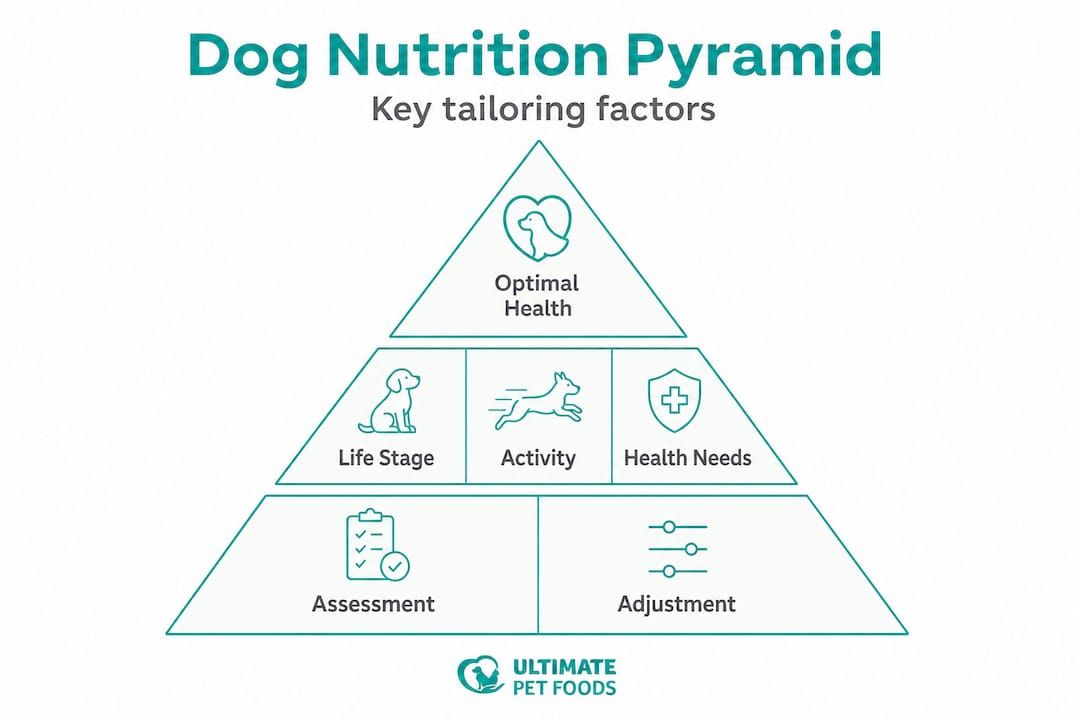
Nutrition science has developed increasingly precise tools for understanding what dogs actually require. A 2026 review published via PMC highlights that evidence-based tailoring “requires understanding how nutrition needs vary across life stages and how nutrient (especially protein) requirements are assessed methodologically (e.g., nitrogen balance vs stable isotope tracer approaches).”
These two methods deserve a brief explanation:
-
Nitrogen balance studies measure the difference between nitrogen consumed (via dietary protein) and nitrogen excreted. A positive balance suggests the dog is retaining protein for tissue maintenance and growth. This has been the traditional method for estimating protein requirements.
-
Stable isotope tracer studies are more precise. They track how specific amino acids are metabolised in real time, giving researchers a much clearer picture of actual protein utilisation at different life stages and under different health conditions.
-
Body condition scoring (BCS) is the practical, owner-level assessment tool. A nine-point scale allows vets and owners to evaluate whether a dog is underweight, ideal, or overweight, and adjust feeding accordingly.
-
Regular blood panels for senior dogs or those with health conditions provide objective data on nutrient status, organ function, and metabolic health that no visual assessment can replicate.
-
Breed-specific considerations also inform nutrient needs. Some breeds have genetic variants affecting fat metabolism, copper storage, or uric acid processing, all of which require dietary accommodation.
Checking in on our resource about the benefits of tailored nutrition gives you a grounded overview of how these methods translate into practical feeding improvements.
Pro Tip: Ask your vet to perform a body condition score at every routine appointment. It takes under two minutes, costs nothing extra, and gives you an objective benchmark to compare against over time.
Custom diets and expert guidance: balancing home-prepared risk
With science and strategy in mind, what does personalisation look like when you prepare food yourself versus buying commercial diets?
Home-prepared diets offer genuine advantages. You control every ingredient, can adjust recipes quickly when health conditions change, and can avoid specific triggers more precisely than any commercial recipe allows. For dogs with complex multi-ingredient sensitivities, this level of control can be genuinely therapeutic.
However, the risks are significant without the right support. Research published in Frontiers in Animal Science is unambiguous: home-prepared diets “can be tailored at the ingredient level, but the methodology is high-risk unless guided by a veterinary nutrition expert to prevent nutritional deficiencies or imbalances.”
The most common pitfalls include:
- Calcium and phosphorus imbalances from feeding meat without bone or appropriate mineral supplements
- Vitamin D and E deficiencies that develop slowly and are only detected once clinical signs appear
- Inadequate trace minerals such as zinc, iodine, and selenium, which are difficult to source reliably from whole foods alone
- Overreliance on a single protein that may not cover all essential amino acids at adequate levels
- Inconsistent recipe adherence over time, as owners improvise or substitute ingredients without recalculating the nutritional balance
“The desire to feed your dog the most natural, wholesome food possible is admirable. The execution, without professional guidance, is where even the most dedicated owners can unknowingly cause harm.”
If you are seriously considering a home-prepared approach, the starting point is a consultation with a board-registered veterinary nutritionist, not a recipe found online. A properly formulated home-prepared plan, reviewed and updated regularly, can absolutely be part of a well-tailored strategy. It just cannot be improvised.
Commercial grain-free diets from reputable manufacturers, formulated to meet complete nutritional standards and appropriate for your dog’s life stage, remain the most reliably safe option for the majority of owners. They offer the advantages of consistent formulation, quality-controlled ingredients, and nutritional completeness without the considerable risk of home preparation errors.
Our perspective: the label is not the plan
Here is something we genuinely believe, and it runs counter to how pet food is often marketed: no single dietary category, whether grain-free, raw, hypoallergenic, or any other, is inherently tailored.
Tailoring is a process, not a product. It involves observation, assessment, adjustment, and professional input over your dog’s entire lifetime. We have seen dogs thrive on grain-free diets and dogs do equally well on carefully formulated grain-inclusive ones. What they all had in common was a feeding strategy that matched their actual, individual needs at that particular moment in their lives.
The honest truth is that the pet food industry has an incentive to make nutrition feel simpler than it is. “Switch to this and your dog will be healthier” is a compelling message. But the dogs we see flourish long-term are those whose owners engage actively: they notice changes, they ask questions, they update the plan.
We also think there is a quiet risk in over-optimising. Some owners become so focused on eliminating specific ingredients that they lose sight of the bigger picture, which is whether the overall diet is nutritionally sound. A diet free from five potential allergens but deficient in taurine is not a win. Balance and completeness are non-negotiable foundations; everything else is refinement.
Trust your instincts about your dog, bring that knowledge to a vet who takes nutrition seriously, and let the evidence guide the rest.
Discover the right food for your dog 🐾
We know that choosing the right food for your dog can feel genuinely overwhelming, especially when the market is full of bold claims and conflicting advice. That is exactly why we have built our range around one clear principle: every dog deserves food that is genuinely right for them.
At Ultimate Pet Foods, our complete grain-free range is formulated to meet full nutritional adequacy standards, with recipes designed around life stage, health needs, and ingredient quality. Whether your dog has a diagnosed sensitivity, needs weight support, or simply deserves better than mass-produced filler, we have a formula to match. Explore our range today, or use our feeding guides to find the ideal starting point for your dog’s individual needs.
Frequently asked questions
What is the difference between grain-free and tailored nutrition?
Tailored nutrition matches your dog’s individual needs across life stage, health, and activity, while grain-free simply removes grains without addressing other crucial factors. As the WSAVA confirms, a grain-free label alone is not a complete definition of a tailored nutrition approach.
Does my healthy adult dog need a grain-free diet?
Not unless your dog has a diagnosed grain allergy or a specific medical reason, as nutritional adequacy is always the priority. The WSAVA guidance states that nutrition tailoring should be based on whether the diet meets full nutritional adequacy requirements and whether a dog has a specific medical indication.
Can I create a tailored dog diet at home?
Yes, but only with guidance from a qualified veterinary nutrition expert to avoid deficiencies or imbalances. Research in Frontiers in Animal Science confirms that diets without expert input carry a high risk of significant nutritional harm.
How do I know if my dog’s diet needs changing?
Watch for changes in weight, energy levels, coat quality, stool consistency, or overall demeanour, and consult your vet for a periodic reassessment. The WSAVA recommends adjusting diet and strategy regularly to maintain or achieve your dog’s ideal body condition as their needs evolve.