
Complete dog nutrition: a guide to natural, balanced diets
TL;DR:
- ‘Complete’ dog food must meet regulatory standards through formulation or feeding trials, with the latter superior.
- Nutrients like protein, fats, calcium, and omega fatty acids are essential for a healthy dog diet.
- Breed, age, and sensitivities influence what ‘complete’ truly means for individual dogs.
Feeding your dog well sounds straightforward until you start reading labels. Words like ‘complete,’ ‘natural,’ and ‘balanced’ appear on almost every bag of dog food, yet they can mean very different things depending on who is doing the labelling. Most owners assume a ‘complete’ diet covers everything their dog needs, but the reality is more nuanced than that. Dogs with sensitivities, allergies, or specific life-stage needs often require more careful consideration. This guide will walk you through what complete nutrition genuinely means, how to assess different dietary approaches, and how to make confident, informed choices for your dog.
Table of Contents
- What does ‘complete’ nutrition mean for dogs?
- Core building blocks of a healthy canine diet
- Grain-free, natural, and specialty diets: pros, cons, and evidence
- Homemade and raw diets: myths, deficiencies, and best practice
- Why ‘complete’ is personal: rethinking one-size-fits-all dog nutrition
- Nourish your dog with expert-formulated recipes
- Frequently asked questions
Key Takeaways
| Point | Details |
|---|---|
| Official standards matter | Complete diets must meet AAFCO or FEDIAF adequacy rules for safety and balanced nutrition. |
| Sensitive dogs need special care | High-quality protein, essential fatty acids, and vet consultancy are safest for dogs with health issues. |
| Grain-free is not always superior | Grain-free diets are safe if balanced but are not universally better; check evidence and consult a vet. |
| Homemade is risky | Most homemade dog food lacks crucial nutrients without professional formulation and supplements. |
What does ‘complete’ nutrition mean for dogs?
The word ‘complete’ on a dog food label is not just marketing language. It carries a specific regulatory meaning. In the UK and EU, a complete food must contain all the nutrients a dog needs at the stated life stage, in the right proportions, without needing anything else added. A ‘complementary’ food, by contrast, is designed to be fed alongside other foods and cannot stand alone.
Two major bodies set the nutritional standards that underpin these definitions: AAFCO (Association of American Feed Control Officials) and FEDIAF (the European Pet Food Industry Federation). FEDIAF guidelines are the relevant standard for UK-made foods. Both organisations publish detailed nutrient profiles covering minimum and maximum levels for proteins, fats, vitamins, and minerals at each life stage.
Here is where it gets important. A manufacturer can claim their food is ‘complete’ in one of two ways:
- Formulation method: The recipe is compared against nutrient profiles on paper. No dogs are actually fed the food.
- Feeding trials: The food is fed to real dogs over a set period, typically 26 weeks for growth and reproduction, to confirm it supports health in practice.
As AAFCO substantiation confirms, both formulation and feeding trials are accepted routes, but they are not equivalent. A food that passes on paper may still fall short in real-world digestibility or bioavailability.
| Claim type | What it means | Dogs tested? |
|---|---|---|
| Complete (formulated) | Meets nutrient profiles on paper | No |
| Complete (feeding trial) | Proven in live dog trials | Yes |
| Complementary | Needs additional foods | No |
For puppy nutrition requirements, this distinction matters enormously. Puppies need precise calcium-to-phosphorus ratios for bone development, and a food that is technically ‘complete’ on a spreadsheet may not deliver those nutrients effectively in the gut.
The takeaway: always look for the nutritional adequacy statement on the label. It should name the life stage and confirm how the claim was substantiated.
Core building blocks of a healthy canine diet
Once you understand what ‘complete’ means officially, the next step is knowing what nutrients your dog genuinely needs and why they matter.
Protein is the foundation. Dogs use amino acids from protein to build muscle, repair tissue, produce enzymes, and support immune function. Quality matters more than quantity. A food with 30% protein from a highly digestible source like fresh chicken will serve your dog better than one with 35% protein from low-grade meat meals.
Fat provides concentrated energy and carries fat-soluble vitamins A, D, E, and K. It also supplies essential fatty acids that the body cannot make on its own.
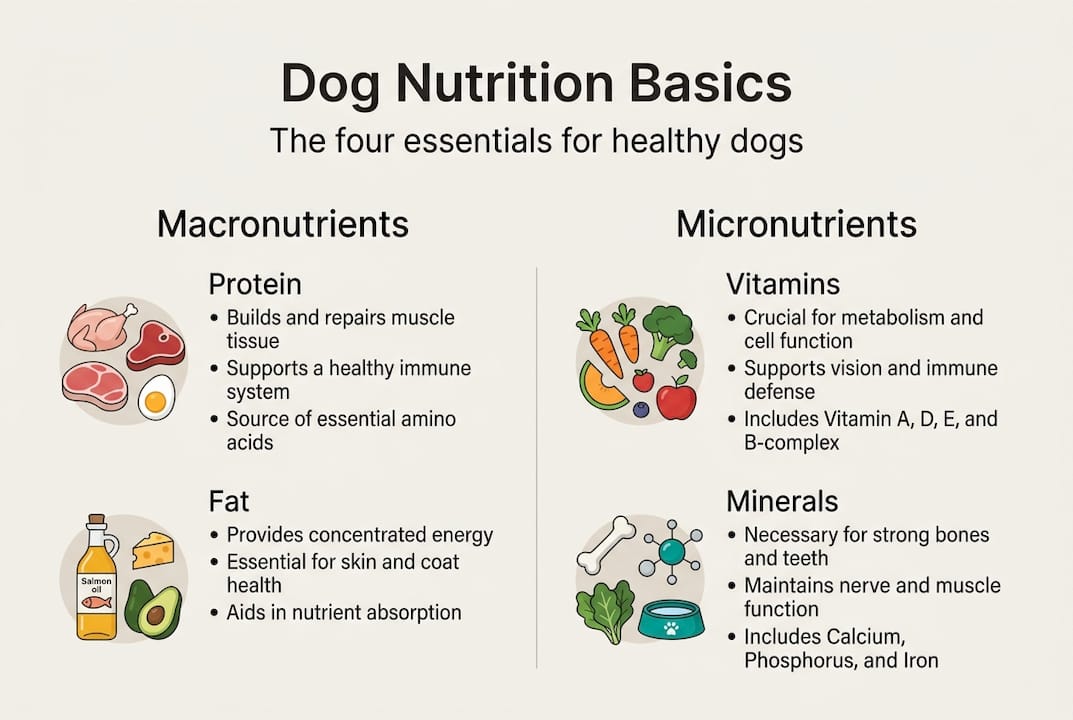
Carbohydrates are not essential for dogs in the way they are for humans, but they provide readily available energy and support gut health through dietary fibre.
The micronutrients are where many diets quietly fall short:
- Calcium and phosphorus: Critical for bones and teeth, especially in growing dogs
- Zinc: Supports skin integrity and immune response
- Vitamin D: Regulates calcium absorption; deficiency causes bone disorders
- B vitamins: Essential for energy metabolism and nervous system function
For dogs with skin sensitivities or digestive issues, the omega fatty acids for dogs conversation is especially relevant. The omega-3 to omega-6 ratio in the diet directly influences inflammation levels. Most commercial diets are high in omega-6 (from poultry and vegetable oils) and low in omega-3 (from oily fish or flaxseed). Correcting this imbalance can visibly improve coat condition and reduce itching.
For dogs with sensitive digestion, essential fatty acids and hydrolysed proteins are particularly valuable because they support the skin barrier and reduce the immune triggers that cause flare-ups.
| Nutrient | Primary function | Best sources |
|---|---|---|
| Protein | Muscle, repair, immunity | Fresh meat, fish, eggs |
| Omega-3 | Anti-inflammation, skin/coat | Salmon, sardines, flaxseed |
| Zinc | Skin, immune support | Meat, pumpkin seeds |
| Vitamin D | Calcium regulation | Oily fish, fortified foods |
Pro Tip: If your dog has a diagnosed sensitivity or chronic condition, work with a veterinary nutritionist rather than adjusting the diet alone. Small imbalances in micronutrients can have significant long-term effects.
Grain-free, natural, and specialty diets: pros, cons, and evidence
Grain-free diets have grown enormously in popularity, and it is easy to see why. The idea of feeding closer to a dog’s ancestral diet, without wheat, corn, or rice, appeals to owners who want something more natural. But the science deserves a careful look.
The main concern emerged around 2018 when the FDA began investigating a potential link between grain-free diets and dilated cardiomyopathy (DCM), a serious heart condition. The focus fell on diets high in legumes and pulses, particularly peas and lentils, which are often used as protein or carbohydrate replacements in grain-free recipes.
Research published in peer-reviewed literature found that grain-free diets high in legumes were associated with taurine deficiency and DCM in some dogs. Crucially, the FDA identified an association, not proven causality. The mechanism is still not fully understood.
What does this mean practically?
- Not all grain-free diets carry the same risk. Formulations that rely heavily on peas and lentils as primary ingredients are more concerning than those using sweet potato or other alternatives.
- Breed matters. Some breeds, including Golden Retrievers and Cocker Spaniels, appear more susceptible to taurine-related DCM.
- Taurine supplementation in grain-free recipes can reduce the risk significantly.
- Grain-free does not mean low-carb. Many grain-free foods simply swap grains for other starchy ingredients.
For dogs with genuine grain sensitivities or allergies, the right food for sensitive dogs can make a real difference. The key is choosing a well-formulated recipe that does not rely on high volumes of legumes as a filler.
“The evidence suggests that diet-associated DCM is multifactorial. No single ingredient has been confirmed as the cause, and well-balanced grain-free diets remain a valid option for many dogs.”
If your dog has a sensitive stomach, a grain-free approach combined with a limited-ingredient recipe can reduce the number of potential triggers and make it easier to identify problem foods.
| Diet type | Potential benefit | Key consideration |
|---|---|---|
| Grain-free (legume-heavy) | Avoids grains | Monitor taurine levels |
| Grain-free (potato-based) | Avoids grains, lower legume load | Starch content still present |
| Natural/whole ingredient | Higher digestibility | Needs complete formulation |
Homemade and raw diets: myths, deficiencies, and best practice
The appeal of homemade dog food is completely understandable. You know exactly what is going in the bowl, you can tailor it to your dog’s preferences, and it feels like an act of care. But the nutritional reality is sobering.

Studies consistently show that 95% of homemade recipes are deficient in at least one essential nutrient. The most commonly missing nutrients include calcium, zinc, vitamin D, iodine, and copper. These are not obscure trace elements. They are foundational to bone health, thyroid function, and immune response.
The problem is not the ingredients themselves. It is the complexity of balancing a diet across dozens of nutrients simultaneously, without professional tools or training. A chicken and rice meal might look balanced, but it is typically very low in calcium, iodine, and several vitamins.
If you want to feed homemade, here is what responsible practice looks like:
- Consult a veterinary nutritionist before starting, not after problems arise
- Use a formulated recipe designed to meet FEDIAF or AAFCO standards
- Supplement strategically: calcium, omega-3, and a broad-spectrum vitamin and mineral mix are usually required
- Review regularly: your dog’s needs change with age, weight, and health status
Our guide on homemade dog food supplements covers the specific additions most homemade diets need. If you are considering making the switch, our step-by-step guide to healthy homemade meals is a practical starting point.
Pro Tip: Before committing to homemade feeding, read our honest breakdown of whether homemade dog food is genuinely healthier than premium commercial options. The answer may surprise you.
Raw diets carry additional risks including bacterial contamination (Salmonella, Listeria) and bone-related injuries. These risks can be managed with careful sourcing and preparation, but they require genuine commitment and knowledge.
Why ‘complete’ is personal: rethinking one-size-fits-all dog nutrition
We have seen this pattern many times. An owner switches their dog to a food labelled ‘complete and balanced,’ follows the feeding guidelines precisely, and still ends up with a dog that is itchy, lethargic, or losing condition. The label was accurate. The food simply was not right for that particular dog.
The truth is that regulatory definitions of ‘complete’ are population-level standards. They are designed to support the average dog. But your dog is not average. A five-year-old Border Collie working on a farm has entirely different energy and protein needs than a neutered Cavalier King Charles Spaniel living in a flat. A dog recovering from gut dysbiosis needs more than a standard fibre level.
Breed, age, activity level, gut microbiome health, and individual sensitivities all shift what ‘complete’ actually means in practice. The benefits of single-protein diets for sensitive dogs illustrate this perfectly. A food that is nutritionally complete for most dogs can still trigger reactions in a dog with a specific protein sensitivity.
Our advice: treat ‘complete’ on a label as a starting point, not a final answer. Monitor your dog’s coat, energy, stool quality, and weight regularly. Be willing to adapt. And always consult your vet before making significant dietary changes.
Nourish your dog with expert-formulated recipes
Understanding your dog’s nutritional needs is the first step. Finding a food that genuinely meets them is the next. 🐾
At Ultimate Pet Foods, we formulate every recipe with real nutritional science behind it, not just marketing claims. Our grain-free range is built around high-quality proteins and carefully selected ingredients, with full transparency on what goes in and why. Whether your dog needs a sensitive-stomach formula, a life-stage-specific recipe, or a natural diet free from common allergens, we have options designed with their unique needs in mind. Explore our grain-free ingredient guide and browse nutrition by life stage to find the right fit for your dog.
Frequently asked questions
How can I tell if my dog’s food is truly ‘complete’?
Look for a nutritional adequacy statement on the label confirming the food meets AAFCO or FEDIAF standards for your dog’s specific life stage. Ideally, choose a food substantiated by feeding trials rather than formulation alone.
Are grain-free diets always safe and better for all dogs?
Grain-free diets and DCM have an association in some dogs, particularly breeds prone to taurine deficiency, but they are not automatically harmful. Speak to your vet before switching, and choose recipes that are not heavily reliant on peas or lentils.
What risks are associated with homemade dog diets?
95% of homemade recipes are deficient in at least one essential nutrient, making professional guidance from a veterinary nutritionist essential before starting a homemade feeding plan.
Should I supplement my dog’s diet with omega fatty acids?
If your dog shows signs of skin irritation, a dull coat, or chronic inflammation, omega-3 supplements (EPA/DHA) can provide meaningful support. Always check with your vet on appropriate dosage first.