
4 step vet plan to rebuild underweight dogs with digestible calories
If your dog is underweight, weigh them and check their body condition now. Contact your vet if the loss is rapid or unexplained, then start a digestible, calorie-dense feeding plan introduced in stages, rather than all at once. Split the extra food across several small meals a day and track weight weekly, adjusting only once you see how your dog tolerates the increase.
TL;DR:
- Most underweight dogs require a thorough vet assessment to identify underlying causes such as parasites, dental issues, or metabolic disorders before starting a weight gain plan.
- Controlled, staged refeeding using calculated calorie increases based on resting energy requirements and target weight prevents digestive overload and promotes steady recovery.
- High-quality, calorie-dense complete diets with high-meat content and added prebiotics support digestion and absorption for effective weight rebuilding.
- Regular weight, body condition score recordings, and visual monitoring help track progress and inform adjustments, with stabilization typically occurring within one to two weeks.
- Achieving full recovery may take several weeks, and ongoing veterinary consultation is essential to ensure safe, sustained weight gain and address any ongoing health issues.
Table of Contents
- How to tell if your dog is underweight: BCS and weighing at home
- See your vet: common causes to rule out and typical diagnostic checks
- Feeding protocol for safe weight gain: calculate calories and use staged refeeding
- Practical food choices and meal tactics to add calories safely
- Supporting digestion and absorption: prebiotics, hydrolysed options and ingredient quality
- Monitoring progress: what to record, realistic timelines and when to adjust or stop
- How we approach underweight dogs at Ultimate Pet Foods
- Try Ultimate Pet Foods for everyday feeding support
- Sources
- FAQ
How to tell if your dog is underweight: BCS and weighing at home
Ribs you can see from across the room, a waist that looks pinched rather than gently tucked, and a spine you can count with your eyes shut are the classic signs. But guessing isn’t good enough when you’re planning a feeding programme, so vets use a structured Body Condition Score instead of a visual once-over.
Most practices use either a 5-point or 9-point scale. On the 9-point version, each single point shift represents roughly a 5% change in body fat, which makes it far more precise than “looks a bit thin.” Here’s how to run the check yourself:
- Do the rib test. Place your thumbs on the spine and spread your fingers across the ribcage. You should feel ribs easily under a thin layer of fat, not see them and not have to press hard to find them.
- Check the waist from above. Look down at your dog standing square. An hourglass shape is normal; a waist so narrow it looks concave suggests underweight.
- Check the abdominal tuck from the side. A visible tuck is healthy; a severely sunken abdomen with visible hip bones and vertebrae signals more serious weight loss.
- Weigh regularly. Bathroom scales work for medium and large dogs (weigh yourself, then weigh yourself holding the dog, and subtract). Kitchen scales suit toys and small breeds.
- Log both numbers together. A single weight reading tells you less than weight plus BCS tracked over time, because muscle and fat distribution vary by breed and age.
Some naturally lean breeds, such as greyhounds and whippets, sit comfortably at a lower BCS than a Labrador ever would. Context matters. What’s worth flagging isn’t a permanently lean build. It’s a change: a dog who was a healthy weight and has since lost condition, or one whose ribs, spine, and hip bones are now prominent with no muscle covering them.
See your vet: common causes to rule out and typical diagnostic checks
A dog that’s genuinely underweight rarely gets that way from “just being a fussy eater.” Something is usually driving it, and food alone won’t fix the underlying cause.
Vets typically investigate several possibilities before settling on a feeding plan:
- Parasites — worms and other internal parasites are among the most common, and often the most easily treated, causes of poor weight gain.
- Dental disease — painful teeth or gums can make a dog reluctant to chew enough to meet their calorie needs.
- Gastrointestinal disease — inflammatory bowel conditions or exocrine pancreatic insufficiency reduce how well nutrients are absorbed even when intake looks normal.
- Endocrine disorders — conditions affecting metabolism can quietly drive weight down despite a normal appetite.
- Chronic infection or cancer — both increase energy demands while often reducing appetite at the same time.
- Chronic pain — arthritis or other ongoing discomfort can suppress the desire to eat.
A standard workup usually includes a weight and BCS record, a faecal parasite screen, blood work (a complete blood count and biochemistry panel), and a urinalysis. Dental examination is routine, and imaging or referral to a specialist follows if initial results don’t explain the picture.
Some signs mean don’t wait for a routine appointment: rapid weight loss over days rather than weeks, a dog refusing food entirely, persistent vomiting or diarrhoea, or severe lethargy. Veterinary charities are consistent on this point: unexplained weight loss deserves professional assessment, not a wait-and-see approach at home.
Feeding protocol for safe weight gain: calculate calories and use staged refeeding
Once medical causes are ruled out or being treated, the actual weight gain diet for dogs comes down to controlled, calculated calorie increases, not simply piling more food into the bowl.
Start with Resting Energy Requirement, or RER, calculated as 70 × (weight in kg)^0.75. This tells you the calories a dog needs at complete rest, before any adjustment for activity, age, or recovery status.
Worked examples:
- A 5 kg dog: 70 × 5^0.75 ≈ 70 × 3.34 = 234 kcal/day at rest.
- A 20 kg dog: 70 × 20^0.75 ≈ 70 × 9.46 = 662 kcal/day at rest.
From RER, you move to Daily Energy Requirement (DER) using a multiplier that reflects life stage and recovery needs. BSAVA guidance sets out standard multipliers for growth, maintenance, and weight gain, and this is where a nutritional needs for underweight dogs conversation with your vet earns its keep. Guessing the multiplier is where owners most often go wrong.
Pro Tip: One of the most common mistakes is feeding for the dog’s current, underweight mass rather than their target weight. Feeding the amount recommended for the ideal weight is what actually creates the calorie surplus needed to rebuild condition.
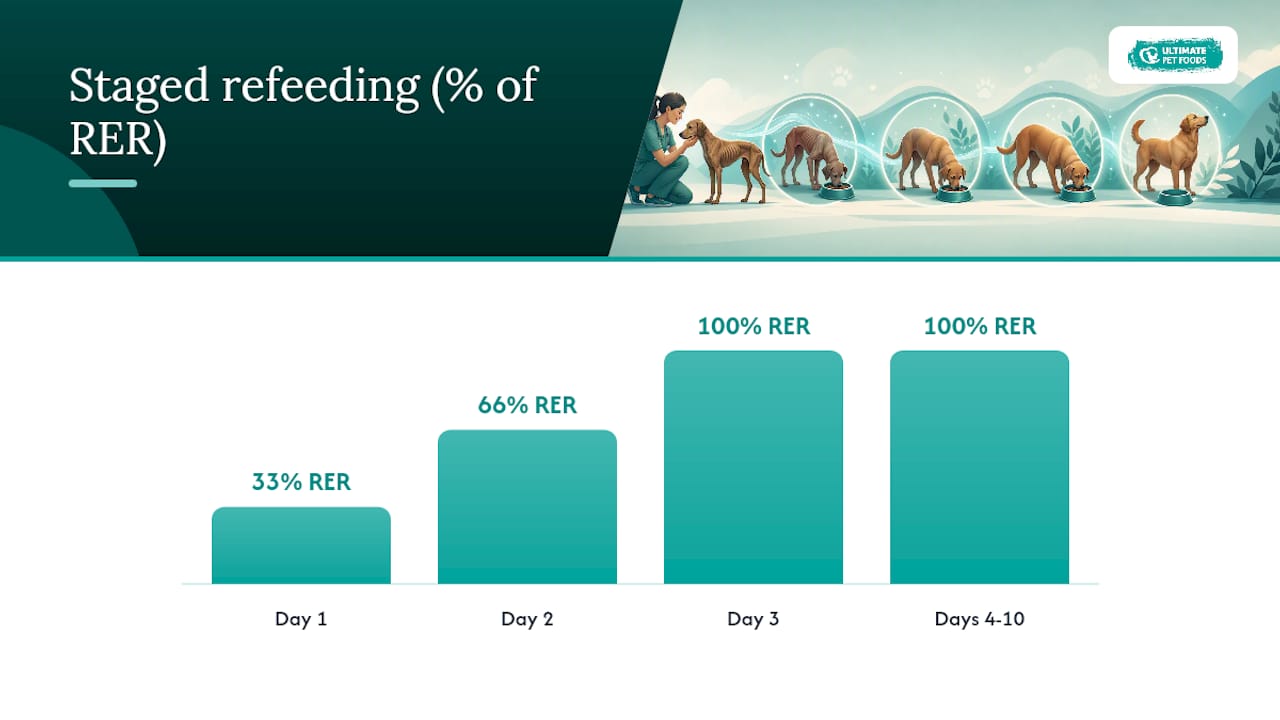
Staged refeeding avoids overwhelming a compromised digestive system. The protocol widely used by veterinary teams looks like this:
- Days 1 to 3: Feed 33% of RER on day one, 66% on day two, then reach 100% of RER by day three.
- Days 4 to 10: Maintain at 100% of RER for around seven days, watching stool quality and appetite closely.
- Week two onward: Increase to DER calculated for the dog’s current weight.
- Ongoing: Gradually increase toward DER calculated for the target (ideal) weight, adjusting based on weekly weight and BCS checks.
During this period, vets often discuss empirical supplementation with thiamine and cobalamin, particularly for dogs that have gone through prolonged poor intake. This is a conversation to have with your vet rather than a shop-bought decision. A controlled, staged increase with close monitoring is what allows you to catch intolerance early and correct course before it becomes a bigger problem.
Weigh daily where possible during the first week, then move to weekly weighing once the dog is stable. Stop the increase and call your vet if you see vomiting, diarrhoea, or a dog who simply won’t touch the extra food. One detail vets flag often: very thin dogs are frequently dehydrated, so an early weight jump can reflect fluid balance returning to normal as much as genuine tissue gain.
Practical food choices and meal tactics to add calories safely
The best dog food for weight gain checks three boxes at once: high calorie density, high biological-value protein, and consistent digestibility. That third point gets overlooked constantly, and it’s often the difference between a dog that gains steadily and one that plateaus despite eating more.
A complete, high-calorie kibble is usually the sensible starting point rather than an assortment of home-cooked additions, simply because it’s nutritionally balanced every single meal, not just on the days you get the recipe right. Look for a formula built around fresh, high-meat content rather than fillers, since protein quality drives how much of what your dog eats actually gets used.
Safe ways to boost calories without upsetting a sensitive gut:
- Warm wet food gently to release aroma and encourage a reluctant eater.
- Add small amounts of cooked, plain lean meat such as chicken or turkey as a topper.
- A teaspoon of full-fat plain yoghurt or a small amount of a dog-safe oil can nudge up calorie density.
- Avoid onion, garlic, grapes, and raisins entirely. All are toxic to dogs regardless of how small the underweight animal is.
- Skip large amounts of plant oils poured on top of meals. They frequently upset digestion faster than they add useful calories.
Puppy or working-dog formulas are sometimes used short-term because they’re calorie-dense by design, but they’re not automatically appropriate for every underweight adult, so check with your vet before switching long-term.
If you’re building a short-term homemade meals for underweight dogs plan while waiting for a vet appointment or during recovery, a simple template works: a digestible protein source (cooked chicken, turkey, or white fish), a digestible carbohydrate (cooked rice or sweet potato), and a small amount of a safe oil for extra calories. This is a bridge, not a long-term diet. Homemade feeding without proper ratio calculations can create serious imbalances over weeks and months, which is exactly why ad hoc home cooking needs veterinary oversight if it continues beyond a short stretch.

Supporting digestion and absorption: prebiotics, hydrolysed options and ingredient quality
Here’s what most feeding advice misses: calories only help if they’re actually absorbed. For a malnourished dog, digestibility is the real bottleneck, not just how many kcal are in the bowl.
This is where gut support earns its place in a weight gain diet for dogs, not as an afterthought but as a core part of the plan:
- MOS and FOS prebiotics feed beneficial gut bacteria, supporting steadier nutrient uptake exactly when a recovering dog needs every calorie to count.
- Highly digestible, high-biological-value protein reduces the workload on a gut that may already be under strain from prior poor nutrition.
- Hydrolysed protein formulas break protein down into smaller components, which can help dogs with suspected malabsorption or sensitive digestion get more from each meal, always under veterinary guidance.
- Gently cooked ingredients tend to preserve nutrient integrity better than heavily processed alternatives.
At Ultimatepetfoods, our complete kibble recipes are made from freshly prepared meat or fish, gently cooked at 82°C to help lock in freshness and nutrients, and formulated with added MOS and FOS prebiotics to support digestion and gut health as standard. Where a dog’s history suggests malabsorption or a sensitive stomach, our Ultimate+ Functional Health range includes Digestive Care and Weight Control & Joint Care formulas built with hydrolysed proteins, worth raising with your vet if a standard diet isn’t delivering steady progress.
Monitoring progress: what to record, realistic timelines and when to adjust or stop
A monitoring routine turns guesswork into a plan you can trust, and it doesn’t need to be complicated.
- Weigh weekly once your dog has passed the initial stabilisation phase (daily weighing in week one is useful if you can manage it).
- Log BCS alongside weight, not weight alone, since fat and muscle recover at different rates.
- Take a photo from the same angle every week or two. Visual change often shows up before the scale confirms it.
- Track appetite and stool quality as a simple daily note, flagging anything unusual straight away.
Expect stabilisation within the first one to two weeks, with consistent, measurable gain building over roughly three to six weeks after that. Full recovery to a healthy BCS can take considerably longer depending on how depleted the dog was to start with, so patience matters more than speed here.
Re-evaluate with your vet at any point progress stalls for more than two consecutive weekly checks.
How we approach underweight dogs at Ultimate Pet Foods
We start from the same principle that runs through this whole guide: calories only matter if they’re absorbed. That’s why our complete kibble recipes lean on freshly prepared meat or fish, gently cooked at 82°C, alongside added MOS and FOS prebiotics as standard, not as an optional extra bolted on for marketing.
For dogs whose recovery needs go beyond a standard diet, our Ultimate+ Functional Health range maps onto the situations we hear about most often from worried owners. Digestive Care suits dogs with sensitive stomachs or suspected malabsorption. Weight Control & Joint Care supports dogs rebuilding condition while managing joint comfort, particularly in older animals.
None of this replaces a vet’s judgment on your individual dog. Every recipe change during recovery deserves a quick conversation with whoever is overseeing that dog’s treatment, so the diet and the medical plan move in the same direction together.
— Glenn
Try Ultimate Pet Foods for everyday feeding support
Ultimatepetfoods makes it straightforward to feed for recovery without juggling multiple products or guessing at ratios: one complete kibble, formulated for daily feeding across all breeds and life stages, does the calorie and nutrient work for you.
Every recipe starts with freshly prepared meat or fish, gently cooked at 82°C to help lock in freshness and nutrients, using human-grade ingredients rather than rendered by-products. Added MOS and FOS prebiotics support digestion as standard, which matters enormously for a dog whose gut needs to work efficiently to convert extra calories into actual weight gain. If your dog’s history points to sensitive digestion, our hydrolysed formula for sensitive stomachs is designed for exactly that, while our high-meat chicken recipe offers a nutrient-dense, everyday option for dogs who simply need steady, reliable calories.
This isn’t a short-term fix diet. It’s a complete, balanced food built for lifelong feeding, so once your dog reaches a healthy weight, the same recipe keeps them there. Order a sample pack or browse the Ultimate+ Functional Health range to find the right starting point for your dog’s recovery.
Sources
- Feeding protocol: nutrition best practices for emaciated dogs
- Body condition score techniques & scales
- Daily energy requirements and nutrition assessment (BSAVA)
- Malnutrition in dogs and cats (clinical review)
- Weight loss in dogs (PDSA)
FAQ
What is the best way to fatten up a skinny dog?
Start with a vet check to rule out medical causes, then introduce a digestible, calorie-dense complete food gradually using a staged refeeding plan rather than a sudden increase in portion size.
What should I give a dog who is underweight?
A complete, high-calorie kibble with high-biological-value protein and added prebiotics forms the base, with safe toppers like warmed wet food or small amounts of cooked lean meat used to boost intake.
What foods can help my dog gain weight?
Digestible, protein-rich foods work best: complete kibble formulated for calorie density, cooked lean meats as toppers, and small additions of dog-safe oils or full-fat yoghurt, while onion, garlic, grapes, and raisins must always be avoided.
How long does it take to fatten up a skinny dog?
Most dogs stabilise within one to two weeks of starting a controlled feeding plan, with consistent measurable weight gain over three to six weeks, though full recovery can take longer depending on how underweight the dog was to begin with.