
How to support active dogs nutritionally: a complete guide
TL;DR:
- Active dogs need diets rich in high-quality, digestible protein, fats, and carbohydrates tailored to their activity levels. Proper meal timing and regular monitoring help optimize performance, recovery, and overall health. Ultimatepetfoods offers freshly prepared, nutritionally balanced recipes designed to support active dogs throughout their lives.
Active dogs require diets with significantly higher levels of protein, fat, and digestible carbohydrates than their sedentary counterparts, making targeted nutrition the single most important factor in their long-term health and performance. Knowing how to support active dogs nutritionally means going beyond simply feeding more of the same food. It means choosing the right macronutrient ratios, timing meals around activity, and monitoring your dog’s condition week by week. At Ultimatepetfoods, we believe every sprint, swim, and fetch session starts with what goes in the bowl. Our recipes are built around freshly prepared meat and fish, gently cooked at 82°C to lock in nutrients, with added prebiotics MOS and FOS to keep digestion working at its best.
How to support active dogs nutritionally: key macronutrients explained
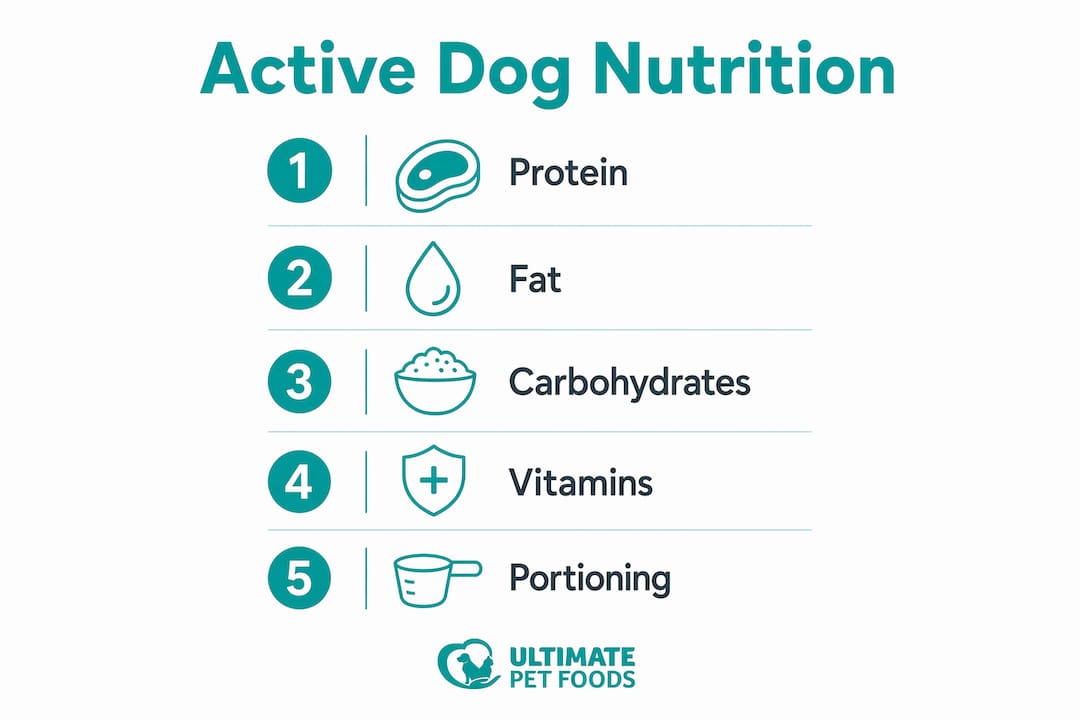
The nutritional needs of active dogs are best understood through the lens of performance nutrition, a term used by veterinary sports medicine specialists to describe diet planning for dogs in regular, demanding physical work. Getting the macronutrient balance right is the foundation of everything else.
Protein: the muscle builder
Protein at 26 to 30%+ on a dry matter basis is the standard recommendation for active and athletic dogs. Protein repairs micro-tears in muscle tissue after exercise and maintains lean body mass during periods of intense training. Crucially, it is not just the percentage that matters. Highly digestible protein sources maximise usable calories and muscle support, meaning a food with 28% digestible protein from freshly prepared chicken outperforms one with 32% crude protein from low-quality meal. This is why Ultimatepetfoods uses human-grade meat and fish as primary ingredients, gently cooked to preserve bioavailability.
Fat: the endurance fuel
Fat is the most energy-dense macronutrient available to dogs, providing more than twice the calories per gram compared to protein or carbohydrates. Fat at 15 to 25% supports endurance activities, sustained metabolic output, and the absorption of fat-soluble vitamins A, D, E, and K. For dogs doing long-distance work, agility training, or regular field sports, fat is the primary energy currency.
Carbohydrates: not a filler
Carbohydrates are often misunderstood in canine nutrition, but they are critical for rapid energy turnover in agility and explosive activity dogs. Carbohydrates at 40 to 50% on a dry matter basis support glycogen replenishment and help prevent the body from breaking down muscle protein for fuel. Think of glycogen as your dog’s short-term energy reserve. When it runs low during a hard training session, performance drops and recovery slows.
Vitamins, minerals, and prebiotics
B-complex vitamins support energy metabolism at a cellular level, while minerals such as calcium and phosphorus maintain bone density under repeated physical stress. Ultimatepetfoods recipes include prebiotics MOS (mannan-oligosaccharides) and FOS (fructo-oligosaccharides), which feed beneficial gut bacteria and improve nutrient absorption. A healthy gut means more of every nutrient actually reaches the muscles and tissues that need it.
Pro Tip: When comparing dog foods for an active breed, check the ingredient list for a named meat or fish as the first ingredient and look for a feeding trial statement on the label. Feeding trials under controlled conditions verify that nutrients are genuinely bioavailable, not just present on paper.
How do you calculate the right calories and portions for an active dog?
Portion sizing for active dogs is not guesswork. It is a calculation based on body weight, activity intensity, and environmental conditions.
Active dogs may require 30 to 70 calories per pound of body weight daily, depending on workload. That is a wide range, and it reflects the real difference between a dog doing a 30-minute daily walk and one competing in agility trials three times a week. Portion sizes for active dogs are typically 1.5 to 2.5 times greater than those for sedentary dogs of the same breed and weight.
The most reliable method for calculating daily intake uses the Resting Energy Requirement (RER):
- Calculate RER: Multiply your dog’s body weight in kilograms to the power of 0.75, then multiply by 70. For a 20kg dog: 70 x (20^0.75) = approximately 674 kcal per day at rest.
- Apply an activity multiplier: Lightly active dogs use a factor of 2.0. Moderately active dogs use 3.0. Highly active or working dogs use 4.0 to 8.0.
- Adjust for environment: Extreme cold or heat significantly modifies caloric requirements beyond standard activity formulas. A working dog in winter may need 25 to 30% more calories simply to maintain body temperature.
- Weigh and monitor weekly: Adjust portions up or down by 10% based on body condition score, not just the scales.
- Reassess with season: Reduce portions during lower-activity periods such as injury recovery or off-season training.
| Scenario | Approximate daily calories (20kg dog) |
|---|---|
| Sedentary or lightly active | 674 to 1,000 kcal |
| Moderately active (daily exercise) | 1,350 to 2,000 kcal |
| Highly active (agility, field sports) | 2,700 to 5,000 kcal |
| Working dog in cold conditions | Up to 6,000+ kcal |
For a more detailed breakdown of how to assess your dog’s individual calorie needs, the Ultimatepetfoods guide on calculating dog calorie needs is a practical starting point.
What are the best meal timing practices around physical activity?
When you feed your dog matters almost as much as what you feed them. Poor timing can reduce performance, slow recovery, and in serious cases, increase the risk of gastric dilatation-volvulus (GDV), commonly known as bloat.
Here is what the evidence supports:
- Feed the main meal at least 3 hours before exercise. Feeding at least 3 hours before activity directs blood flow away from the digestive system and towards working muscles, while reducing gastric risk during vigorous movement.
- Offer a small pre-exercise snack 30 to 60 minutes before activity. A light, easily digestible treat such as a small portion of kibble or a natural chew provides a quick energy top-up without overloading the stomach.
- Hydrate consistently. Daily water intake of 50 to 60ml per kg is normal for dogs at rest, but this increases by 50 to 100% during intense activity. Dehydration reduces endurance and cognitive sharpness, so always carry water on longer outings.
- Feed within 30 to 60 minutes after exercise. Post-exercise feeding supports glycogen replenishment and muscle repair when the body is most receptive to nutrients.
- Keep feeding times consistent. Irregular feeding disrupts energy availability and increases metabolic stress, which is the opposite of what a working or sporting dog needs.
A consistent feeding routine is one of the simplest and most effective tools you have for supporting your dog’s digestive health and energy levels. Pair it with a high-quality, complete food and you are already ahead of most.
Pro Tip: If your dog competes or trains in the morning, feed a light meal the evening before rather than a large meal on the morning of activity. This keeps the stomach settled while ensuring glycogen stores are topped up overnight.
How do you monitor and adjust your active dog’s diet over time?
Nutrition is not a set-and-forget decision. Your dog’s needs change with age, season, training load, and health status, and your feeding approach should change with them.
Watch for these key indicators every week:
- Energy levels and recovery speed. A well-nourished active dog bounces back within 24 hours of hard exercise. Persistent fatigue or sluggishness after normal activity suggests the diet needs reviewing.
- Muscle tone and body condition. Run your hands along your dog’s ribcage. Ribs should be palpable with light pressure but not visibly prominent. Visible ribs indicate underfeeding; difficulty feeling them suggests excess body fat.
- Coat condition. A dull, dry, or flaky coat often signals a deficiency in omega-3 fatty acids or overall caloric intake. Shiny, dense fur is a reliable sign of good nutritional status.
- Digestive health. Firm, well-formed stools indicate good digestibility. Loose stools, excessive wind, or irregular bowel movements suggest the food is not being absorbed efficiently.
- Joint mobility. For dogs in high-impact activities such as agility, flyball, or canicross, joint-supporting nutrients including glucosamine, chondroitin, and omega-3 fatty acids help sustain long-term mobility. Consider a food that includes these or discuss supplementation with your vet.
If you notice any significant change in weight, coat, energy, or digestion, adjust feeding amounts by 10 to 15% and reassess after two weeks. For dogs with specific health concerns or those in elite-level competition, a consultation with a veterinary nutritionist is worth the investment.
How does Ultimatepetfoods support the nutritional needs of active dogs?
Ultimatepetfoods is built around one principle: that everyday food should do extraordinary things for your dog’s health. Every recipe in our range is designed to meet the nutritional needs of active dogs across all breeds and life stages, not just as a short-term fix but as a lifelong foundation.
Here is what sets our approach apart:
- Freshly prepared meat and fish, gently cooked at 82°C. This low-temperature cooking method preserves the natural amino acid profile and palatability of the protein, making it more digestible and more useful to your dog’s muscles.
- Complete and balanced recipes. Every Ultimatepetfoods dry food meets the nutritional standards required for all life stages, so you are not compromising on any essential nutrient.
- Added prebiotics MOS and FOS. These support a healthy gut microbiome, which directly improves nutrient absorption and immune function. A dog with a healthy gut extracts more value from every meal.
- Human-grade ingredients. We use the same quality standards for our ingredients that apply to food produced for people. This matters because ingredient quality directly affects digestibility and nutrient density.
- The Ultimate+ Functional Health range. For active dogs with specific needs, our functional range uses hydrolysed proteins and targeted formulations to support areas including Joint Care and Weight Control, Digestive Care, Skin and Coat Care, and Dental Care. These are not occasional supplements. They are complete daily foods designed for targeted, ongoing support.
Pro Tip: If your active dog is showing signs of joint stiffness after exercise, the Ultimatepetfoods Ultimate+ Weight Control and Joint Care formula provides daily nutritional support through a complete, grain-free recipe rather than relying on separate supplements.
For a deeper look at how to match food choices to your dog’s activity type, the Ultimatepetfoods guide on active dog nutrition covers breed-specific considerations and ingredient breakdowns in detail.
Key takeaways
Supporting active dogs nutritionally requires the right balance of digestible protein, energy-dense fat, and glycogen-fuelling carbohydrates, timed correctly around activity and adjusted regularly to match your dog’s changing needs.
| Point | Details |
|---|---|
| Protein and fat ratios matter | Aim for 26 to 30%+ protein and 15 to 25% fat on a dry matter basis for active dogs. |
| Calorie needs vary widely | Active dogs need 30 to 70 calories per pound of body weight daily, depending on workload and environment. |
| Meal timing reduces health risks | Feed the main meal at least 3 hours before exercise to reduce bloat risk and support performance. |
| Monitor condition weekly | Check muscle tone, coat quality, energy, and digestion to catch nutritional gaps early. |
| Food quality determines digestibility | Freshly prepared, highly digestible ingredients deliver more usable nutrition than crude protein percentages alone. |
What I have learned from years of watching active dogs thrive or struggle
One thing I have noticed consistently is that owners of active dogs tend to focus almost entirely on quantity. They increase the portion size when their dog seems tired and reduce it when the dog gains weight. What they rarely examine is the quality and composition of what they are feeding.
The most common mistake I see is feeding a standard adult maintenance food to a dog doing serious physical work, simply because the label says “complete and balanced.” Technically, it may be. Practically, it is like asking a marathon runner to train on a diet designed for someone who walks to the office. The macronutrient ratios are wrong, the protein digestibility is often poor, and the energy density is insufficient.
The second thing I have learned is that consistency matters more than perfection. A dog fed a good-quality, appropriately formulated food at regular times, with weekly monitoring and sensible adjustments, will almost always outperform a dog on a theoretically perfect diet that changes every few weeks. Routine supports digestion, metabolism, and stress levels in ways that are genuinely measurable.
My honest advice: invest in a food with freshly prepared protein as the primary ingredient, check that it includes prebiotics for gut health, and build a feeding schedule around your dog’s actual training week. Then watch and adjust. Your dog will tell you, through their coat, their energy, and their recovery, whether the diet is working.
— Glenn
Find the right food for your active dog with Ultimatepetfoods

We know that finding the right food for an energetic dog can feel like a lot to navigate. That is why Ultimatepetfoods makes it straightforward. Our dry dog food recipes are made with freshly prepared meat and fish, gently cooked at 82°C, and formulated to be complete and balanced for everyday feeding across all breeds and life stages. Whether your dog is a weekend agility enthusiast or a full-time working dog, we have a recipe to match their needs.
The best way to find your dog’s perfect match is to try our personalised sample box, which lets you test a selection of our recipes before committing to a full bag. You can also explore our dry dog food range to compare formulas side by side, including our Ultimate+ Functional Health options for dogs needing targeted joint, digestive, or skin and coat support.
FAQ
What protein percentage is best for active dogs?
Active and athletic dogs perform best on foods containing 26 to 30% protein on a dry matter basis. Digestibility is equally important, so choose a food with a named, freshly prepared meat or fish as the primary ingredient.
How many calories does an active dog need per day?
Active dogs require 30 to 70 calories per pound of body weight daily, with the precise amount depending on activity intensity, body size, and environmental conditions such as temperature.
How long before exercise should I feed my dog?
Feed your dog’s main meal at least 3 hours before exercise to reduce the risk of gastric dilatation-volvulus and allow nutrients to be directed to working muscles rather than the digestive system. A small, light snack 30 to 60 minutes before activity is fine for most dogs.
What signs indicate my active dog’s diet needs adjusting?
Persistent fatigue after normal exercise, visible ribs or difficulty feeling them, a dull coat, loose stools, or reduced muscle tone are all signs that the current diet may not be meeting your dog’s nutritional needs. Adjust portions by 10 to 15% and reassess after two weeks, or consult your vet.
Are grain-free foods better for active dogs?
Grain-free recipes can be a good choice for active dogs, particularly those with sensitivities, as they often use higher-quality protein and fat sources. The most important factor is overall digestibility and macronutrient balance, not grain content alone. Ultimatepetfoods offers a full grain-free range formulated to meet the demands of active and working dogs.