
Nutritional needs by dog size: a complete feeding guide
TL;DR:
- Dog nutritional needs vary greatly with size, growth stage, and activity level, requiring tailored diets for optimal health. Smaller dogs have higher calorie needs per kilogram due to metabolic scaling, while large-breed puppies require controlled calcium levels to prevent skeletal issues. Regular body condition assessments and precise portion adjustments ensure long-term well-being across all breeds and ages.
Nutritional needs by dog size are defined by metabolic rate, growth stage, and body weight, meaning a Chihuahua and a Great Dane require fundamentally different diets to stay healthy. The science behind this is called metabolic scaling, and it explains why a small dog needs more calories per kilogram than a large one. AAFCO (the Association of American Feed Control Officials) sets the nutrient baselines that all complete dog foods must meet, but size and life stage determine how those baselines shift. At Ultimatepetfoods, we formulate our grain-free dry dog food recipes to meet these criteria using freshly prepared meat and fish, gently cooked at 82°C to lock in nutrients.
How do energy requirements differ by dog size?
The RER formula is 70 × (body weight in kg)^0.75 and is the starting point for every feeding calculation, regardless of breed. RER stands for Resting Energy Requirement. It represents the calories your dog needs at complete rest, before activity, growth, or reproduction are factored in.
From RER, you calculate the Maintenance Energy Requirement (MER) by multiplying RER by an activity factor. A neutered adult dog typically uses a factor of 1.6, while a working dog may need 2.0 or higher. This is where size and lifestyle intersect most clearly.
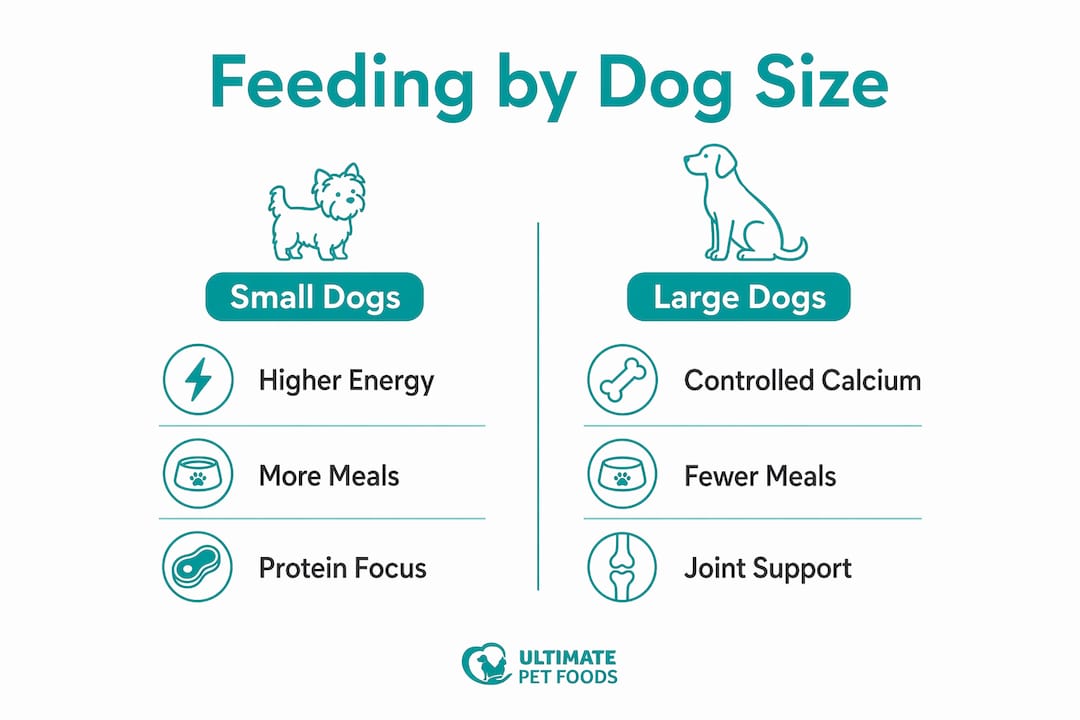
Smaller dogs have a higher energy demand per kg than larger dogs due to metabolic scaling. A 5 kg Toy Poodle needs roughly 280 kcal per day, while a 40 kg Labrador needs around 1,400 kcal. That sounds like a lot more for the Labrador, but per kilogram of body weight, the Poodle requires significantly more energy. This is why small-breed foods are often more calorie-dense per gram.

| Dog Size | Typical Weight | Estimated RER (kcal/day) | Estimated MER (kcal/day, neutered adult) |
|---|---|---|---|
| Toy/Small | 2–10 kg | 95–395 | 152–632 |
| Medium | 11–25 kg | 420–840 | 672–1,344 |
| Large | 26–45 kg | 860–1,340 | 1,376–2,144 |
| Giant | 46–70 kg | 1,360–1,870 | 2,176–2,992 |
These figures are estimates. Two dogs of identical weight can have different caloric needs depending on their activity level, reproductive status, and health. Use the table as a guide, not a prescription.
Pro Tip: Weigh your dog monthly and assess their body condition score (BCS) on a 1–9 scale. A score of 4–5 is ideal. If ribs are hard to feel, reduce portions. If ribs are very prominent, increase them. No formula replaces this hands-on check.
For a practical walkthrough of calculating daily calorie needs, including adjustments for activity and life stage, our dedicated guide covers the full process.
What nutrients vary most across dog sizes and life stages?
AAFCO nutrient profiles specify higher protein and fat minimums for growth stages (22.5% protein, 8.5% fat on a dry matter basis) compared to adult maintenance (18% protein, 5.5% fat). This gap matters most during puppyhood, when tissue development, bone growth, and organ formation are all happening simultaneously.
The most critical size-specific nutrient decision involves large-breed puppies. Large-breed puppy diets must cap calcium at around 1.8 g per 1,000 kcal to avoid developmental orthopaedic disease. Excess calcium in fast-growing breeds like German Shepherds, Rottweilers, and Golden Retrievers can disrupt bone mineralisation and lead to conditions such as hip dysplasia and osteochondrosis. AAFCO mandates a special large-size growth substantiation on labels for puppies expected to exceed 70 lb (approximately 32 kg) at adult weight. Feeding a standard puppy formula to a large-breed pup without checking this label claim is one of the most common and costly mistakes owners make.
Here is a summary of the key nutrients that shift most significantly by size and life stage:
- Protein: Minimum 22.5% (dry matter) for growth; 18% for adult maintenance. Active and working dogs may benefit from higher levels.
- Fat: Minimum 8.5% for growth; 5.5% for adults. Fat is the primary energy source for small breeds eating calorie-dense foods.
- Calcium and phosphorus: Tightly controlled for large-breed puppies. Excess calcium raises skeletal risk in giant breeds.
- Omega-3 fatty acids (DHA/EPA): Particularly important for brain and eye development in puppies of all sizes.
- Fibre: Supports digestive health across all sizes. Prebiotics such as MOS (mannan-oligosaccharides) and FOS (fructo-oligosaccharides) enhance gut microbiome balance.
- Glucosamine and chondroitin: Increasingly relevant for large and giant breeds prone to joint stress.
Pro Tip: Avoid supplementing a complete and balanced diet with extra calcium or vitamins unless directed by your vet. Over-supplementation, especially in large-breed puppies, can cause more harm than a nutrient shortfall.
Understanding how life stage nutrition intersects with size helps you choose the right formula at every phase of your dog’s life.
How do you assess and adjust feeding amounts by size?
Feeding guidelines on packaging are starting points, not fixed rules. Two dogs of the same weight may need different portions based on activity level, metabolism, and body condition. Treating the bag’s feeding chart as gospel is one of the most common dog feeding mistakes owners make.
Here is a practical process for assessing and adjusting feeding amounts safely:
- Start with the packaging guideline for your dog’s current weight and life stage. This gives you a baseline portion.
- Weigh your dog every two to four weeks. Puppies should be weighed weekly during rapid growth phases.
- Score body condition monthly using a 1–9 BCS scale. Aim for a score of 4–5, where ribs are easily felt but not visible.
- Adjust portions in 10% increments. Increase or decrease by 10% and reassess after two weeks before making further changes.
- Account for treats and extras. Treats should not exceed 10% of daily caloric intake. Factor them into the total.
- Transition gradually when changing formulas. Switching diets should happen over 2–4 weeks to avoid digestive upset and allow accurate body condition monitoring.
When selecting a food, look for the phrase “complete and balanced” on the label. A complete and balanced diet meets all nutrient minimums and can be fed alone, without supplementation, for the long term. For large-breed puppies, confirm the label carries large-breed growth substantiation. For adults, confirm the formula is appropriate for your dog’s size category.
Overfeeding is most common in small dogs, where even a small extra portion represents a significant calorie surplus relative to body weight. Monitoring body condition and weight trends is the most reliable way to catch this early.
What feeding strategies support digestive health across dog sizes?
Digestive health is the foundation of everything else. A dog that cannot absorb nutrients efficiently will not thrive regardless of how good the food is. Size influences digestive health in specific ways: small breeds tend to have faster metabolisms and may benefit from two to three smaller meals per day, while large and giant breeds are at greater risk of bloat (gastric dilatation-volvulus) and benefit from controlled meal sizes and slower eating.
Prebiotics such as MOS and FOS support the gut microbiome by feeding beneficial bacteria and reducing harmful ones. Both are included in Ultimatepetfoods recipes to support digestive balance across all sizes. Every wag and bounce starts with a healthy gut, and these ingredients work quietly in the background to keep things running smoothly.
For dogs with specific health concerns, the Ultimate+ Functional Health range from Ultimatepetfoods uses hydrolysed proteins and targeted ingredients to provide everyday support beyond standard nutrition.
| Ultimate+ Range | Primary Benefit | Best Suited For |
|---|---|---|
| Digestive Care & Defence | Gut microbiome support | Dogs with sensitive stomachs, all sizes |
| Skin & Coat Care & Defence | Coat condition and skin barrier | Dogs prone to dryness or itching |
| Weight Control & Joint Care | Healthy weight and mobility | Large breeds, senior dogs |
| Dental Care | Oral hygiene support | Small breeds (higher dental risk) |
| Healthy Living | General vitality | Active adult dogs of all sizes |
Feeding frequency also matters. Small breeds generally do well with two to three meals daily to maintain blood sugar stability. Large breeds benefit from two measured meals to reduce bloat risk. Giant breeds should avoid vigorous exercise for at least an hour before and after eating.
Key takeaways
Matching your dog’s diet to their size and life stage is the single most effective step you can take for their long-term health.
| Point | Details |
|---|---|
| Size drives energy needs | Smaller dogs need more calories per kg; use the RER formula as your starting calculation. |
| Large-breed puppies need specific diets | Calcium must be capped around 1.8 g per 1,000 kcal to prevent skeletal disease in fast-growing breeds. |
| AAFCO standards shift by life stage | Growth diets require 22.5% protein and 8.5% fat; adult maintenance requires 18% and 5.5% respectively. |
| Body condition scoring is non-negotiable | Packaging guidelines are estimates; monthly BCS checks are the most reliable way to adjust portions. |
| Prebiotics support all sizes | MOS and FOS in complete diets support gut health as a daily foundation, not a short-term fix. |
Size-based feeding: what i’ve learned after years of getting it wrong
One thing I see repeatedly is owners treating dog food as a one-size-fits-all product. They pick a well-reviewed food, follow the bag’s feeding chart, and assume the job is done. The problem is that the chart is built on averages. Your dog is not average.
The most consequential decision most owners never realise they are making is choosing the right food for a large-breed puppy. Feeding a standard puppy formula to a German Shepherd or a Labrador because it says “puppy” on the bag is genuinely risky. The calcium and energy levels in general puppy foods are not calibrated for the growth rate of a breed that will reach 35 kg. The large-breed growth substantiation on a label is not marketing. It is a meaningful formulation difference.
On the other end of the scale, small-breed owners often underestimate how easy it is to overfeed. A single extra biscuit for a 4 kg dog can represent 5–10% of their daily calorie allowance. Multiply that across a year and you have a dog carrying significant excess weight, with all the joint and metabolic consequences that brings.
What actually works is combining a quality complete diet with regular body condition checks and honest portion discipline. Ultimatepetfoods’ recipes, made with freshly prepared meat gently cooked at 82°C, give you a solid nutritional foundation. The rest comes down to observation and adjustment. Check your dog’s ribs once a month. Weigh them. Adjust by 10% if needed. That simple habit will do more for your dog’s health than any supplement or trend diet.
For a broader view of how life stage feeding connects to size-specific choices, that guide is worth reading alongside this one.
— Glenn
How Ultimatepetfoods supports size-specific nutrition every day
At Ultimatepetfoods, we believe every dog deserves food that genuinely fits their needs, not just their bowl. Our complete grain-free dry dog food recipes are made with freshly prepared meat and fish, gently cooked at 82°C to help lock in nutrients and flavour. Every recipe is complete and balanced, suitable for daily lifelong feeding across all breeds and life stages.
We include prebiotics MOS and FOS in our recipes to support digestive health from the inside out. For dogs needing targeted everyday support, our Ultimate+ Functional Health range covers Digestive Care, Skin & Coat Care, Weight Control & Joint Care, Dental Care, and Healthy Living. If you are exploring whether a grain-free diet is right for your dog’s size and health needs, we have the recipes and the knowledge to help you find the right fit.
FAQ
What is the RER formula and why does it matter for feeding?
The RER formula is 70 × (body weight in kg)^0.75 and calculates your dog’s resting calorie needs. It is the baseline for working out daily feeding amounts across all dog sizes.
Do small dogs really need more food per kg than large dogs?
Yes. Smaller dogs have higher metabolic rates relative to their body weight, so they require more calories per kilogram than large or giant breeds.
Why do large-breed puppies need a different food from other puppies?
Large-breed puppies need controlled calcium levels (around 1.8 g per 1,000 kcal) to prevent developmental orthopaedic disease. Standard puppy formulas are not calibrated for their growth rate.
How often should i adjust my dog’s food portions?
Reassess portions every two to four weeks using body condition scoring. Adjust in 10% increments and allow two weeks before making further changes.
What does “complete and balanced” mean on a dog food label?
A complete and balanced food meets all AAFCO nutrient minimums for the stated life stage and can be fed as the sole diet, long term, without additional supplementation.