
Meaning of complete dog food: the premium owner's guide
TL;DR:
- The term “complete” dog food is legally defined to ensure it provides all essential nutrients for a specific life stage; however, ingredient quality and digestibility are not guaranteed by this label.
- Premium owners should assess ingredient sources, preparation methods, and bioavailability, rather than relying solely on minimum nutrient standards.
- Ultimate Pet Foods offers freshly prepared, human-grade recipes with added prebiotics, emphasizing genuine nourishment beyond regulatory compliance.
If you’ve ever stood in a pet shop aisle, bag in hand, puzzling over what “complete” actually means on a dog food label, you’re not alone. The meaning of complete dog food is something many owners assume they understand, but the reality is more nuanced than the packaging suggests. “Complete” is a regulated term with specific nutritional requirements behind it, yet it tells you nothing about ingredient quality, digestibility, or how gently that food was made. This guide cuts through the label confusion so you can make genuinely informed choices for your dog.
Table of Contents
- What does complete dog food mean? Understanding nutritional completeness
- Quality and ingredient considerations beyond ‘complete’ nutrition
- Comparing complete dog food options: grain-free, natural, and functional health formulas
- Feeding complete dog food daily: tips for premium pet nutrition
- Rethinking complete dog food: what premium owners must consider beyond minimum standards
- Why Ultimate Pet Foods is the complete food choice for your dog’s lifelong health
- Frequently asked questions
Key Takeaways
| Point | Details |
|---|---|
| Complete dog food definition | Complete dog food provides all essential nutrients your dog needs for their life stage in one formula. |
| Quality matters beyond labels | The ‘complete’ claim ensures nutrients, but ingredient quality and digestibility vary widely across products. |
| Grain-free is a choice, not a necessity | Grain-free diets meet nutrition standards but grains often benefit dog health unless allergies exist. |
| Complementary foods are supplements | Complementary products do not provide full nutrition and should be fed sparingly alongside complete food. |
| Ultimate Pet Foods standards | Ultimate Pet Foods offers complete, balanced, natural, and gently cooked recipes using human-grade ingredients and prebiotics. |
What does complete dog food mean? Understanding nutritional completeness
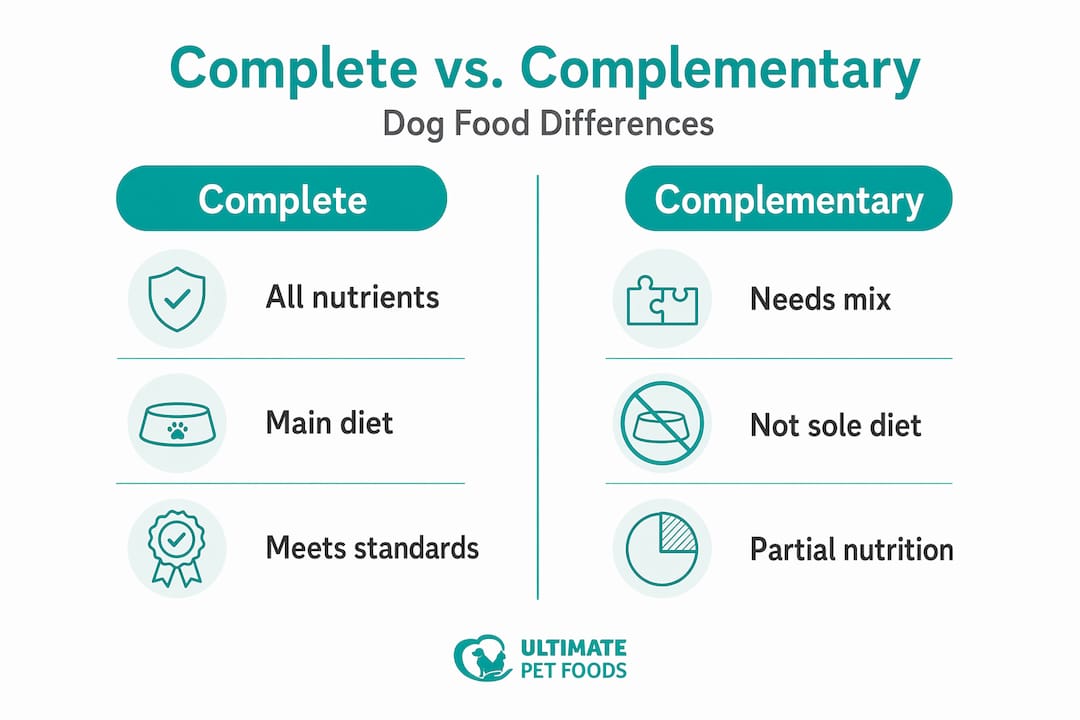
“Complete” is not a marketing word. It is a legally defined term in the pet food industry. A food labelled as complete must provide every essential nutrient your dog needs at the right levels to sustain health as a sole diet, across a specific life stage such as puppy, adult, or senior.
Regulatory bodies like FEDIAF set the minimum nutrient levels that qualify a food as complete. These include minimum protein levels of around 18% for adult maintenance and up to 30% for growth, alongside a minimum 9% fat content. These figures are not suggestions; they are floors below which a food cannot legally claim to be complete and balanced.
The contrast is with complementary dog food, which is designed to be fed alongside a complete diet. Think of mixer biscuits, raw meaty bones, or broth toppers. These are not nutritionally self-sufficient. In fact, complementary foods should make up no more than 10% of your dog’s daily calorie intake, and feeding them as a sole diet would leave your dog with serious nutritional gaps over time.
What the label must tell you
Pet food labelling standards across the UK and EU require manufacturers to clearly state whether a product is complete or complementary. If you see “complete pet food” on the packaging, the manufacturer is legally declaring that this food alone meets your dog’s daily nutritional needs. No guesswork required, as long as you choose the right formula for your dog’s life stage.
| Feature | Complete dog food | Complementary dog food |
|---|---|---|
| Meets all nutrient minimums | Yes | No |
| Can be fed as sole diet | Yes | No |
| Maximum of daily intake | 100% | Under 10% |
| Typical examples | Dry kibble, wet food, raw complete | Mixer biscuits, treats, toppers |
| Suitable for all life stages | Yes (when formulated correctly) | No |
Pro Tip: Always check the label says “complete” and confirms the life stage it is formulated for. A food labelled complete for adult dogs is not nutritionally adequate for puppies, and vice versa. For more on choosing balanced premium diets, our guide walks you through the key criteria.
Now that you know what “complete” technically means, let’s examine how quality and ingredient choices impact the actual nutrition.
Quality and ingredient considerations beyond ‘complete’ nutrition

Here is where many premium dog owners are surprised. The “complete” label confirms that minimum nutrients are present. It does not tell you where those nutrients came from, how they were processed, or how well your dog can actually absorb them.
As veterinary nutrition guidance makes clear, a food being complete means all nutrients are present, but it says nothing about ingredient quality or digestibility. A food could technically meet minimum protein requirements using low-grade rendered by-products or heavily processed plant-based proteins, and it would still qualify as complete.
“Complete” tells you a food meets minimum nutrient requirements. It does not tell you those nutrients came from fresh, natural sources or that your dog’s body can readily use them.
This distinction matters enormously when you are feeding your dog every single day for years. Bioavailability, which is how much of a nutrient your dog’s body actually absorbs and uses, varies significantly depending on ingredient source and preparation method. Freshly prepared meat protein, for example, is typically far more bioavailable than protein derived from dried meat meal or plant-based alternatives.
The grain-free question
Veterinary experts note that grain-free complete dog foods meet minimum nutritional standards, but grains themselves offer real benefits for dogs without allergies, including fibre, B vitamins, and steady energy release. The grain-free choice becomes genuinely valuable when your dog has a confirmed grain sensitivity or intolerance. For dogs without those issues, it is a preference-based decision worth discussing with your vet.
- Ingredient origin matters: Human-grade meat and fish offer superior protein quality compared to feed-grade alternatives.
- Cooking method matters: Gentle cooking at lower temperatures preserves more natural nutrients, enzymes, and flavour than high-temperature extrusion.
- Additive reliance: Some complete foods compensate for poor ingredient quality by adding high levels of synthetic vitamins and minerals. This meets the minimum, but it is not the same as naturally nutrient-dense whole food ingredients.
- Digestibility markers: Look for added prebiotics such as MOS (mannan-oligosaccharides) and FOS (fructo-oligosaccharides), which actively support gut flora and improve nutrient absorption.
Pro Tip: Scan the ingredient list for the primary protein source. It should be named meat or fish (such as “freshly prepared chicken” or “salmon”), listed first or second. Vague terms like “meat and animal derivatives” are a sign the source is undefined and likely inconsistent. Our comparison of grain-free vs grain-inclusive dog food can help you decide what is right for your dog specifically.
Understanding the quality nuances leads us to compare complete dog food types and their practical benefits.
Comparing complete dog food options: grain-free, natural, and functional health formulas
Not all complete dog foods are built the same way, even when they meet the same regulatory floor. The types of complete dog food available today include dry kibble, grain-free recipes, natural and minimally processed options, and functional health-focused formulas designed to address specific wellbeing needs.
| Type | Key features | Typical benefits |
|---|---|---|
| Standard dry complete | Convenient, long shelf life, varied proteins | Daily energy, affordability |
| Grain-free complete | No wheat, corn, or rice; often higher meat content | Suitable for sensitivities; supports lean muscle |
| Natural/human-grade complete | Named ingredients, gentle cooking, no artificial additives | Superior digestibility, palatability, ingredient integrity |
| Functional health complete | Targeted formulas for digestion, skin, weight, dental | Everyday support for specific health needs |
We believe the most meaningful progress in premium dog nutrition is happening in that last category. Functional health formulas, such as the Ultimate+ range, go beyond ticking the “complete” box. They are built around named, freshly prepared proteins cooked gently at 82°C, with added prebiotics and targeted ingredients that actively support digestion, coat condition, weight management, and dental health.
What to look for when comparing options
- Is the primary protein source named and specific, such as freshly prepared salmon or chicken?
- Does the food declare added prebiotics or digestive support ingredients?
- Is it formulated for your dog’s specific life stage, from puppy to senior?
- Does the brand provide clear information about how the food is made and tested?
- Are the grain-free diet benefits relevant to your dog’s individual health profile?
Our dry dog food comparison breaks down the key differences across ranges so you can match the right formula to your dog’s needs with confidence.
With clarity on options, let’s explore how to practically apply the meaning of complete dog food when feeding your dog daily.
Feeding complete dog food daily: tips for premium pet nutrition
Knowing the theory is one thing. Applying it to your dog’s bowl every day is where the real difference is made. Here is how to put complete dog nutrition explained into daily practice.
-
Match food to life stage. Always feed a complete food formulated for your dog’s current life stage. Puppies need higher protein and calcium levels than adults. Seniors often benefit from adjusted fat content and joint-supporting ingredients. Getting this wrong, even with a high-quality food, creates nutritional imbalances over time.
-
Keep complementary treats below 10%. Treats, toppers, and chews are enjoyable and have their place, but they must not exceed 10% of your dog’s daily calorie intake. Going beyond that dilutes the nutritional balance your complete food provides.
-
Prioritise ingredient transparency. Look for foods where every ingredient is named. “Freshly prepared duck” tells you something meaningful. “Poultry derivatives” does not. Transparency at ingredient level usually reflects transparency throughout the manufacturing process.
-
Adjust portions for your individual dog. Feeding guidelines on packaging are starting points, not fixed rules. A highly active Border Collie and a calm Basset Hound of the same weight have very different calorie needs. Monitor body condition and adjust accordingly.
-
Maintain routine consistency. Dogs thrive on routine, and their digestive systems do too. Consistent feeding times and gradual food transitions (over 7 to 10 days) reduce the chance of digestive upset when changing formulas.
Pro Tip: If your dog has a diagnosed health condition such as pancreatitis, kidney disease, or severe food allergy, consult your vet before selecting a complete food. Even premium complete foods are not one-size-fits-all in clinical scenarios. Our expert guide to feeding your dog covers life-stage nutrition and health-specific feeding in much greater detail.
Rethinking complete dog food: what premium owners must consider beyond minimum standards
We want to say something that does not get said enough in pet food marketing. Meeting minimum nutrient standards is not the same as providing genuinely great nutrition. The regulatory floor exists to prevent deficiency, not to define excellence.
Many foods on the market achieve their “complete” status through synthetic vitamin and mineral supplementation rather than through naturally nutrient-rich ingredients. A food can check every regulatory box while containing ingredients you would not recognise, cooked at temperatures that degrade natural nutrients, and padded with fillers that contribute little to your dog’s long-term health. That is a complete dog food. It is not, in our view, a good one.
What premium owners should look for goes beyond the label. It is about how the food is made, what goes into it, and whether the brand can demonstrate that the ingredients are working as intended. Freshly prepared meat and fish, gently cooked to preserve bioavailability, combined with active digestive support ingredients, is a meaningfully different proposition from a synthetically fortified kibble, even if both technically qualify as complete.
The complete dog nutrition guide we have developed reflects this philosophy. We believe every wag, bounce, and healthy coat starts with food that is not just complete on paper, but genuinely nourishing in practice. The Ultimate+ Functional Health range was developed precisely because we saw the gap between minimum standards and optimal daily nutrition, and decided to bridge it.
The question worth asking of any complete food is not simply “does it meet the minimum?” but “does it actually support my dog’s health every day, year after year?” Those are very different questions, and the answers should guide your choice.
Why Ultimate Pet Foods is the complete food choice for your dog’s lifelong health
If this guide has left you wanting a complete dog food that goes beyond the regulatory minimum, we think you will feel at home with what we have built at Ultimate Pet Foods. Every recipe starts with freshly prepared meat or fish, gently cooked at 82°C to lock in natural nutrients and flavour without heavy processing.
Our commitment to human-grade ingredients means there are no vague “meat derivatives” or unnamed fillers. You know exactly what your dog is eating, and so do we. Added prebiotics MOS and FOS actively support gut health, so every meal is gentle on the inside and strong on the outside. 🐾
- 🥩 Freshly prepared meat or fish as the named primary protein in every recipe
- 🌿 Human-grade, natural ingredients with no artificial colours, flavours, or preservatives
- 🔥 Gently cooked at 82°C to preserve natural nutrients and digestibility
- 🦠 Added MOS and FOS prebiotics for active digestive support and gut health
- 💪 Ultimate+ Functional Health range for targeted support across digestion, skin and coat, weight and joints, dental care, and healthy living
Explore the grain-free diet benefits behind our recipes, discover what makes our grain-free dog food ingredients different, or head to our dry dog food comparison to find the perfect match for your dog.
Frequently asked questions
What does complete dog food mean?
Complete dog food contains all essential nutrients in the right amounts to meet your dog’s dietary needs as a sole diet, without requiring other foods. As veterinary nutrition guidance confirms, the term relates to nutrient presence, not ingredient quality, so it is worth looking beyond the label to how a food is made.
Are grain-free complete dog foods nutritionally better?
Grain-free complete dog foods meet the same minimum standards as grain-inclusive options and are not inherently superior; for most dogs without allergies or intolerances, grains provide genuine benefits including fibre and steady energy. Grain-free becomes the stronger choice when your dog has a confirmed sensitivity.
Can I feed complementary dog food as my dog’s main diet?
No. Complementary dog food must not exceed 10% of your dog’s daily calorie intake and cannot serve as a sole diet, as it lacks the full nutrient profile required to sustain your dog’s health alone.
What makes Ultimate Pet Foods’ complete dog food premium?
Ultimate Pet Foods uses freshly prepared, human-grade meat and fish gently cooked at 82°C, with added prebiotics MOS and FOS, to provide natural, highly digestible, complete nutrition formulated for everyday lifelong feeding across all breeds and life stages.