
How dog food choices shape your dog's gut health
TL;DR:
- Switching to grain-free dog food is not a guaranteed solution for gut health issues, as ingredient quality and formulation matter more. Gut health relies on a balanced microbiome supported by targeted ingredients like hydrolysed proteins, specific fibres, and postbiotics, rather than just the absence of grains. Careful ingredient analysis, tailored dietary choices, and patience are essential to effectively support your dog’s digestion and overall well-being.
Switching to grain-free dog food feels like the obvious answer when your dog suffers from loose stools, itchy skin, or persistent bloating. But here’s the thing: grain-free alone is not a gut health solution. The real difference between a dog that thrives and one that continues to struggle often comes down to specific ingredients, fibre sources, and protein quality rather than simply the absence of grains. We know how overwhelming the options feel, and we want to help you cut through the noise with evidence-based guidance that genuinely supports your dog’s digestion.
Table of Contents
- Understanding gut health in dogs: Why it matters
- Grain-free diets and gut health: What the evidence shows
- Key gut-health ingredients: Protein, fibre, prebiotics and postbiotics
- Practical tips for choosing premium gut-friendly dog food
- The uncomfortable truth most owners miss about gut-friendly dog food
- Find your dog’s perfect gut-friendly food
- Frequently asked questions
Key Takeaways
| Point | Details |
|---|---|
| Grain-free isn’t always better | Diet composition and quality matter more for gut health than just removing grains. |
| Hydrolysed protein aids sensitive guts | Clinical studies support hydrolysed proteins for dogs with chronic digestive issues. |
| Fibre and prebiotics vary in effect | Not all fibres and prebiotics deliver strong gut health benefits; ingredient types influence results. |
| Read labels carefully | Check for ingredient specifics, not just broad health claims, when choosing gut-friendly dog foods. |
| Trial and patience are essential | Most dogs benefit from careful dietary trials and observation rather than chasing trends. |
Understanding gut health in dogs: Why it matters
Having addressed common confusion, let’s start by clarifying what gut health actually means for your dog.
Gut health in dogs refers to the balance and function of the entire digestive system, from the stomach through to the large intestine, including the trillions of microorganisms that live there. This community of bacteria, fungi, and other microbes is called the microbiome, and it plays a central role in nutrient absorption, immune function, and even mood regulation. When the microbiome is balanced, your dog digests food efficiently, maintains a healthy weight, and shows it through bright eyes and a glossy coat.
When things go wrong, the signs are hard to miss:
- 🐾 Loose or inconsistent stools
- 🐾 Frequent flatulence or bloating
- 🐾 Vomiting after meals
- 🐾 Dull coat or persistent skin irritation
- 🐾 Low energy or reluctance to eat
- 🐾 Mucus or blood in stools (always consult a vet immediately for these)
These symptoms prompt many owners to explore dietary changes, and rightly so. Diet is one of the most powerful levers you have for supporting your dog’s gut. However, not all dietary changes are equal. Research confirms that fibre and prebiotics can support canine gut health, but the effects depend strongly on fibre type and may be mild or biologically variable depending on the individual dog.
Different dogs also have vastly different needs. A Labrador with a robust constitution is not the same as a Cocker Spaniel prone to food sensitivities. Breed, age, activity level, and existing health conditions all influence which dietary approach will work best. Our grain free feeding guide is a great starting point for understanding how to tailor feeding to your dog’s specific profile.
Grain-free diets and gut health: What the evidence shows
With the basics of gut health defined, we turn to the grain-free debate: what does research actually reveal?
Grain-free dog food has grown enormously in popularity over the past decade, largely driven by the belief that grains cause inflammation, allergies, and poor digestion in dogs. The reality is more nuanced. True grain allergies in dogs are relatively rare. Most food sensitivities are triggered by specific proteins, particularly beef, chicken, dairy, and wheat, rather than grains as a category.
The evidence is clear: grain-free is not automatically better for gut health. Any benefit is often formulation and ingredient specific rather than simply the result of removing grain. In fact, some grain-free diets that rely heavily on legumes and pulses as carbohydrate replacements have been associated with broader nutritional safety concerns, including a link to dilated cardiomyopathy (DCM) in dogs, a serious heart condition.
Here is a simple comparison to help you see the difference between a well-formulated grain-free diet and a poorly formulated one:
| Feature | Well-formulated grain-free | Poorly formulated grain-free |
|---|---|---|
| Primary protein source | Named fresh meat (e.g. salmon, duck) | Meat meal or unspecified derivatives |
| Carbohydrate source | Sweet potato, peas in moderation | High legume or pulse content |
| Fibre sources | Beet pulp, chicory root | Filler starches with no prebiotic value |
| Transparency | Full ingredient list with clear sourcing | Vague or generic ingredient names |
| Gut health benefit | Targeted and formulation driven | Relies on grain-free label alone |
“The gut-health benefit, if any, is often formulation and ingredient specific rather than the absence of grain per se. Legume and pulse-rich grain-free diets have been a safety concern in the broader DCM context.” This is a critical reminder that the label matters far less than what is inside the bag.
For dogs that genuinely do better without grains, particularly those with wheat sensitivity or inflammatory bowel responses, a thoughtfully formulated grain-free diet can make a real difference. You can read more about the grain-free benefits for UK owners and explore grain free diet benefits in detail. If you are still weighing up the options, our breakdown of grain-free diet pros and cons gives a balanced view.
Key gut-health ingredients: Protein, fibre, prebiotics and postbiotics
Next, let’s look beyond grains to the actual ingredients shaping your dog’s digestion.
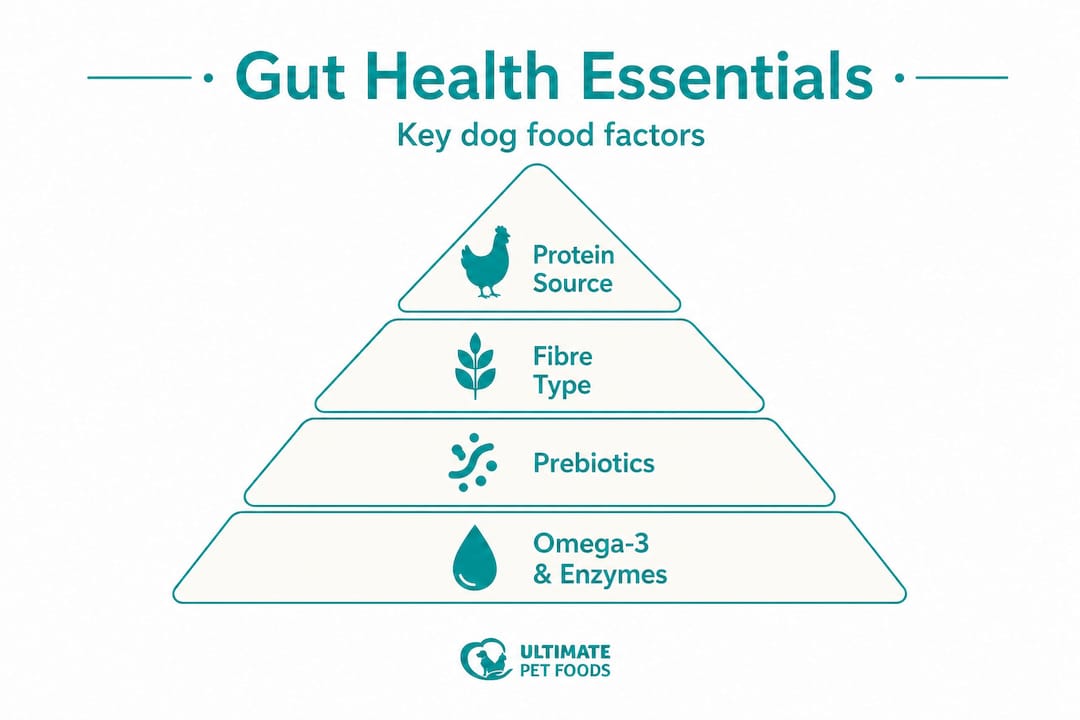
This is where the real science lives. The ingredients in your dog’s food determine how well their gut functions, how their microbiome is nourished, and whether their immune system gets the support it needs. Here are the four categories that matter most:
1. Hydrolysed protein
Hydrolysed protein is created by breaking down whole proteins into smaller fragments called peptides. This process reduces the protein’s ability to trigger an immune response, making it far gentler for dogs with food sensitivities or chronic digestive conditions. Hydrolysed protein diets are a mainstream, clinically supported first-line strategy for dogs with diet-responsive chronic enteropathy, which is a persistent inflammatory condition of the gut. If your dog has been struggling with recurring digestive flare-ups, this is worth discussing with your vet. Our hydrolyzed protein guide explains how this works in practice.
2. Fibre and prebiotics
Not all fibre is created equal. Soluble fibres, such as chicory root (inulin) and beet pulp, act as prebiotics, meaning they feed the beneficial bacteria already living in your dog’s gut. Insoluble fibres, like cellulose, add bulk and support regular bowel movements. Research into fibre and prebiotic effects on canine gut health confirms genuine benefits, but also highlights that results vary considerably depending on the specific fibre type used and the individual dog’s baseline health.
3. Postbiotics
Postbiotics are a newer area of pet nutrition research, and the early findings are encouraging. Unlike probiotics (live bacteria) or prebiotics (food for bacteria), postbiotics are the beneficial compounds produced by bacteria during fermentation. These include short-chain fatty acids and other metabolites that support the gut lining and reduce inflammation. Studies show that postbiotic ingredients can improve measurable stool consistency in dogs with loose stools in randomised controlled settings, though broader generalisation still needs more clinical data.
4. Omega-3 fatty acids and digestive enzymes
These supporting players are often overlooked. Omega-3s from fish oil reduce gut inflammation, while digestive enzymes help break down nutrients more efficiently, particularly in older dogs or those with reduced pancreatic function.
Here is a practical reference table for what to look for on ingredient labels:
| Ingredient | Gut health role | What to look for |
|---|---|---|
| Hydrolysed salmon or duck | Reduces allergenic response | Named protein source |
| Chicory root (inulin) | Prebiotic, feeds good bacteria | Listed in fibre sources |
| Beet pulp | Mixed fibre, supports stool quality | Moderate amounts |
| Fish oil | Anti-inflammatory | Omega-3 content on label |
| Postbiotic cultures | Supports gut lining | Emerging, check for research backing |
Pro Tip: When reading an ingredient list, the first five ingredients tell you the most. If a named meat source is not in the top three, the food is likely protein-light and carbohydrate-heavy, which is not ideal for gut health.
For a broader view of how formulation choices compare, our grain free pros and cons article is a helpful companion read.
Practical tips for choosing premium gut-friendly dog food
Armed with evidence about key ingredients, let’s make it practical: how do you actually choose the best food for your dog’s gut?
Here is a straightforward process we recommend:
-
Start with your dog’s specific symptoms. Loose stools, skin flare-ups, and chronic gas each point to different dietary priorities. A dog with food protein enteropathy needs hydrolysed protein. A dog with inconsistent stools may benefit most from improved fibre balance.
-
Read the ingredient list, not the marketing. Words like “natural,” “holistic,” and “grain-free” on the front of the bag mean very little without a strong ingredient list to back them up. Look for named protein sources, clearly identified fibre types, and an absence of artificial preservatives or colourings.
-
Check the guaranteed analysis. This section tells you the minimum protein and fat content, and maximum fibre and moisture. For gut health, a crude fibre content between 2% and 5% is generally a good range for most adult dogs.
-
Transition slowly. Switching foods too quickly is one of the most common causes of digestive upset. A 7 to 10 day transition, gradually increasing the new food while decreasing the old, gives your dog’s microbiome time to adjust.
-
Track and observe. Keep a simple food diary for the first four weeks. Note stool quality, energy levels, coat condition, and any digestive symptoms. This evidence is invaluable when assessing whether a food is working.
-
Consult your vet for persistent issues. If symptoms continue beyond four to six weeks on a new diet, a veterinary assessment is essential. Chronic digestive problems can have underlying causes that diet alone cannot resolve.
It is also worth knowing that prebiotics and probiotics are not universally beneficial. Depending on the specific fibre or substrate and your dog’s baseline gut health, microbiome changes can be mild or not biologically meaningful. This is why a targeted, evidence-led approach always beats a scattergun supplement strategy.
For dogs with known sensitivities, our guide on grain free for sensitive dogs offers tailored advice worth reading before you make your next food decision.
Pro Tip: If your dog has been on the same food for over a year and is showing new digestive symptoms, the food itself may not be the problem. Stress, seasonal changes, and age-related shifts in gut function can all play a role. Rule these out before switching foods.
The uncomfortable truth most owners miss about gut-friendly dog food
Having reviewed practical choices, let’s pause for a reality check: what’s the bigger lesson most people overlook?
We have spoken to many dog owners over the years, and the pattern is remarkably consistent. They switch to a grain-free food because it promises better digestion. Their dog improves slightly, or not at all. They switch again. And again. Each time, they are chasing a label rather than a formulation.
The uncomfortable truth is this: the “grain-free” badge has become a marketing shortcut that obscures what actually matters. A grain-free food loaded with cheap legume fillers, vague meat derivatives, and no meaningful fibre strategy is not a gut health food. It is just a food without grains. The difference is enormous.
What genuinely supports gut health is a precise combination of high-quality, named protein sources, appropriate fibre types, and where relevant, clinically supported ingredients like hydrolysed proteins or postbiotics. This takes more than reading the front of the packet. It requires looking at the full ingredient list, understanding what each component does, and being willing to observe your dog’s response over several weeks rather than expecting overnight results.
We also want to gently challenge the idea that one food will work for every dog. A grain-free puppy diet has very different requirements from a senior dog’s gut-supportive formula. Breed, life stage, and individual sensitivity all shape what “gut-friendly” actually means for your specific dog. If you are just getting started, our grain-free basics guide is a grounded, honest starting point.
Patience and observation are not glamorous advice. But they are the most effective tools you have.
Find your dog’s perfect gut-friendly food
If you are seeking dog food that ticks all the evidence-backed boxes, here’s where to explore your options.
At Ultimate Pet Foods, we believe every wag, bounce, and cuddle starts with great gut health. Our grain-free ranges are formulated with ingredient transparency at the core, using named fresh meat sources, carefully selected fibre types, and no unnecessary fillers. We do not hide behind buzzwords.
Whether you are exploring grain-free diet benefits for the first time, wanting to understand exactly what goes into each recipe through our grain-free ingredient guide, or ready to compare options side by side with our dry dog food comparison, we have the resources to help you make a confident, informed choice. Your dog deserves food that is gentle on the inside and strong on the outside. Let’s find it together. 🐾
Frequently asked questions
Do grain-free dog foods always improve gut health?
No, the effect depends more on the overall formulation and ingredient quality than simply removing grains. As research confirms, any gut-health benefit is often formulation and ingredient specific rather than the absence of grain per se.
Are hydrolysed proteins safe for dogs with digestive issues?
Yes, hydrolysed protein diets are clinically supported as a safe first-line strategy for dogs with chronic enteropathy. Hydrolysed protein therapeutic diets are a mainstream, evidence-aligned approach using reduced antigenicity as the core mechanism.
Which types of fibre benefit my dog’s gut?
Soluble fibres like chicory root (inulin) and beet pulp tend to offer the most prebiotic benefit, but fibre effects in canine gut health vary considerably with fibre type and may not always be substantial for every dog.
Are postbiotics proven to help dogs with sensitive digestion?
Emerging postbiotic ingredients show genuine promise, with postbiotics improving stool consistency in dogs with loose stools in randomised controlled settings. More clinical evidence is still needed before broad recommendations can be made.
Can all dogs benefit from probiotic and prebiotic supplements?
Not always. The impact can be mild or not biologically meaningful depending on the fibre type and your dog’s baseline gut health. Probiotics and prebiotics are not universally beneficial, and a targeted approach based on your dog’s individual needs will always deliver better results than a one-size-fits-all supplement strategy.