
How dog food choices influence canine behaviour
TL;DR:
- Nutrition, especially tryptophan and protein balance, significantly affects dog behaviour and mood.
- Grain-free diets are beneficial only if they are well-formulated with quality ingredients; removal of grains alone isn’t enough.
- Gradual diet transitions and professional guidance are essential for supporting canine behavioural improvements.
Many dog owners invest in premium, grain-free foods hoping to see a calmer, happier dog almost overnight. It’s a reasonable hope. But the relationship between what your dog eats and how they behave is more nuanced than simply swapping one bag of food for another. Research shows that specific nutrients, not just the absence of grains, are what truly shape mood, stress responses, and even aggression. In this guide, we walk you through the science behind diet and canine behaviour, what grain-free really means for your dog’s temperament, and how to make genuinely informed food choices.
Table of Contents
- How nutrition influences dog behaviour
- The truth about grain-free diets and behaviour
- Choosing the right food for your dog’s unique needs
- Practical strategies for promoting positive behaviour through diet
- A fresh perspective: why behaviour and dog food advice often fails owners
- Find the right grain-free food to support your dog’s behaviour
- Frequently asked questions
Key Takeaways
| Point | Details |
|---|---|
| Nutrition impacts behaviour | Nutrients like tryptophan and protein balance can influence your dog’s mood and stress response. |
| Grain-free isn’t a cure-all | Switching to grain-free alone won’t guarantee behavioural change—overall formulation quality matters most. |
| Personalised diet is best | Each dog’s behaviour responds best to a diet tailored to their age, breed, and specific needs. |
| Gradual change works best | Introduce new dog food slowly and observe both obvious and subtle behavioural shifts over time. |
How nutrition influences dog behaviour
Every mood your dog expresses, from a relaxed afternoon nap to an anxious reaction at the front door, has a biological basis. And nutrition sits right at the heart of that biology. What your dog eats directly affects the production of neurotransmitters, the chemical messengers that regulate mood, stress, and social behaviour.
One of the most important nutrients in this context is tryptophan, an amino acid found in protein-rich foods. Tryptophan is the precursor to serotonin, the neurotransmitter most associated with feelings of calm and wellbeing. When your dog’s diet is low in tryptophan relative to other amino acids, serotonin production can drop, and that can show up as irritability, anxiety, or reactive behaviour.
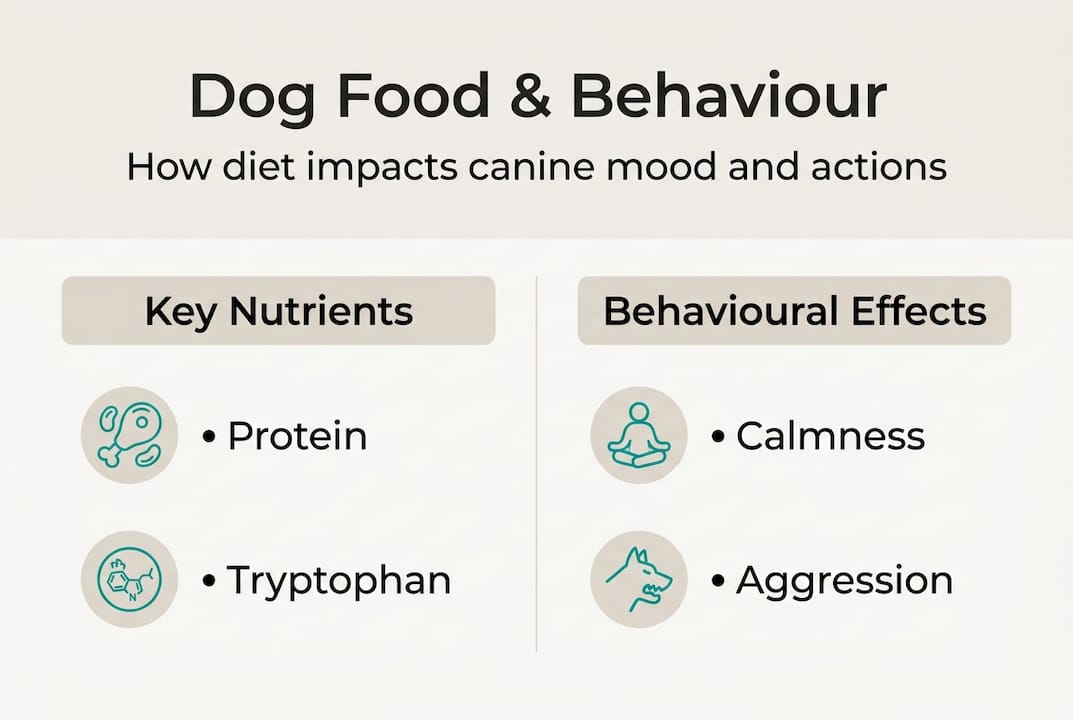
Research confirms this connection clearly. Tryptophan influences aggression, stress resistance, and overall behaviour in dogs, and dietary supplementation may reduce certain aggression types. This is not a minor footnote; it is a fundamental reason why the quality and composition of your dog’s food matters so much.
Key nutrients that influence canine behaviour include:
- Tryptophan: Supports serotonin production, promoting calm and reducing anxiety
- Protein balance: Too much or too little protein can shift mood and reactivity
- Omega-3 fatty acids: Support brain health and reduce inflammatory responses linked to stress
- Magnesium and B vitamins: Play a role in nerve function and emotional regulation
- Fibre and gut health: A healthy gut microbiome is increasingly linked to stable mood via the gut-brain axis
Observed behavioural changes when diet is properly optimised include reduced dominance aggression, lower anxiety in unfamiliar situations, and improved focus during training. These are not dramatic overnight transformations, but they are real and measurable over time.
Understanding grain free diet benefits is a useful starting point, but it is the full nutritional profile of a food that ultimately makes the difference to your dog’s temperament.
Pro Tip: Watch for subtle changes in your dog’s mood when you alter their food. Not all effects are dramatic straight away. A slightly calmer response to visitors or less restlessness at bedtime can both be meaningful signals.
The truth about grain-free diets and behaviour
Now that we understand how nutrients shape behaviour, let’s look honestly at what the grain-free trend actually delivers. The short answer is: it depends entirely on the formulation.
A well-formulated grain-free diet can be genuinely beneficial, particularly for dogs with sensitivities or allergies to common grains like wheat or barley. However, removing grains alone does not automatically improve behaviour. No direct evidence links grain-free diets to behavioural changes; what matters most is the overall nutritional balance of the food.

An 18-month study found that grain-free diets supported health outcomes as effectively as grain-inclusive diets, provided the formulation was balanced and complete. This is an important finding because it shifts the focus away from the grain question and towards ingredient quality and nutrient ratios.
Here is how grain-free and grain-inclusive foods typically compare:
| Feature | Grain-free | Grain-inclusive |
|---|---|---|
| Primary carbohydrate source | Sweet potato, peas, lentils | Wheat, rice, barley |
| Typical protein content | Higher | Moderate |
| Fibre profile | Varied, often rich | Consistent |
| Suitability for allergies | Better for grain-sensitive dogs | May trigger reactions |
| Behavioural impact | Indirect, via protein and tryptophan | Indirect, via overall formulation |
When might grain-free make a genuine difference to behaviour?
- Your dog has a confirmed grain sensitivity causing digestive discomfort, which in turn drives irritability
- The grain-free option provides a higher-quality protein source with better tryptophan availability
- Removing grains reduces inflammatory responses that may be affecting your dog’s comfort and mood
- The formulation uses whole food ingredients that support gut health and the gut-brain connection
Exploring the grain-free pros and cons honestly is worthwhile, and understanding the impacts of grains on your individual dog helps you make a decision grounded in their actual needs rather than marketing.
Grain-free is not a guaranteed behavioural fix. Formulation quality is the real deciding factor.
Choosing the right food for your dog’s unique needs
Every dog is different. A working Spaniel has different nutritional needs from a senior Labrador or a growing puppy. Matching your dog’s diet to their life stage, activity level, and individual sensitivities is where real behavioural support begins.
Research by DeNapoli et al. 2000 found that tryptophan-supplemented, low-protein diets reduced dominance aggression in dogs. This tells us that it is not just about feeding more protein; it is about feeding the right protein in the right balance.
Here is a practical guide to matching diet attributes to your dog’s needs:
| Dog profile | Recommended diet attributes | Behavioural benefit |
|---|---|---|
| Puppy (under 12 months) | High protein, DHA-rich, easily digestible | Supports brain development and social learning |
| Active or working dog | Moderate to high protein, complex carbs | Sustains energy and focus without spikes |
| Senior dog | Lower protein, joint support nutrients | Reduces discomfort-related irritability |
| Anxious or reactive dog | Tryptophan-rich, balanced protein, omega-3s | Supports serotonin and calm responses |
| Dog with food sensitivities | Hypoallergenic, limited ingredients | Reduces discomfort-driven reactive behaviour |
Signs that your dog’s current diet may be affecting their behaviour:
- Unexplained irritability or snappiness around mealtimes
- Hyperactivity that does not settle after exercise
- Poor focus during training sessions
- Restless sleep or night-time anxiety
- Digestive upset accompanied by low mood or lethargy
You can compare dry dog foods side by side to spot differences in protein sources and tryptophan-rich ingredients. If you are unsure where to start, our grain-free by life stage guide and breed-specific guide can help you narrow down the right option for your dog.
Pro Tip: Always transition foods gradually over 7 to 10 days and observe subtle behaviour shifts over 1 to 2 weeks. Sudden changes can cause digestive upset, which itself affects mood.
Practical strategies for promoting positive behaviour through diet
Knowing the science is one thing. Putting it into practice is another. Here is a clear, step-by-step approach to using diet as a genuine tool for behavioural support.
How to introduce dietary changes for behavioural support:
- Assess your dog’s current behaviour patterns and note specific concerns such as anxiety, aggression, or hyperactivity before making any changes
- Review the current food’s ingredient list and look for tryptophan-rich protein sources like turkey, chicken, or salmon
- Choose a new food based on your dog’s life stage, breed, and specific behavioural concerns, not just the grain-free label
- Transition gradually by mixing 25% new food with 75% old food for three days, then 50/50 for three days, then 75% new for three days before fully switching
- Monitor and record subtle changes in mood, sleep, reactivity, and focus over the following two weeks
- Consider tryptophan-rich additions if your vet recommends it, either through food choices or targeted supplements
Tryptophan supplementation may reduce certain aggression types in dogs, making it a worthwhile conversation to have with your vet if you are dealing with reactive or dominant behaviour.
Positive signs that your dietary changes are working:
- Calmer greetings at the door with less jumping or barking
- Improved focus and responsiveness during training
- More settled behaviour in the evenings
- Reduced resource guarding or food-related tension
- Better sleep quality and less night-time restlessness
Our calming treats for dogs can complement a balanced diet during particularly stressful periods. For a broader overview of how to feed your dog well, our grain-free feeding guide is a great next read.
Pro Tip: If concerning behaviours persist after a dietary adjustment, consult your vet or a qualified canine nutritionist. Diet is one piece of the puzzle, not the whole picture.
A fresh perspective: why behaviour and dog food advice often fails owners
Here is something we see time and again. An owner switches to a grain-free food, waits a fortnight, and feels disappointed when their dog is still reactive or anxious. They conclude that diet does not matter. But the real issue is that they followed a trend rather than a formulation.
The dog food industry has done a good job of making “grain-free” feel synonymous with “better behaved.” It is not. We have spoken with owners whose dogs showed persistent aggression until the protein source was changed and mineral balance was corrected. The grain-free label on the bag was irrelevant. What mattered was whether protein quality was actually supporting tryptophan availability and serotonin production.
Our honest view is this: stop chasing labels and start reading ingredient lists. A grain-free food made with poor-quality protein and cheap fillers will not calm your dog. A thoughtfully formulated food, grain-free or otherwise, with high-quality protein and the right nutrient balance, genuinely can. Seek professional guidance, experiment carefully, and trust the process over the packaging.
Find the right grain-free food to support your dog’s behaviour
You now have the knowledge to make a genuinely informed decision about your dog’s diet and how it connects to their behaviour and wellbeing. The next step is finding the right food to put that knowledge into action.
At Ultimate Pet Foods, we offer a range of premium, natural grain-free options designed with nutritional balance at their core. Use our compare grain-free options tool to find the right formulation for your dog’s breed, age, and behavioural needs. Explore our grain-free benefits page for a deeper look at what sets quality apart. And if you are navigating different life stages, our life stage nutrition guide helps you match the right food to where your dog is right now. 🐾
Frequently asked questions
Can food really change my dog’s behaviour?
Nutrients like tryptophan and protein balance can influence mood and aggression in some dogs, but immediate drastic changes are rare. Consistent, well-formulated feeding over several weeks is where the real difference tends to show.
Is a grain-free diet guaranteed to improve behaviour?
No. Research finds no direct behavioural link to grain removal alone; a balanced formulation with quality protein sources is far more important than simply cutting out grains.
How long does it take to see improvement after a food change?
Behavioural improvements may take 1 to 2 weeks to become noticeable, so observe for subtle changes and transition gradually to avoid digestive disruption masking any progress.
Are supplements like tryptophan safe for all dogs?
Tryptophan supplements may help with certain aggressive behaviours, but you should always consult your vet before adding new nutrients to your dog’s diet to ensure safety and correct dosing.