
Dog food with real ingredients: your 2026 UK guide
TL;DR:
- Dog food with real ingredients features named, traceable proteins like chicken or fish, not vague terms. Owners often mistake marketing claims for regulated standards, but only “complete” and “complementary” are legally regulated labels. Proper label reading involves checking ingredient percentages, natural preservatives, and digestibility rather than artwork or vague claims.
Dog food with real ingredients is defined as food where named natural components, particularly high-quality animal proteins, appear prominently in the ingredient list and are backed by transparent labelling that reflects genuine nutritional value. Most dog owners scan a bag and assume “natural” means something legally binding. It does not. In the UK, terms like “natural,” “premium,” and “holistic” carry no legal definition in pet food labelling. Only “complete” and “complementary” hold regulated status. Understanding this distinction is the first step to feeding your dog well, every single day, not just occasionally. At Ultimatepetfoods, every recipe starts with freshly prepared meat or fish, gently cooked at 82°C to lock in flavour and nutrients, using human-grade ingredients your dog’s body can actually use.
What does dog food with real ingredients actually mean?
Real ingredients, in the industry sense, refers to whole food components that are named, traceable, and nutritionally meaningful. Think “fresh chicken,” “salmon,” or “sweet potato,” not vague catch-all terms like “meat and animal derivatives” or “cereals.” The difference matters because named ingredients tell you what your dog is actually eating. Vague terms can legally cover a rotating mix of whatever is cheapest at the time of production.
The term most nutritionists use is “whole food nutrition” or “named ingredient formulation.” Both describe the same principle: every component in the recipe is identifiable, consistent, and chosen for a specific nutritional purpose. When you read dog food ingredients with this lens, the difference between a quality recipe and a filler-heavy one becomes obvious within seconds.
Ultimatepetfoods recipes are built around freshly prepared meat and fish as the primary protein source. The recipes are complete and balanced, meaning they meet all nutritional requirements for daily feeding across all breeds and life stages. That is not a marketing claim. It is a regulated designation with real meaning.
How to read UK dog food labels to identify real ingredients
UK labelling rules set specific thresholds that determine what a manufacturer can legally claim on pack. A product named “chicken dog food” must contain at least 26% chicken. A product labelled “rich in chicken” requires a minimum of 14%, and “with chicken” requires just 4%. That gap is enormous. A food with 4% chicken can legally feature a chicken image on the front of the bag.
Here is what each label term means in practice:
- “Chicken dog food” or “chicken recipe”: Minimum 26% chicken. This is the threshold where chicken genuinely drives the nutritional profile.
- “Rich in chicken”: Minimum 14%. Chicken is a meaningful ingredient but not necessarily the dominant one.
- “With chicken”: Minimum 4%. Chicken is present but plays a minor role.
- “Chicken flavour”: No minimum percentage required. The food may contain no actual chicken at all.
- “Complete”: Legally regulated. The food meets all daily nutritional requirements on its own.
- “Complementary”: Legally regulated. The food must be fed alongside other foods to meet nutritional needs.
Moisture content also affects how you read a label. Moisture above 14% must be declared on UK pet food labels. Fresh meat contains a high proportion of water, so it weighs more before cooking. This pushes it higher up the ingredient list by weight, even if it delivers less protein than a dried meat meal listed lower down.
Pro Tip: Always cross-reference the ingredient list with the analytical constituents panel. A food showing 28% crude protein with named animal protein first is a strong signal of quality. One showing 28% protein with “meat and animal derivatives” first may be drawing that protein from far less digestible sources.
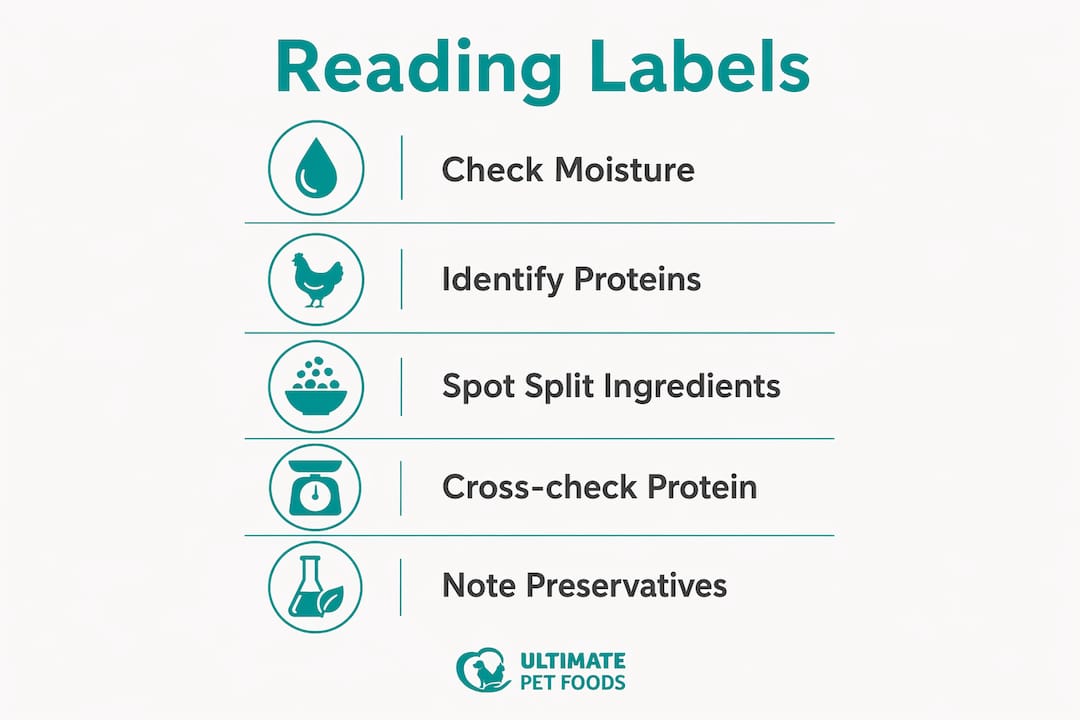
Watch out for ingredient splitting. This tactic involves listing the same ingredient under several different names, for example “maize,” “maize flour,” and “maize gluten,” to push each entry further down the list. Combined, they may outweigh the named protein at the top. It is a legal practice, but it obscures the true composition of the food.
Key natural ingredients to look for in quality dog food
The best natural dog foods share a recognisable set of ingredients. Knowing what to look for makes label reading faster and more reliable.
Named animal proteins are the foundation of any quality recipe. Fresh chicken, dried chicken meal, salmon, and white fish each bring different nutritional profiles. Dried chicken meal is more protein-dense than fresh chicken because the moisture has been removed. Healthy complete dry dog foods for adults generally contain mid-20% protein levels or higher on a dry-matter basis, with a named animal protein first in the ingredient list.
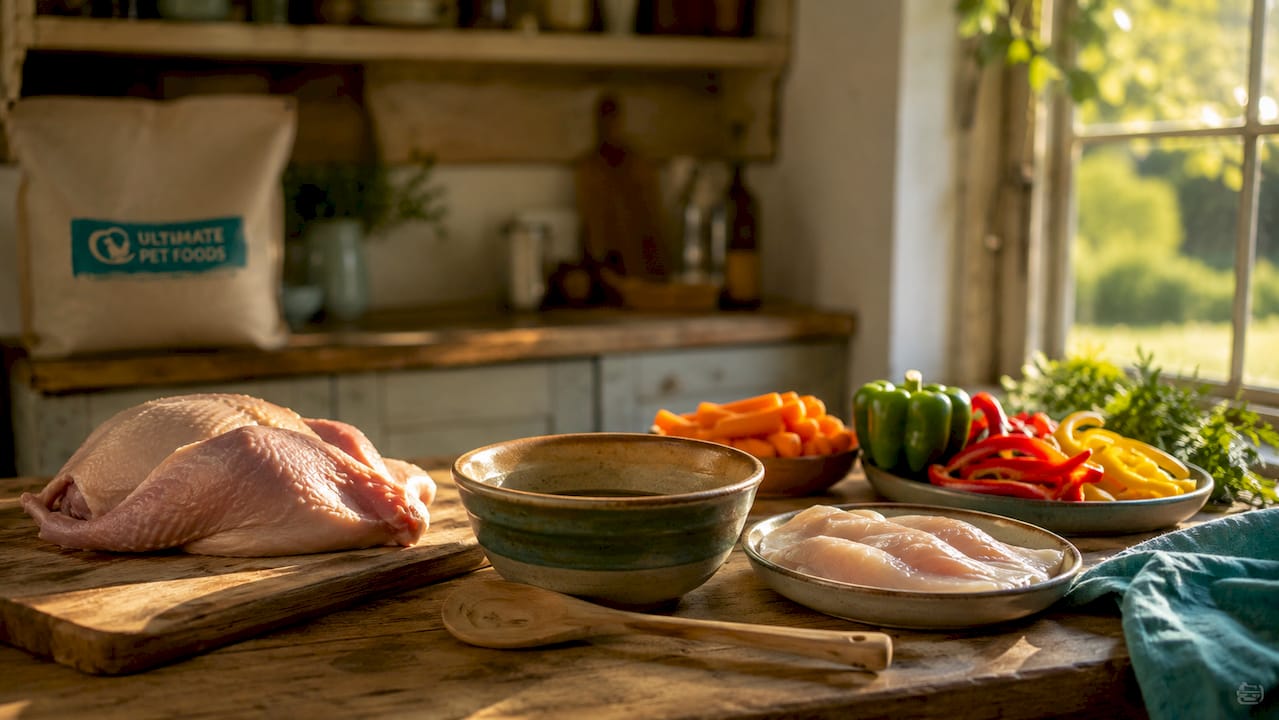
Wholesome carbohydrate and vegetable sources include sweet potato, brown rice, and peas. These provide sustained energy, dietary fibre, and micronutrients. Sweet potato, in particular, offers beta-carotene and supports digestive regularity. These are the carbohydrate sources you want to see. Contrast them with “cereals,” which is a vague term that can cover anything from oats to heavily processed grain fractions.
Natural preservatives signal manufacturer intent. Tocopherols (vitamin E) are the preferred choice over artificial preservatives such as BHA and BHT. Seeing tocopherols on a label tells you the brand has chosen a more considered approach to shelf stability. Artificial preservatives are associated with lower-quality formulations and are increasingly being phased out by quality-focused producers.
Prebiotics, specifically MOS (mannan-oligosaccharides) and FOS (fructo-oligosaccharides), support gut health by feeding beneficial bacteria in the digestive tract. Ultimatepetfoods adds both MOS and FOS to its recipes. Every wag, bounce, and cuddle starts with a healthy gut, and these two ingredients are a quiet but meaningful part of that.
Beneficial fats such as salmon oil and chicken fat provide omega-3 and omega-6 fatty acids. These support skin condition, coat quality, and cognitive function. Named fat sources are preferable to “animal fat,” which, like “meat and animal derivatives,” can vary batch to batch.
How moisture and processing affect what you see on the label
Fresh meat ingredients are listed by weight before cooking. Fresh chicken may appear first on the ingredient list but actually deliver less protein than dried chicken meal listed further down. This is not deceptive on its own. It is simply a consequence of how weight-based listing works. The key is knowing how to interpret it.
| Ingredient type | Moisture content | Protein density | Position on label |
|---|---|---|---|
| Fresh chicken | High (approx. 70%) | Lower per gram | Often listed first |
| Dried chicken meal | Low (approx. 10%) | Higher per gram | Often listed lower |
| “Meat and animal derivatives” | Variable | Unpredictable | Can appear anywhere |
| Named fish (e.g. salmon) | Moderate | Good, with omega-3 | Ideally in top three |
The table above shows why a food with fresh chicken first is not automatically superior to one with dried chicken meal second. Both can deliver excellent nutrition. The question is whether the analytical constituents panel confirms a strong protein percentage overall.
High crude protein alone does not guarantee quality. Source digestibility matters just as much. Feather meal, for example, is technically high in protein but poorly digestible. Pet nutritionists emphasise that bioavailability, meaning how much of a nutrient the body can actually absorb and use, is as important as the percentage on the label.
Pro Tip: If a food lists “maize,” “maize flour,” and “maize starch” separately, add them together mentally. If their combined weight would likely exceed the named protein, the food is grain-heavy regardless of what appears first.
How to choose natural dog food that supports your dog’s health
Choosing the best all natural dog food for your dog comes down to a clear, repeatable checklist. Use this every time you evaluate a new product.
- Check the first ingredient. Named animal protein (fresh chicken, salmon, turkey, etc.) should lead the list. If “cereals” or “meat and animal derivatives” appears first, move on.
- Verify the label designation. Only buy food labelled “complete” for everyday feeding. “Complementary” foods are not designed to be fed alone.
- Read the analytical constituents. Look for mid-20% or higher crude protein on a dry-matter basis for adult dogs. Cross-reference this with the ingredient list to confirm the protein comes from named animal sources.
- Look for natural preservatives. Tocopherols signal quality. BHA, BHT, and ethoxyquin are worth avoiding where alternatives exist.
- Check for prebiotics. MOS and FOS support digestive health and are a marker of a thoughtfully formulated recipe.
- Ignore unregulated marketing terms. “Natural,” “premium,” and “holistic” carry no legal definition in UK pet food. Focus on the ingredient list and analytical guarantees instead.
- Consider functional health needs. For dogs with specific requirements, Ultimatepetfoods offers the Ultimate+ Functional Health range, which uses hydrolysed proteins for targeted everyday support. This includes Digestive Care, Skin & Coat Care, Weight Control & Joint Care, Dental Care, and Healthy Living formulas. For dogs with sensitive stomachs, hydrolysed dog food provides gentle, targeted nutrition without the need for a prescription.
Natural dog food for puppies follows the same principles, with one addition: the food must be labelled suitable for puppies or “all life stages.” Puppies have higher protein and calcium requirements than adult dogs, so a food formulated only for adults will not meet their needs long term.
Key takeaways
Dog food with real ingredients is identified through named animal proteins, transparent labelling, regulated “complete” status, and natural preservatives rather than marketing terms.
| Point | Details |
|---|---|
| Named proteins matter most | Look for specific animal proteins (chicken, salmon) listed first, not vague “meat and animal derivatives.” |
| “Complete” is the only label that counts | Only foods labelled “complete” are suitable for daily feeding without supplementation. |
| Moisture distorts ingredient rankings | Fresh meat appears high due to water weight; cross-check with the analytical constituents panel. |
| Ingredient splitting hides fillers | Separate listings of the same ingredient can mask its true proportion in the recipe. |
| Prebiotics signal quality formulation | MOS and FOS support gut health and indicate a recipe built with digestive wellbeing in mind. |
Why I think most dog owners are reading labels backwards
After years of working with dog nutrition, the pattern I see most often is this: owners focus on the front of the bag and ignore the back. A large chicken image, the word “natural,” and a brown kraft paper design are enough to convince most people the food is good. None of those things are regulated. None of them tell you anything meaningful about what is actually inside.
The back of the bag is where the truth lives. The ingredient list and the analytical constituents panel together give you everything you need to make an informed decision. I have seen foods with beautiful packaging and vague ingredient lists sitting next to plainly labelled foods with named proteins, declared percentages, and honest analytical data. The second type is almost always the better choice.
What I find genuinely encouraging is the shift towards transparency we are seeing from quality producers. Ultimatepetfoods publishes clear ingredient information, uses freshly prepared meat cooked at 82°C, and adds MOS and FOS prebiotics to support gut health from the inside out. The natural dog food ingredients used in these recipes are chosen for nutritional purpose, not marketing appeal.
The emerging use of hydrolysed proteins in functional ranges is also worth paying attention to. Hydrolysed proteins are broken down into smaller fragments, making them easier to digest and less likely to trigger immune responses in sensitive dogs. This is not a trend. It is applied nutritional science, and it belongs in everyday feeding for dogs that need it.
Feed your dog the same quality of food you would expect for yourself. Read the back of the bag. Trust the ingredient list over the artwork.
— Glenn
Real ingredients, real results: Ultimatepetfoods for everyday feeding
Ultimatepetfoods recipes are built around freshly prepared meat and fish, gently cooked at 82°C to preserve flavour and nutritional integrity. Every recipe uses human-grade ingredients, is labelled complete and balanced, and is suitable for daily feeding across all breeds and life stages.
The full range includes added MOS and FOS prebiotics to support healthy digestion, and the Ultimate+ Functional Health range offers targeted everyday support through hydrolysed proteins for dogs with specific needs. Whether you are looking for a high-meat chicken recipe for everyday feeding or exploring the benefits of a grain-free diet for your dog, Ultimatepetfoods offers a recipe built on real, named ingredients with nothing to hide.
FAQ
What does “complete” mean on a dog food label?
“Complete” is a legally regulated term in the UK, meaning the food meets all of a dog’s daily nutritional requirements on its own. A food labelled “complementary” must be fed alongside other foods.
How much chicken must a food contain to be called “chicken dog food”?
UK labelling rules require a minimum of 26% chicken for a product to be named “chicken dog food.” A product labelled “with chicken” requires only 4%.
Why does fresh chicken sometimes appear first but deliver less protein?
Fresh chicken is listed by weight before cooking, and it contains a high proportion of water. After cooking, its protein contribution is lower than dried chicken meal, which is already moisture-reduced and more protein-dense.
Are “natural” and “holistic” regulated terms on UK dog food labels?
No. “Natural,” “premium,” and “holistic” carry no legal definition in UK pet food labelling. Only “complete” and “complementary” are regulated category claims.
What are MOS and FOS, and why do they matter?
MOS (mannan-oligosaccharides) and FOS (fructo-oligosaccharides) are prebiotics that feed beneficial bacteria in your dog’s gut. Their inclusion in a recipe indicates a formulation designed to support long-term digestive health, not just short-term palatability.