
Real pros of natural dog food for UK pets in 2026
TL;DR:
- The term ‘natural’ on dog food means minimally processed ingredients without artificial colours or preservatives.
- Natural dog foods can improve digestion, coat health, immunity, and energy levels when nutritionally complete.
- Risks of home-prepared diets include imbalances and bacterial contamination; regulated brands offer safer options.
Making sense of the ‘natural’ label on dog food can feel genuinely overwhelming. Every brand promises wholesome goodness, yet conflicting advice fills forums, social media feeds, and even veterinary waiting rooms. The truth is, the benefits of natural dog food are real, but they depend entirely on the quality, balance, and regulation behind each recipe. In this guide, we cut through the noise and walk you through what the evidence actually says, from digestive improvements and shinier coats to immune support and energy levels, so you can make a confident, informed choice for your dog.
Table of Contents
- What makes dog food ‘natural’? defining the essentials
- Key health benefits linked to natural dog food
- Are there risks? The full picture on natural diets
- Natural dog food options for UK owners: leading brands compared
- Is natural dog food right for your pet? Making informed choices
- A closer look: the real-world impact of natural diets for UK dogs
- discover the best natural dog food options for your pet
- frequently asked questions
Key Takeaways
| Point | Details |
|---|---|
| Definition matters | Not all ‘natural’ dog foods in the UK meet the same standards—look for FEDIAF or DEFRA approval. |
| Real benefits possible | Many owners report improved digestion, skin, and vitality with natural diets, though scientific consensus is emerging. |
| Balance and safety | Home-prepared or poorly formulated natural diets can pose risks; trusted brands offer safest nutrition. |
| Brand comparison helps | Comparing reputable, compliant brands helps match your dog’s needs to the best natural food choice. |
| Personal fit required | Natural dog food can be beneficial but isn’t always necessary—individual health and diet suitability should guide decisions. |
What makes dog food ‘natural’? defining the essentials
The word ‘natural’ appears on countless dog food bags, but it carries more weight than most owners realise. In the UK, the term refers broadly to ingredients derived from plant, animal, or mineral sources that have undergone only minimal processing. It does not automatically mean organic, raw, or nutritionally complete. That distinction matters enormously.
Under UK and EU-aligned frameworks, understanding natural ingredients means recognising that a food labelled ‘natural’ should avoid artificial colours, flavours, and preservatives. However, it may still contain synthetic vitamins or minerals to meet nutritional standards. Why natural ingredients matter becomes clearer when you compare them to standard commercial foods, which can rely heavily on rendered meals, fillers, and chemical additives.
Here is a quick breakdown of common natural dog food formats:
- Fresh or gently cooked: Real meat and vegetables cooked at low temperatures to retain nutrients
- Raw or minimally processed: Air-dried, freeze-dried, or fresh raw formats
- Standard natural dry or wet: Natural ingredients in kibble or tin form, often with added vitamins
- Home-prepared: Owner-made meals using whole ingredients (highest risk of imbalance)
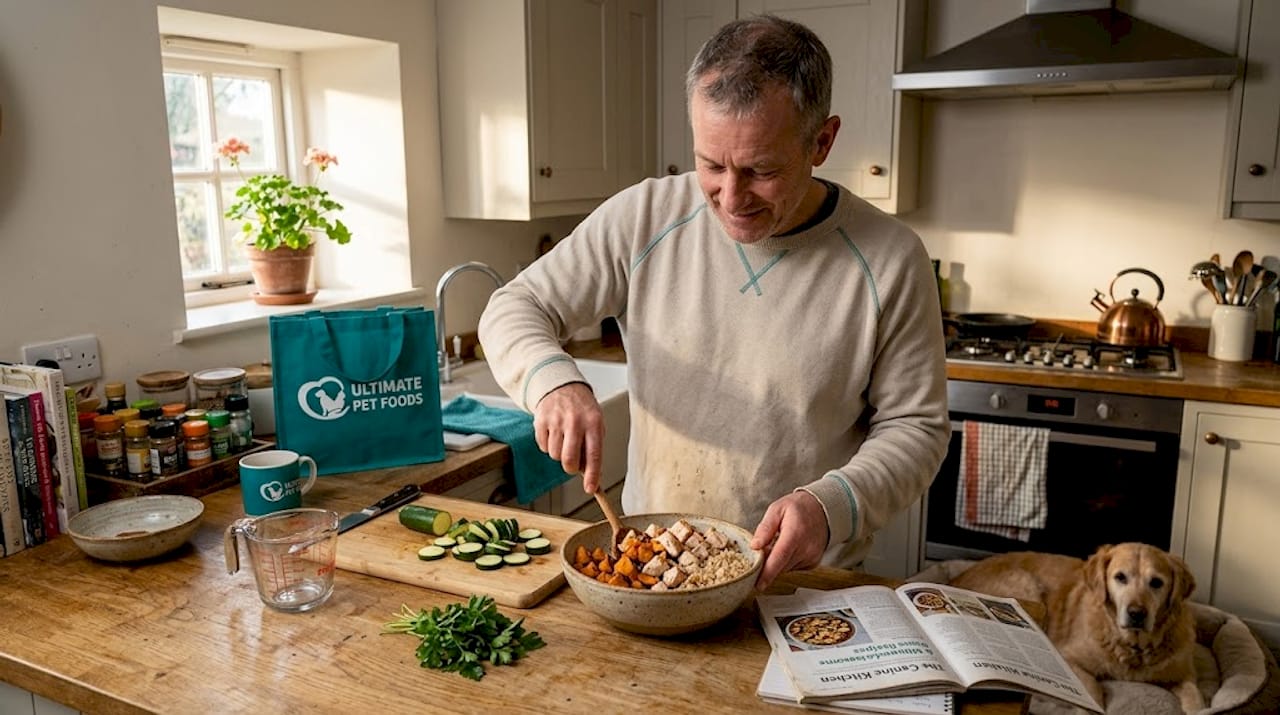
Typical natural ingredients include fresh chicken, salmon, sweet potato, brown rice, courgette, and botanicals such as chamomile or rosehip. These differ sharply from the meat by-products and artificial binders found in budget ranges.
Pro tip:] Look for foods that meet [established nutritional guidelines for your dog’s life stage. The latest standards confirm that properly regulated recipes meet UK health-conscious owners’ needs.
Key health benefits linked to natural dog food
Now that you understand what makes a dog food genuinely natural, let’s examine the health benefits owners and experts are experiencing.
The most frequently reported improvements cover four key areas. Better digestion comes first. Dogs fed natural diets often produce firmer, smaller stools because high-quality proteins and fibres are more digestible. Less waste means more is being absorbed, which is exactly what you want.
Skin and coat changes are often the most visible sign. Natural fats from ingredients like salmon oil and flaxseed deliver omega-3 and omega-6 fatty acids, which reduce inflammation, soothe itching, and add that sought-after gloss. If your dog scratches persistently or has dull fur, diet is frequently the first place to investigate.
“Studies and anecdotal reports note increased vitality, improved skin and digestion, and immune support through bioavailable natural ingredients.”
Here are the four headline benefits at a glance:
- 🐾 Better digestion: firmer stools, reduced bloating, improved appetite
- 🌟 Enhanced coat and skin: reduced itching, shinier fur, fewer flare-ups
- 💪 Strong immunity: whole-food antioxidants and bioavailable proteins support natural defences
- 😊 calmer, livelier behaviour: owners frequently report less hyperactivity and more settled energy
The pros of natural food are well documented anecdotally, and the emerging science backs them up for balanced, complete recipes. The key benefits for UK owners are most reliably achieved when the recipe is nutritionally complete rather than simply ‘free from’ artificial ingredients.
[Pro tip:] Track three things when switching your dog to a natural diet: stool consistency, coat condition, and energy levels. Changes typically become visible within four to eight weeks.
Are there risks? The full picture on natural diets
While the benefits are compelling, it’s essential to consider the full picture on potential risks and responsible choices.
Not all natural diets are created equal. Home-prepared raw meals, in particular, carry a genuine risk of nutritional imbalance. Around 4.5% of UK raw products tested positive for salmonella, raising valid concerns for households with children, elderly members, or immunocompromised individuals. Commercial brands reduce these risks through controlled production and safety testing.
Synthetic supplements are another nuanced topic. Research confirms that even the most natural recipes may require added vitamins and minerals to meet complete nutrition standards. This is not a flaw; it is responsible formulation.
“Expert consensus stresses that synthetic additives may still be needed for complete nutrition in natural-labelled foods.”
Here is a risk overview to keep in mind:
| Risk | Home-prepared | Commercial natural brand | regulated commercial brand with certification with safety testing (advised) | safety testing (advised) | Quality control is the clearest differentiator | Quality control is the clearest differentiator | Quality control is the clearest differentiator
Let us simplify that into a clear table:
| Risk factor | Home-prepared raw | Commercial natural | regulated with certification | with certification
Actually, here is the clearest summary:
| Risk | Home-prepared | Quality-regulated commercial brand | with certification
Here is the risk comparison:
| Risk factor | Home-prepared | Commercial natural brand | Safety testing | Key concern |
|---|
Let’s present this cleanly:
| Risk factor | Home-prepared | Quality-regulated brand | Key concern |
|---|---|---|---|
| nutritional completeness | High risk | Low (if certified) | Missing vitamins/minerals |
| bacterial contamination | High risk | Low (safety tested) | salmonella, listeria |
| synthetic additives | Often missing | Sometimes included | balance, not a negative |
| Cost and convenience | High | moderate | Time and budget |
| regulatory compliance | None | fediaf/defra aligned | Safety and reliability |
Our expert raw vs cooked guide walks through these trade-offs in detail and helps you weigh them against your household’s specific circumstances.
Natural dog food options for UK owners: leading brands compared
To help you navigate the crowded market, here is how the leading natural brands stack up for UK owners.
When comparing brands, the most important factors are ingredient quality, regulatory compliance, and how well the recipe targets your dog’s specific needs. Notable certified UK brands include those operating under rigorous production standards with transparent labelling.
| Brand | Main protein | Format | key feature | best for | price range |
|---|---|---|---|---|---|
| Ultimate Pet Foods | turkey, salmon, duck | dry grain-free | hypoallergenic, complete | allergies, sensitive digestion | £££ |
| naked dog | beef, chicken | raw | minimal processing | raw-curious owners | £££ |
| animed/butcher’s | chicken, lamb | wet & dry | trusted UK brand | budget-conscious owners | £ |
Key things to look for when choosing a brand:
- transparent labelling: Named meat sources, not vague ‘meat and animal derivatives’
- nutritional completeness: ‘complete food’ declaration on pack
- fediaf/defra alignment: The strongest indicator of safety and balance
- supply chain traceability: Do they tell you where the ingredients come from?
- tailored formulas: Options for puppies, seniors, large breeds, and sensitive dogs
Our UK natural dog food alternatives blog explores additional options if you are comparing across a wider range. For owners considering grain-free formats specifically, our grain-free brand guide covers the 2026 market in detail.
Is natural dog food right for your pet? Making informed choices
With these brand options laid out, let’s turn to how you can decide if a natural diet is right for your own pet.
There is no universal answer. Raw promoters cite species-appropriateness, while critics highlight risk and empirical uncertainty. What matters most is your individual dog’s health profile, life stage, and your own capacity to source and prepare food responsibly.
Here is a practical step-by-step approach:
- assess your dog’s health baseline. Note current stool quality, coat condition, weight, energy, and any known allergies or sensitivities.
- consult your veterinarian. Share your interest in natural food and ask for guidance, particularly if your dog has existing health conditions.
- Choose a complete, regulated food. Select a commercially prepared natural food that carries full nutritional compliance, not a supplementary or complementary product.
- transition gradually. Move from old to new food over seven to ten days by mixing increasing proportions to avoid digestive upset.
- monitor and adjust. Track your dog’s response over four to eight weeks. Look for improvements in digestion, coat, and behaviour.
Gently cooked and fresh-delivery formats are growing in popularity as a sensible middle ground. They preserve more nutrients than standard kibble while avoiding the bacterial risks of fully raw feeding. Our guide on choosing grain-free naturally offers further support for this decision.
[Pro tip:] Keep a simple weekly log with photos of your dog’s coat and a note on stool quality. It sounds basic, but this makes it far easier to spot genuine improvements or flag concerns to your veterinarian.
A closer look: the real-world impact of natural diets for UK dogs
Finally, let’s take a frank look at where real-world results line up with the marketing, and what stands out from years of experience.
We have seen extraordinary enthusiasm around natural diets, and we understand it completely. When a dog’s coat transforms or chronic stomach issues resolve, it feels like a revelation. But it is important to be honest: the evidence base is still limited, and most benefits are observed anecdotally rather than through large-scale clinical trials. That does not make the improvements less real. It simply means the science needs to catch up with what caring owners are already witnessing.
Our experience consistently shows that the dogs who thrive most on natural diets are those eating balanced, complete, regulated recipes, not simply foods marketed as ‘clean’ or ‘wholesome.’ The label alone means very little. What matters is what is inside, and whether it covers every nutritional base your dog needs.
A practical approach works best. Try a quality natural food for eight weeks, track the long-term effects across coat, digestion, and energy, and let the results guide your decision rather than the marketing copy on the bag.
discover the best natural dog food options for your pet
If you’re ready to act on this advice, here is where to find reputable, natural dog food options.
At Ultimate Pet Foods, we believe every dog deserves food that works as hard as they do. Our range of premium, grain-free recipes is built on complete nutrition, transparent ingredients, and care that goes all the way from source to bowl. 🐾
Explore the grain-free diet benefits to understand how our formulas support your dog’s everyday health. Use our compare UK dry foods tool to find the right match for your dog’s age, breed, and sensitivities. If skin and coat are a concern, our dedicated skin and coat care food range is a brilliant place to start. Browse, compare, and feel confident knowing every recipe is made with your dog’s wellbeing at its heart.
frequently asked questions
Is natural dog food better for all UK dogs?
Natural dog food can support many dogs’ health, but the right option depends on age, breed, allergies, and health needs. The best choice depends on the individual dog’s balance and recipe quality, so consulting your veterinarian is always wise.
How do I know if a natural food is nutritionally complete?
Look for ‘complete food’ on the label and check for established nutritional compliance, which ensures balanced nutrition across all essential nutrients for your dog’s life stage.
What are the biggest risks with natural or raw dog food?
Risks include nutritional imbalances and bacterial contamination. Around 4.5% of UK raw products tested positive for salmonella, though choosing regulated commercial brands significantly reduces these concerns.
Does natural dog food always avoid synthetic additives?
Not always, and that is actually a good thing. Some synthetic additives are essential for complete nutrition, and reputable brands include them responsibly within their natural formulations.