
Dog food and behaviour changes: what owners must know
TL;DR:
- Dog diet significantly influences their mood, behavior, and ability to learn through the gut-brain axis.
- Gradually transitioning to high-quality, nutrient-dense foods over 7 to 14 days supports emotional stability and reduces anxiety.
What your dog eats directly determines how they feel, think, and behave, making diet one of the most underestimated influences on canine temperament. The connection between dog food and behaviour changes is not anecdotal. It is grounded in the gut-brain axis, a bidirectional communication network linking the digestive system to the central nervous system via metabolic, neural, and immune signals. When that system is well-nourished, your dog is calmer, more focused, and easier to train. When it is disrupted, even briefly, the effects show up in ways that look remarkably like a training problem or a personality shift. Understanding this link is the first step toward doing something about it.
How dog food and behaviour changes are connected
The relationship between diet and canine behaviour runs deeper than most owners realise. Your dog’s gut houses trillions of microorganisms that produce neurotransmitters, including serotonin and GABA, the chemical messengers responsible for mood regulation, impulse control, and stress response. When the gut microbiome is balanced and well-fed, these neurotransmitters are produced consistently, supporting emotional stability.

A poor-quality diet with excess fermentable carbohydrates and inadequate omega-3 fatty acids raises your dog’s physiological stress baseline, impairing emotional regulation before any obvious physical symptoms appear. That means a dog eating a low-grade, grain-heavy food may appear reactive, distracted, or difficult to settle, not because of a training gap, but because their nervous system is under constant nutritional stress.
The gut-brain axis in dogs functions bidirectionally through metabolic, neural, and immune pathways, so diet-induced gut changes directly influence behaviour. This is why switching to a higher-quality, nutrient-dense food often produces noticeable improvements in temperament within weeks, not months.
How sudden food changes affect your dog’s mood
Abrupt diet switches are one of the most common and avoidable causes of behavioural disruption in dogs. Rapid dietary changes can trigger restlessness, irritability, and anxiety within a 24 to 96 hour window. That is not a coincidence. It reflects a genuine physiological cascade.
When you change your dog’s food overnight, the existing digestive enzymes are mismatched to the new food’s protein and fat profile. At the same time, the microbial populations in the gut, which are highly food-specific, begin to shift. This disruption triggers a stress hormone response that your dog experiences as genuine anxiety. The gut microbiome instability that follows affects neurochemical signalling, which is why you may notice reduced focus, clinginess, or uncharacteristic snappiness alongside loose stools.
The behavioural signs to watch for during a food transition include:
- Increased restlessness or pacing, particularly in the evening
- Reduced engagement during training or play
- Heightened reactivity to sounds or movement
- Loose or inconsistent stools, which indicate ongoing gut instability
- Reduced appetite or selective eating behaviour
Pro Tip: A gradual transition over 7 to 14 days, starting with 25% new food and increasing by roughly 10 to 15% every two days, gives the gut microbiome time to adapt without triggering a stress response. Dogs with sensitive digestion benefit most from the slower end of that range.
Skipping this transition is one of the most frequent mistakes we see. Transitions without gradual change trigger anxiety and restless behaviours that owners often attribute to the new food itself, when the real issue is the speed of the switch.
Which nutrients in dog food shape behaviour?
The impact of food on dogs goes well beyond calories. Specific nutrients act directly on the nervous system, and their presence or absence in your dog’s daily diet has measurable effects on temperament and learning.
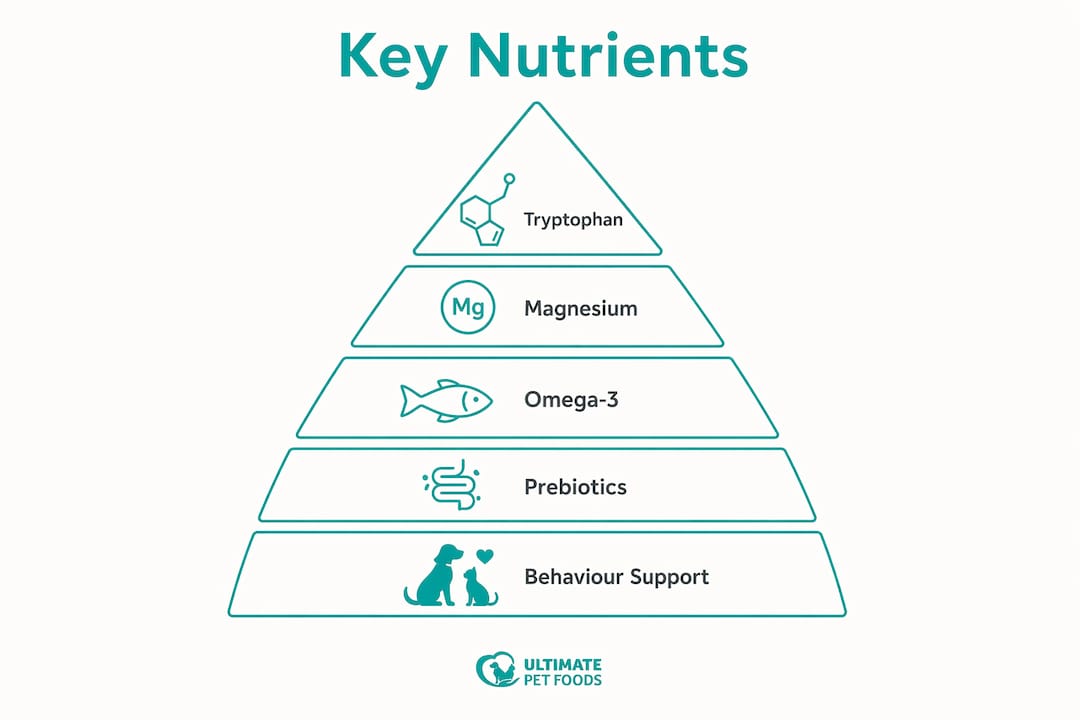
Tryptophan is an amino acid found in quality animal proteins. It is the precursor to serotonin, the neurotransmitter most associated with impulse control and emotional stability. Tryptophan-enriched diets are linked to improved emotional stability in reactive dogs, which is why protein source and quality matter far beyond muscle-building.
Magnesium modulates excitatory nervous signalling and acts as a natural stress buffer. Chronic stress depletes magnesium reserves, creating a cycle where a stressed dog becomes increasingly prone to nervous system instability. Foods that include magnesium-rich ingredients, such as fish, seeds, and leafy vegetables, help break that cycle.
Omega-3 fatty acids, particularly EPA and DHA from marine sources, support neuronal membrane fluidity and reduce neuroinflammation. A dog whose diet is low in omega-3s may show increased reactivity and slower learning, because the neurons responsible for processing and responding to stimuli are less efficient.
Prebiotics, specifically MOS (mannan-oligosaccharides) and FOS (fructo-oligosaccharides), feed the beneficial bacteria in the gut that produce calming neurotransmitters. Distinct gut microbiota compositions correlate directly with anxiety and aggression profiles in dogs. Feeding prebiotics consistently is one of the most practical ways to support a calmer, more settled temperament.
| Nutrient | Primary behavioural role | Key food sources |
|---|---|---|
| Tryptophan | Serotonin production, impulse control | Chicken, turkey, fish, eggs |
| Magnesium | Stress buffering, nervous system stability | Fish, pumpkin seeds, leafy greens |
| Omega-3 (EPA/DHA) | Neuronal function, reduced reactivity | Salmon, mackerel, fish oil |
| MOS and FOS prebiotics | Gut microbiome balance, neurotransmitter support | Added to quality complete kibble |
Pro Tip: When reading a dog food label, look for named meat or fish as the first ingredient, and check for added MOS and FOS prebiotics. These two markers alone tell you a great deal about whether a food will support your dog’s gut-brain health.
Is it diet or a medical issue? How to tell the difference
Not every behavioural change traces back to nutrition and dog behaviour. Some shifts signal something more urgent, and knowing the difference protects your dog’s health.
Appetite changes lasting more than 24 to 48 hours require veterinary assessment to rule out gastrointestinal inflammation, dental pain, or endocrine disorders such as hypothyroidism or Addison’s disease. A dog that suddenly refuses food, or conversely becomes ravenous, is communicating something that diet alone cannot explain.
One of the most common and costly misunderstandings we encounter is owners interpreting pain-driven behaviour as defiance. Physical pain manifests as lethargy, withdrawal, and irritability well before obvious physical symptoms appear. A dog that snaps when touched near the hips, or that suddenly refuses stairs, is not being stubborn. They are telling you something hurts.
The following signs warrant a vet visit rather than a diet change:
- Sudden, unexplained aggression with no dietary change
- Persistent lethargy lasting more than two days
- Appetite loss or dramatic increase lasting over 48 hours
- Excessive thirst alongside behavioural changes
- Disorientation, circling, or seizure-like episodes
Dogs communicate physical discomfort through behavioural shifts well before obvious symptoms emerge, so behaviour may mask underlying health issues. The rule of thumb is straightforward: if the behavioural change is sudden, severe, or accompanied by physical symptoms, see a vet first. If it is gradual and correlates with a recent food change, diet is the more likely cause.
How to manage your dog’s diet for better behaviour
Practical nutrition management is where the science becomes something you can act on today. Here is a step-by-step approach that supports stable behaviour and long-term wellbeing.
-
Audit your current food. Check the ingredient list for named meat or fish as the first ingredient. If you see cereals, maize, or wheat listed first, the protein quality is likely insufficient to support consistent neurotransmitter production.
-
Plan a gradual transition. Move to a new food over 10 to 14 days. Start at 25% new food mixed with 75% old, then increase the proportion every two to three days. Watch stool quality as your guide. Firm, consistent stools indicate the gut is adapting well.
-
Maintain consistent meal timing. Dogs regulate cortisol, their primary stress hormone, partly through routine. Feeding at the same times each day supports a calmer baseline temperament and reduces food-related anxiety.
-
Choose complete and balanced recipes. A complete food meets all nutritional requirements without supplementation. Switching to nutrient-rich protein enhances training response and stabilises temperament, particularly when moving away from low-protein, grain-heavy foods.
-
Consider a specialist formula for sensitive dogs. Dogs with food sensitivities or chronic digestive issues often benefit from hydrolysed protein diets, where the protein is broken into smaller fragments that are less likely to trigger an immune response. The Ultimatepetfoods Ultimate+ Functional Health range includes a Digestive Care option built around this principle.
-
Add prebiotics consistently. MOS and FOS prebiotics, added to every Ultimatepetfoods recipe, feed the beneficial gut bacteria that underpin calm, stable behaviour. This is not a short-term fix. It is a daily investment in your dog’s gut-brain health.
Ultimatepetfoods recipes are made with freshly prepared meat or fish, gently cooked at 82°C to retain nutritional integrity. Every recipe is complete and balanced, suitable for daily feeding across all life stages and breeds. The Ultimate+ Functional Health range extends this further, with targeted formulas for Digestive Care, Skin and Coat Care, Weight Control and Joint Care, Dental Care, and Healthy Living, all using hydrolysed proteins for dogs that need a gentler approach.
Key takeaways
Diet quality is the single most controllable factor in your dog’s daily behaviour, mood, and capacity to learn.
| Point | Details |
|---|---|
| Diet drives behaviour | Poor nutrition raises stress hormones and disrupts neurotransmitter production, directly affecting temperament. |
| Abrupt changes cause disruption | Switching food without a 7 to 14 day transition triggers gut instability and anxiety within 24 to 96 hours. |
| Key nutrients matter | Tryptophan, magnesium, omega-3s, and prebiotics like MOS and FOS each play a direct role in emotional regulation. |
| Behaviour can signal illness | Sudden or severe changes in behaviour require veterinary assessment before attributing them to diet. |
| Consistency is the foundation | Regular meal timing, complete balanced recipes, and daily prebiotics support long-term behavioural stability. |
What I have learned from watching dogs eat their way to calm
After years of working closely with dog owners and nutrition data, the pattern I see most often is this: owners exhaust every training technique before they look at the bowl. A dog that pulls on the lead, struggles to settle, or reacts badly to other dogs is almost always labelled a training problem. Rarely is the first question “What are they eating?”
The gut-brain connection in dogs is not a fringe theory. It is well-supported science, and the practical implications are significant. I have seen working Spaniels become markedly more focused within three weeks of switching to a higher-protein, prebiotic-supported diet. I have seen anxious rescue dogs settle noticeably once their gut microbiome stabilised on a consistent, quality food. These are not dramatic transformations. They are the quiet, cumulative effect of giving the nervous system what it needs every single day.
The mistake I see most often is impatience. Owners switch food, see no change in a week, and conclude diet is not the issue. The gut microbiome takes three to four weeks to meaningfully shift. Behaviour follows the gut, not the other way around. Give the transition time, watch the stools as your progress indicator, and resist the urge to switch again too quickly.
My honest recommendation is to treat your dog’s food as the foundation of everything else, including training, socialisation, and emotional resilience. A dog whose nervous system is well-nourished is simply more capable of learning and more able to cope with the world around them. That is not a small thing. It is the whole game.
— Glenn
Supporting your dog’s behaviour with Ultimatepetfoods nutrition
If you have noticed changes in your dog’s behaviour and want to address the root cause through diet, we are here to help. At Ultimatepetfoods, every recipe is built around freshly prepared meat or fish, gently cooked at 82°C to lock in nutrients, with added MOS and FOS prebiotics to support the gut-brain connection every day.
Our complete grain-free range is suitable for all breeds and life stages, and our Ultimate+ Functional Health range offers targeted support for digestion, skin and coat, weight and joints, dental health, and general healthy living, using hydrolysed proteins for dogs that need a gentler approach. Whether you are switching foods for the first time or looking for a long-term nutritional foundation, you can try a sample box to find the right fit for your dog. You can also explore our dry dog food comparison to see exactly how our recipes stack up on the nutrients that matter most for behaviour and wellbeing.
FAQ
Can dog food really change my dog’s behaviour?
Yes. Diet directly influences neurotransmitter production, gut microbiome composition, and stress hormone levels, all of which shape your dog’s mood and behaviour. A nutrient-dense, balanced diet supports calmer, more consistent temperament compared to low-quality, grain-heavy alternatives.
How quickly do dietary changes affect a dog’s behaviour?
Behavioural symptoms from an abrupt food change can emerge within 24 to 96 hours, reflecting gut microbiome disruption and enzyme mismatch. Positive behavioural improvements from a higher-quality diet typically become noticeable after three to four weeks of consistent feeding.
What nutrients most affect a dog’s mood and temperament?
Tryptophan, magnesium, omega-3 fatty acids, and prebiotics such as MOS and FOS are the nutrients most directly linked to emotional regulation and nervous system stability in dogs. Each supports a different part of the gut-brain communication pathway.
How do I know if my dog’s behaviour change is diet-related or a health issue?
If the change is gradual and coincides with a recent food switch, diet is the likely cause. If the change is sudden, severe, or accompanied by physical symptoms such as appetite loss, excessive thirst, or lethargy lasting more than 48 hours, a veterinary assessment is needed first.
How long should a dog food transition take?
A gradual transition over 7 to 14 days is recommended, starting with 25% new food and increasing slowly every two to three days. Dogs with sensitive digestion or a history of gut issues benefit from the slower end of that range.