
Dog dental health nutrition: a practical guide for owners
TL;DR:
- Dog dental health nutrition involves choosing foods and nutrients that support oral hygiene by reducing plaque, maintaining gums, and controlling inflammation. Proper food texture and nutrients like omega-3s and vitamins bolster periodontal tissue resilience, but daily brushing remains essential. Certified products and consistent routines significantly improve your dog’s dental health over time.
Dog dental health nutrition is the deliberate choice of foods and nutrients that support your dog’s oral hygiene by reducing plaque formation, maintaining gum tissue, and controlling oral inflammation. The industry term for this field is veterinary oral nutrition, and it sits at the intersection of diet, preventive dentistry, and everyday feeding. What you put in your dog’s bowl genuinely influences how quickly plaque builds, how resilient the gum tissue remains, and how well the mouth responds to cleaning. That said, diet supports but does not replace professional dental care once periodontal disease has taken hold. This guide covers what the evidence actually says, which products are worth your attention, and how to build a practical daily routine.
How does food texture affect your dog’s dental health?
Food texture is one of the most underappreciated factors in canine oral care. Increasing kibble size by 50% led to 42% less tartar in controlled studies. That figure matters because it shows texture is not a minor variable. It is a meaningful lever you can pull every single day at feeding time.

The mechanism is straightforward. When a dog bites through a larger, firmer piece of kibble, the mechanical abrasion scrapes the tooth surface in a similar way to a coarse cloth on glass. Smaller kibble, or kibble swallowed whole, skips that process entirely. Wet and soft foods provide excellent hydration and palatability, but they offer very little mechanical cleaning. You can read more about wet vs dry food differences to understand how each format affects oral health alongside other factors.
There is an important caveat here. Dental diets’ efficacy depends on actual chewing. If your dog gulps food without chewing, the mechanical benefits disappear regardless of kibble size. This shifts the emphasis toward nutritional additives and adjunct home care for fast eaters. Breeds like Labrador Retrievers and Beagles are notorious for swallowing food whole, so texture alone may not be enough for them.
Here is what to look for when assessing your dog’s food format:
- Kibble size and firmness: Choose a kibble large enough to require genuine chewing for your dog’s breed and jaw size.
- Dental-specific shapes: Some recipes use specially designed kibble shapes that increase surface contact with the tooth during chewing.
- Avoid exclusively soft diets: Wet food as a sole diet reduces mechanical cleaning opportunity significantly.
- Monitor eating speed: A dog that inhales food in seconds is not getting the abrasive benefit of dry kibble.
Pro Tip: If your dog eats too quickly, a slow-feeder bowl can extend meal time and increase the number of chewing actions per meal, giving the kibble more opportunity to do its job.
What nutrients support healthy gums and reduce oral inflammation?
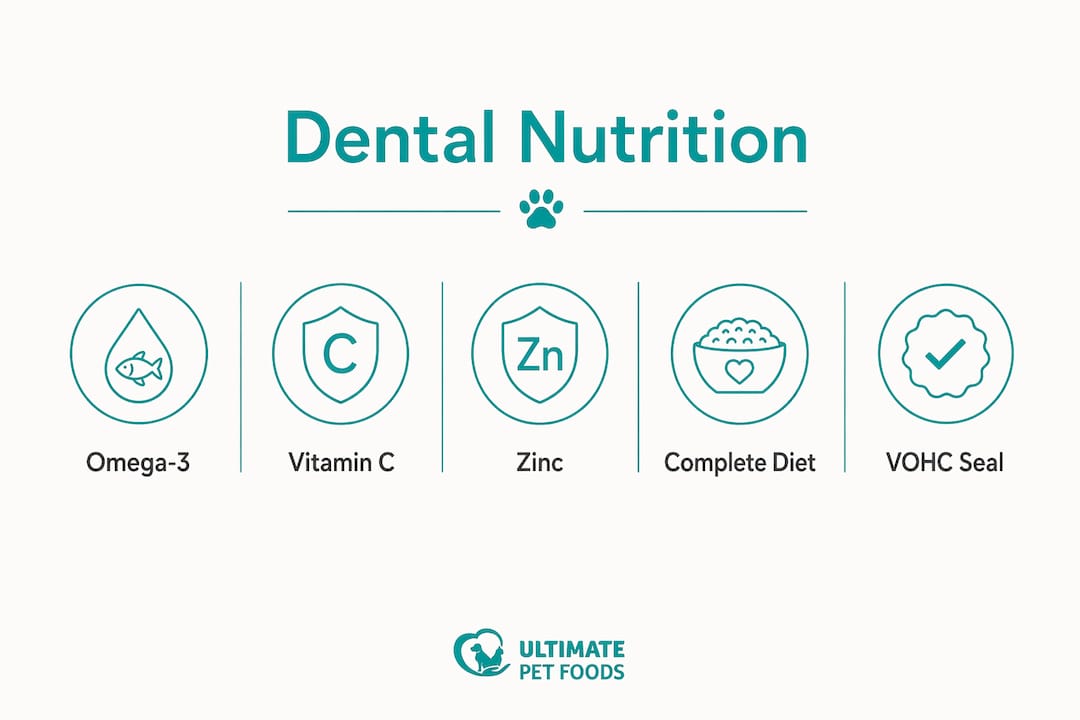
Gum tissue integrity and oral inflammation are directly influenced by the micronutrients in your dog’s diet. Omega-3 fatty acids and antioxidants such as vitamin C support periodontal tissue health and reduce oral inflammation, though they are not standalone treatments. Think of them as the maintenance crew working quietly in the background, keeping tissue resilient between brushing sessions.
The key nutrients and their roles are worth understanding clearly:
- Omega-3 fatty acids (EPA and DHA): Found in oily fish like salmon and mackerel, these fatty acids modulate the inflammatory response in gum tissue. Chronic gum inflammation is a driver of periodontal disease, so reducing it through diet is genuinely useful. Ultimatepetfoods includes omega-3 support in several of its recipes for exactly this reason.
- Vitamin C: An antioxidant that supports collagen synthesis in gum tissue. Dogs produce their own vitamin C, but dietary sources from fresh ingredients add a useful top-up.
- Vitamin D and calcium: Both are critical for the alveolar bone that anchors teeth. A diet deficient in these nutrients weakens the structural foundation of every tooth in your dog’s mouth.
- Vitamin E: Works alongside omega-3s to reduce oxidative stress in oral tissues, supporting the immune response at the gumline.
- Phosphorus: Works in balance with calcium to maintain bone density. The calcium-to-phosphorus ratio in a complete and balanced diet matters more than the absolute level of either mineral alone.
The phrase “complete and balanced” is not marketing language. It is a nutritional standard that confirms a food meets minimum requirements for all life stages or a specific life stage. A diet that is genuinely complete and balanced, made with freshly prepared ingredients, delivers these micronutrients in their most bioavailable form.
Pro Tip: Look for recipes that list named oily fish, such as salmon or herring, in the first three ingredients. This signals a meaningful omega-3 contribution rather than a trace amount added for label appeal.
Which dental products actually work, and what is the VOHC seal?
Not every product claiming dental benefits has the evidence to back it up. The Veterinary Oral Health Council (VOHC) Seal of Acceptance is the clearest signal of a product that has been tested in controlled trials for meaningful plaque or tartar reduction. VOHC-certified products are the most trustworthy choices for nutritional dental aids, and vets use this seal to guide their recommendations.
The table below compares the main categories of dental products available to UK dog owners:
| Product type | Mechanism | VOHC-eligible? | Key consideration |
|---|---|---|---|
| Dental kibble | Mechanical abrasion via kibble shape and size | Yes | Only works if dog chews rather than gulps |
| Dental chews | Mechanical scraping and bacterial barrier | Yes | Feed once daily; account for calories |
| Water additives | Reduces oral bacteria chemically | Some products | Introduce gradually to prevent drinking refusal |
| Dental gels and wipes | Direct plaque disruption on tooth surface | Some products | Useful for dogs that resist brushing |
| Raw bones | Mechanical abrasion | No | Pose fracture risks and contamination concerns |
Dental chews with the VOHC seal provide mechanical plaque reduction and create barriers to bacterial adherence. They should be fed once daily and monitored for calorie contribution, particularly in dogs prone to weight gain. Long-lasting, digestible options are preferred over hard nylon or antler chews, which carry their own fracture risks.
The most important takeaway from this comparison is that no single product replaces another. Combining a dental diet with a VOHC-certified chew and a water additive multiplies the benefit of each. You can explore teeth cleaning chews and how they fit into a broader dental care routine in more detail.
How to combine nutrition with home care and veterinary visits
Brushing remains the gold standard for plaque removal in dogs. Daily brushing, or near-daily brushing focusing on the gumline and outer tooth surfaces, reduces plaque and tartar formation more effectively than any dietary intervention alone. Nutrition supports this process but does not replace it.
A practical daily and monthly routine looks like this:
- Daily: Feed a complete, balanced dry kibble of appropriate size. Offer a VOHC-certified dental chew once per day. Add a vet-approved water additive to the drinking bowl.
- Several times per week (ideally daily): Brush your dog’s teeth using a dog-specific toothpaste. Human toothpaste risks toxicity due to xylitol and fluoride, so this is non-negotiable. Use a soft-bristled brush or finger brush and focus on the outer surfaces where plaque accumulates fastest.
- Monthly: Check the gumline for redness, swelling, or recession. Note any changes in breath odour, which is often the first sign of developing gum disease.
- Annually (or as recommended by your vet): Book a professional dental examination. Once visible tartar and gingivitis are present, veterinary dental prophylaxis under general anaesthesia is required. At-home care and nutritional support cannot remove tartar below the gumline.
The role of nutrition in this routine is to slow plaque formation between brushing sessions, support gum tissue resilience, and reduce the inflammatory load that accelerates periodontal disease. Think of a well-chosen diet as extending the window between professional cleanings rather than eliminating the need for them. For practical guidance on choosing food for dental health, the principles above translate directly into product selection criteria.
Key takeaways
Optimal dog dental health nutrition combines a complete and balanced diet, VOHC-certified dental products, and a consistent plaque-removal routine. Nutrition alone cannot reverse mineralised tartar, but it meaningfully slows its formation and supports the tissue that holds every tooth in place.
| Point | Details |
|---|---|
| Texture drives mechanical cleaning | Larger kibble that requires chewing reduces tartar by up to 42% compared to small or soft food. |
| Micronutrients protect gum tissue | Omega-3 fatty acids, vitamins C, D, and E, and balanced calcium and phosphorus all support periodontal resilience. |
| VOHC seal signals proven products | Only products with the Veterinary Oral Health Council seal have controlled trial evidence for plaque or tartar reduction. |
| Brushing remains non-negotiable | Daily brushing with dog-specific toothpaste is the single most effective home care intervention available. |
| Vet care is essential once tartar forms | Professional dental prophylaxis under anaesthesia is the only way to remove subgingival tartar safely. |
Why I think most owners underestimate what daily feeding can do
I have spent years looking at how dogs eat, what they eat, and what their mouths look like as a result. The honest observation is this: most owners focus on dental care only when something goes wrong. A bad smell, a reluctant chew, a vet flagging inflamed gums at a routine check. By that point, the diet has already been working against the dog for months or years.
What I find genuinely encouraging is that the daily feeding decision is the most consistent intervention any owner can make. You cannot guarantee your dog will tolerate brushing every night. You cannot always get to the vet as often as you would like. But you can choose a food that is made with freshly prepared meat or fish, gently cooked at 82°C to preserve nutrients, and formulated to be complete and balanced for lifelong feeding. That choice happens every single day, twice a day, for the life of your dog.
I am also cautious about raw bones, which some owners use as a natural dental solution. The mechanical benefit is real, but fracture risks and contamination concerns are equally real. A well-formulated dry kibble with added prebiotics like MOS and FOS, combined with a VOHC-certified chew, achieves the mechanical and nutritional benefit without the risk.
The dogs I see thriving dentally are not the ones whose owners do everything perfectly. They are the ones whose owners do the basics consistently. Good food, daily. A chew, most days. A brush, as often as possible. A vet check, once a year. That is a routine any owner can build.
— Glenn
How Ultimatepetfoods supports your dog’s dental health every day
At Ultimatepetfoods, we have built our recipes around the principle that everyday feeding should do more than fill a bowl. Our dry kibble is made with freshly prepared, human-grade meat or fish, gently cooked at 82°C to lock in nutrients and flavour. Every recipe is complete and balanced, with added prebiotics MOS and FOS to support digestion and gut health alongside oral wellness.
For dogs that need targeted support, our Ultimate+ Functional Health Dental Care recipe uses hydrolysed proteins designed for sensitive mouths, with a kibble format that supports mechanical cleaning at every meal. It is formulated for everyday, lifelong feeding, not as a short-term fix. Explore our full range of dry dog food options to find the recipe that fits your dog’s breed, age, and dental needs.
FAQ
What is dog dental health nutrition?
Dog dental health nutrition, or veterinary oral nutrition, is the practice of selecting foods and nutrients that reduce plaque formation, support gum tissue, and control oral inflammation. It complements but does not replace brushing and professional dental care.
Does dry kibble actually clean a dog’s teeth?
Dry kibble provides mechanical abrasion during chewing, which reduces plaque and tartar. Larger kibble reduces tartar more effectively than small kibble, but only if the dog actually chews rather than swallowing whole.
What are the best dog dental chews to look for?
Choose dental chews that carry the VOHC Seal of Acceptance, as these have controlled trial evidence for plaque or tartar reduction. Feed once daily and factor the chew’s calories into your dog’s total daily intake.
Can nutrition prevent gum disease in dogs?
Nutrition supports gum tissue resilience and slows plaque formation, which helps in preventing dog gum disease from progressing. However, once tartar and gingivitis are established, professional veterinary prophylaxis under anaesthesia is required to remove subgingival tartar.
Is human toothpaste safe for dogs?
Human toothpaste is not safe for dogs. It contains xylitol and fluoride, both of which are toxic to dogs. Always use a dog-specific toothpaste when brushing your dog’s teeth.