
Holistic dog food: A guide to better canine health
TL;DR:
- Holistic dog food is an unregulated marketing term; focus on ingredient quality and “complete and balanced” labels.
- Genuinely holistic diets feature fresh meats, vegetables, and minimal artificial additives, supporting overall health.
- Balanced grain-free diets can be safe and beneficial, especially for sensitive dogs, when formulated correctly.
The word ‘holistic’ is everywhere on dog food packaging right now, and it sounds reassuring. But here’s the truth: ‘holistic dog food’ is unregulated and carries no legal definition in the UK or EU pet food industry. Any brand can print it on a bag without meeting a single additional standard. That doesn’t mean holistic feeding is meaningless — far from it. It means you need to look past the label. This guide cuts through the marketing noise to show you what genuinely holistic nutrition looks like, how grain-free fits in, and how to choose food that truly supports your dog’s health from the inside out.
Table of Contents
- What makes a dog food ‘holistic’?
- Comparing ingredients: Holistic vs conventional dog food
- Grain-free in holistic diets: Benefits and myths
- Tailoring holistic dog food to your dog’s needs
- Why the holistic label matters less than ingredient quality
- Explore premium holistic and grain-free options for your dog
- Frequently asked questions
Key Takeaways
| Point | Details |
|---|---|
| Holistic is unregulated | ‘Holistic’ on dog food labels is a marketing term—not a regulated nutritional standard. |
| Ingredient quality matters | High-quality meats, vegetables, and minimal processing are hallmarks of the holistic approach. |
| Grain-free isn’t risky | Balanced grain-free diets are as digestible and safe for heart health as traditional formulas. |
| Tailor to your dog | Individual needs—like age, sensitivities, and activity level—should guide your food choice. |
| Check for balance | Choose foods with AAFCO ‘complete & balanced’ on the label to ensure essential nutrition. |
What makes a dog food ‘holistic’?
Let’s clear this up straight away. ‘Holistic’ is a marketing term, not a regulated category. No UK or EU authority — including FEDIAF, the European pet food industry body — defines or enforces what ‘holistic’ means on a label. So when you see it on a bag, it tells you very little on its own.
What the term should signal is a philosophy: feeding the whole dog, not just filling a bowl. That means ingredient quality, minimal processing, and avoiding synthetic additives like artificial colours, chemical preservatives, and low-grade by-products. It means thinking about how each ingredient contributes to your dog’s digestion, coat, joints, and immune system — not just hitting a minimum protein percentage.
For dogs with sensitivities, this distinction is especially important. A food labelled ‘holistic’ but packed with maize, wheat gluten, and artificial flavourings isn’t doing your dog any favours. Understanding holistic nutrition means learning to read past the front-of-pack claims and into the actual ingredient list.
What should you look for instead of ‘holistic’? Seek out the phrase ‘complete and balanced’ on the label. This phrase is regulated. It means the food meets established nutritional standards for your dog’s life stage. It’s a far more meaningful guarantee than any marketing buzzword.
Here’s a quick comparison to help you spot the difference between genuine quality and clever packaging:
| Label claim | Regulated? | What it actually means |
|---|---|---|
| Holistic | No | Marketing term only |
| Natural | Partially | Minimal legal definition |
| Complete and balanced | Yes | Meets nutritional standards |
| Grain-free | No | Describes ingredient exclusion only |
| Hypoallergenic | No | No legal standard in pet food |
We also recommend exploring natural remedies for dogs as a complement to good nutrition, particularly for dogs managing chronic sensitivities or skin conditions. A genuinely holistic approach considers the whole picture.
Comparing ingredients: Holistic vs conventional dog food
Now that we know what ‘holistic’ should mean, let’s see what goes into these foods compared to typical kibble.
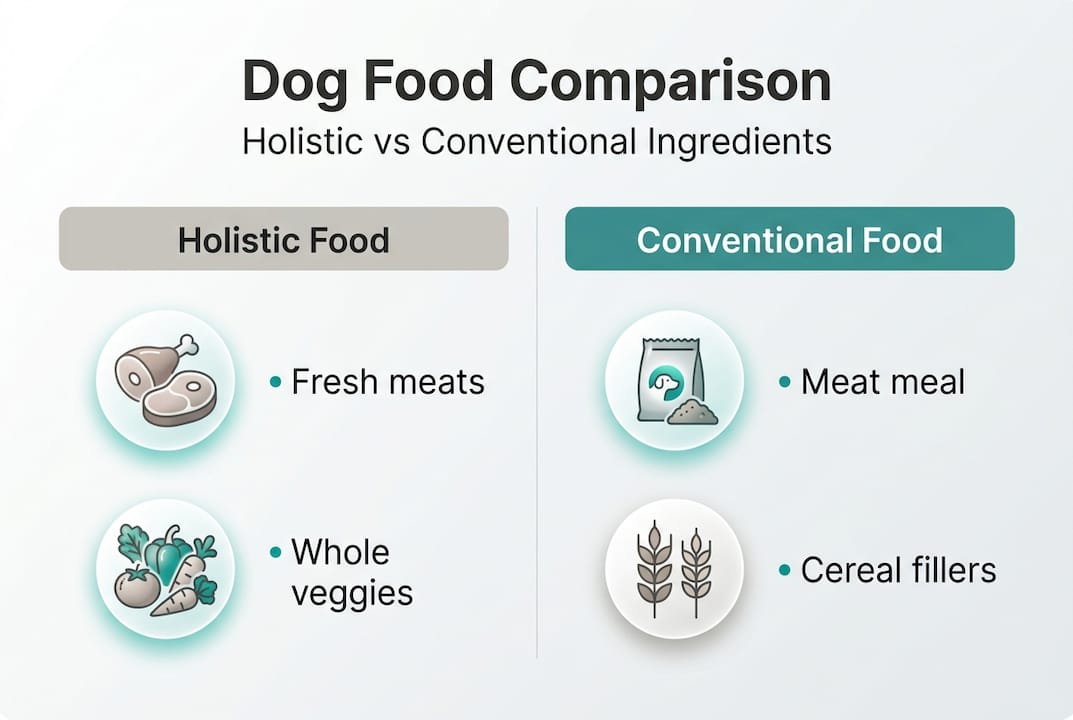
Conventional dog foods often rely on meat meals (rendered, dried protein sources), cereal fillers like wheat and maize, artificial preservatives such as BHA and BHT, and synthetic flavour enhancers. These ingredients are not inherently dangerous in small amounts, but they are less digestible and offer fewer natural nutrients than whole food alternatives.
Genuinely holistic and premium foods tend to feature fresh or dried meats as the primary protein, organ meats for natural vitamins and minerals, vegetables and botanicals for antioxidants, and healthy fats from sources like salmon oil or flaxseed. The difference shows up in your dog’s coat, energy levels, and stool quality — often within weeks.

The advantages of premium dog food go beyond the ingredient list. Research shows that whole food diets improve digestibility, lower obesity prevalence, and support better antioxidant and immune responses in dogs. That’s meaningful science, not marketing.
| Feature | Holistic/premium food | Conventional food |
|---|---|---|
| Primary protein | Fresh or dried named meat | Meat meal or by-products |
| Carbohydrate source | Sweet potato, peas, lentils | Wheat, maize, rice |
| Preservatives | Natural (vitamin E/C) | Synthetic (BHA, BHT) |
| Digestibility | Higher | Lower |
| Additives | Minimal or none | Artificial colours/flavours |
Here’s what to look for on the ingredient list:
- Named meat first: Chicken, salmon, or lamb listed as the first ingredient, not ‘meat and animal derivatives’
- No artificial colours: Avoid E102, E110, E124 and similar codes
- Recognisable vegetables: Carrots, spinach, and sweet potato are positive signs
- Omega fatty acids: Salmon oil or linseed for skin and coat support
- No added sugars or flavour enhancers: These mask poor-quality ingredients
Pro Tip: Don’t be fooled by a long ingredient list. A shorter list of high-quality, recognisable ingredients is almost always better than a lengthy one full of fillers and additives.
Grain-free in holistic diets: Benefits and myths
With ingredients compared, the next logical concern is whether grain-free holistic foods are safe and beneficial.
Grain-free diets became popular for dogs with grain sensitivities, skin flare-ups, and digestive issues. But they also attracted controversy, particularly around a potential link to dilated cardiomyopathy (DCM), a serious heart condition. This scared many owners away from grain-free options entirely — and understandably so.
Here’s what the latest research actually says. Balanced grain-free diets show no increased cardiac risk compared to grain-inclusive diets over 18 months. The key word is balanced. A well-formulated grain-free food that meets complete and balanced standards, contains adequate taurine (an amino acid important for heart function), and uses quality protein sources is not a cardiac risk.
The earlier DCM concerns were linked to specific formulations, not grain-free as a category. Understanding grain-free dog food basics helps you separate the science from the scare stories. And the benefits of grain-free diets for sensitive dogs are well documented, including improved digestion and reduced skin irritation.
Here’s a practical checklist for assessing a healthy grain-free food:
- Named meat protein as the first ingredient — not a vague ‘meat derivative’
- Taurine-containing ingredients — heart muscle, dark poultry meat, or direct supplementation
- Quality carbohydrate alternatives — sweet potato, lentils, or chickpeas rather than cheap fillers
- Complete and balanced label — confirms it meets nutritional standards
- No artificial additives — colours, preservatives, or flavour enhancers should be absent
- Omega-3 fatty acids — from salmon oil or similar, for heart and coat health
Pro Tip: If your dog has a diagnosed heart condition, always consult your vet before switching to any new diet, grain-free or otherwise. For healthy dogs, a well-formulated grain-free food is a sound choice. You can also read more about dog food and heart health for a deeper look at the evidence.
Tailoring holistic dog food to your dog’s needs
Evidence and ingredient choices aside, every dog is unique — so how do you translate the holistic approach for your individual pet?
Start with the basics: age, breed, activity level, and any known sensitivities or health conditions. A working Border Collie has very different nutritional needs from a senior Cavalier King Charles Spaniel. Puppies need higher protein and calcium ratios for growth. Older dogs often benefit from joint-supporting nutrients like glucosamine and reduced calorie density.
Animal proteins at appropriate life stages are fundamental to a holistic plan. Dogs are not obligate carnivores like cats, but they thrive on diets where high-quality animal protein forms the foundation. Plant proteins alone cannot provide the full amino acid profile dogs need for muscle maintenance, immune function, and organ health.
Here’s what to consider when tailoring your dog’s holistic diet:
- Protein source: Match to your dog’s sensitivities. Novel proteins like duck, venison, or kangaroo work well for dogs with chicken or beef intolerances
- Fat content: Active dogs need higher fat for energy; overweight or less active dogs need controlled fat levels
- Fibre: Supports healthy digestion. Look for chicory root (a natural prebiotic) or beet pulp in moderate amounts
- Life stage: Choose a food formulated for your dog’s current stage, puppy, adult, or senior
- Portion control: Even the best food causes problems if overfed. Follow feeding guidelines and adjust based on body condition
One common mistake is self-formulating a raw or home-cooked diet without professional guidance. Without careful balancing, these diets can develop serious deficiencies over time. If you’re interested in home feeding, explore grain-free meal prep ideas as a starting point, and always work with a veterinary nutritionist to ensure balance.
Always use the AAFCO ‘complete and balanced’ statement as your baseline when selecting a commercial food. It’s not perfect, but it’s the most reliable minimum standard currently available.
Why the holistic label matters less than ingredient quality
Here’s our honest take, and it might surprise you. We care deeply about what goes into dog food. But we’d actually encourage you to stop searching for the word ‘holistic’ and start reading ingredient lists instead.
The fixation on ‘holistic’ as a quality signal is understandable. It sounds caring and natural. But owners should look for AAFCO ‘complete and balanced’ and scrutinise ingredient choices rather than trusting front-of-pack claims. We’ve seen premium-quality foods that never use the word ‘holistic,’ and we’ve seen foods labelled ‘holistic’ that contain more fillers than fresh meat.
Real results come from knowing what you’re feeding. That means understanding what holistic nutrition actually looks like in practice, not just what it says on the bag. Your dog doesn’t care about the label. They care about how they feel after eating. Shiny coat, settled digestion, good energy, and a healthy weight — those are the real markers of a diet that’s working. Trust the ingredients, not the branding.
Explore premium holistic and grain-free options for your dog
Ready to put evidence-based choices into action? We’ve made it straightforward to find dog foods that genuinely reflect the holistic principles we’ve covered here.
At Ultimate Pet Foods, our grain-free recipes are built around named meat proteins, natural preservatives, and carefully selected whole ingredients — with no artificial nasties. Whether your dog needs support for digestion, skin, coat, or weight management, we have options tailored to their needs. Explore our guide on why grain-free is best for a clear breakdown of the benefits, learn more about grain-free ingredients, or compare dry dog food options to find the right fit. Every wag starts with the right bowl. 🐾
Frequently asked questions
Is holistic dog food really better than conventional food?
Holistic foods often prioritise ingredient quality and minimal processing, which can benefit your dog, but always verify the food carries a ‘complete and balanced’ statement rather than relying on the label alone.
Are grain-free holistic diets safe for my dog’s heart?
Recent research shows no increased cardiac risk in balanced grain-free diets; choose formulas that meet AAFCO standards and contain adequate taurine from quality protein sources.
How do I know if holistic dog food is suitable for my pet’s sensitivities?
Look for limited ingredient lists, avoid artificial additives, and choose high-quality animal proteins matched to your dog’s specific sensitivities, such as novel proteins like duck or venison.
What nutrients should I prioritise in a holistic dog food?
Focus on named meat proteins, healthy omega fats, and a ‘complete and balanced’ label to ensure your dog receives everything they need at their life stage.