
Grain free chicken dog food: your complete guide
TL;DR:
- Choosing grain free chicken dog food involves prioritizing high-quality, balanced nutrition over marketing claims about grain absence.
- While beneficial for dogs with sensitivities, most healthy dogs digest grains well, and carefully formulated recipes with fresh ingredients support overall health.
Choosing the right food for your dog has never felt more complicated, and grain free chicken dog food sits right at the centre of the debate. Grain-free now accounts for 30 to 35% of premium dry dog food volume, driven largely by owners who want to address allergies, sensitivities, or simply feed something cleaner and closer to nature. But between bold marketing claims and genuine nutritional science, it can be hard to know what you are actually buying. This guide cuts through the noise so you can make a confident, informed choice for your dog.
Table of Contents
- Key takeaways
- What grain free chicken dog food actually contains
- Health benefits and potential risks
- Premium vs mass-market grain free kibble
- How to choose the right food for your dog
- Transitioning to grain free chicken dog food
- My honest take after years in pet nutrition
- Discover Ultimatepetfoods grain free chicken recipes
- FAQ
Key takeaways
| Point | Details |
|---|---|
| Grain-free is not automatically superior | Quality and complete, balanced nutrition matter far more than whether grains are present. |
| Chicken is a high-quality protein | Freshly prepared chicken supports muscle, energy, and coat health when sourced and cooked properly. |
| Legume levels need watching | High concentrations of peas and lentils, not grain absence itself, are linked to DCM heart concerns. |
| Read labels carefully | Look for an AAFCO nutritional adequacy statement, not just marketing words like “natural” or “premium.” |
| Transition gradually | Moving to a new food too quickly disrupts digestion. A slow seven to ten day switch protects gut comfort. |
What grain free chicken dog food actually contains
The phrase “grain-free” simply means the recipe excludes cereal grains. Wheat, corn, rice, barley, and oats are all absent. What replaces them as a carbohydrate source matters enormously, and this is where grain-free is primarily a marketing term if the replacement ingredients are not well chosen.
Most grain free kibble for dogs swaps grains for one or more of the following:
- Sweet potato and potato provide digestible carbohydrates and are gentle on sensitive stomachs.
- Peas and lentils are widely used as both a carbohydrate and protein source, though their high concentration has been linked to heart concerns (more on that below).
- Chickpeas and tapioca offer energy without triggering common grain sensitivities.
Chicken as the primary protein is where a well-formulated recipe truly earns its keep. As a lean, complete protein, chicken delivers all the essential amino acids your dog needs for muscle maintenance, healthy skin, and steady energy. The difference between a natural chicken dog food made with freshly prepared meat and one built around dried chicken meal is significant. Freshly prepared chicken retains more natural moisture and flavour, and when it is gently cooked at 82°C as Ultimatepetfoods does, the process helps lock in vitamins and nutrients rather than burning them away at high extrusion temperatures.
A complete and balanced formulation is non-negotiable. Removing grains changes the entire macronutrient profile of a recipe, so producers must compensate carefully to hit protein, fat, fibre, and micronutrient targets. When this is done well, grain free chicken dog food is genuinely nourishing. When it is done cheaply, you end up with a recipe high in legumes and low in everything that actually matters.
Health benefits and potential risks
Not every dog needs a grain-free diet, and understanding who truly benefits helps you avoid making a switch based on marketing rather than need.
Dogs who typically do well on grain free chicken dog food include:
- Dogs with confirmed grain allergies or sensitivities, which show up as itchy skin, recurring ear infections, or loose stools after eating grain-containing foods.
- Dogs with digestive sensitivities who respond better to potato or sweet potato as a carbohydrate source.
- Dogs whose owners want a diet closer to a biologically appropriate, natural chicken dog food model.
It is worth knowing that grains are not inherently bad for most dogs. Most healthy dogs digest cooked grains perfectly well. The concern is not grains themselves but rather poor-quality grain-inclusive formulas where fillers dominate over protein. As the research is clear: high-quality grain-inclusive diets are often preferable to a poorly formulated grain-free alternative.
The more serious concern is dilated cardiomyopathy (DCM). Studies have found that high concentrations of peas and lentils in some grain-free recipes may interfere with taurine absorption, potentially contributing to heart disease. This is not a reason to panic, but it is a reason to scrutinise legume levels in any recipe you choose. The good news is that nutritional DCM is often reversible when the diet is changed promptly and monitored by a vet.
Recipes that add prebiotics like MOS and FOS, as Ultimatepetfoods does, go a step further by supporting a healthy gut microbiome and enhancing nutrient absorption. A healthy gut means your dog gets more from every meal, which matters especially on a grain-free diet where nutrient density needs to be spot on.
Pro Tip: If your dog has a history of heart issues or is a breed predisposed to DCM (such as Dobermanns or Cocker Spaniels), speak to your vet before switching to a grain-free diet.
Premium vs mass-market grain free kibble
Not all grain free kibble for dogs is created equal, and the price difference reflects something real about what goes into the bag.
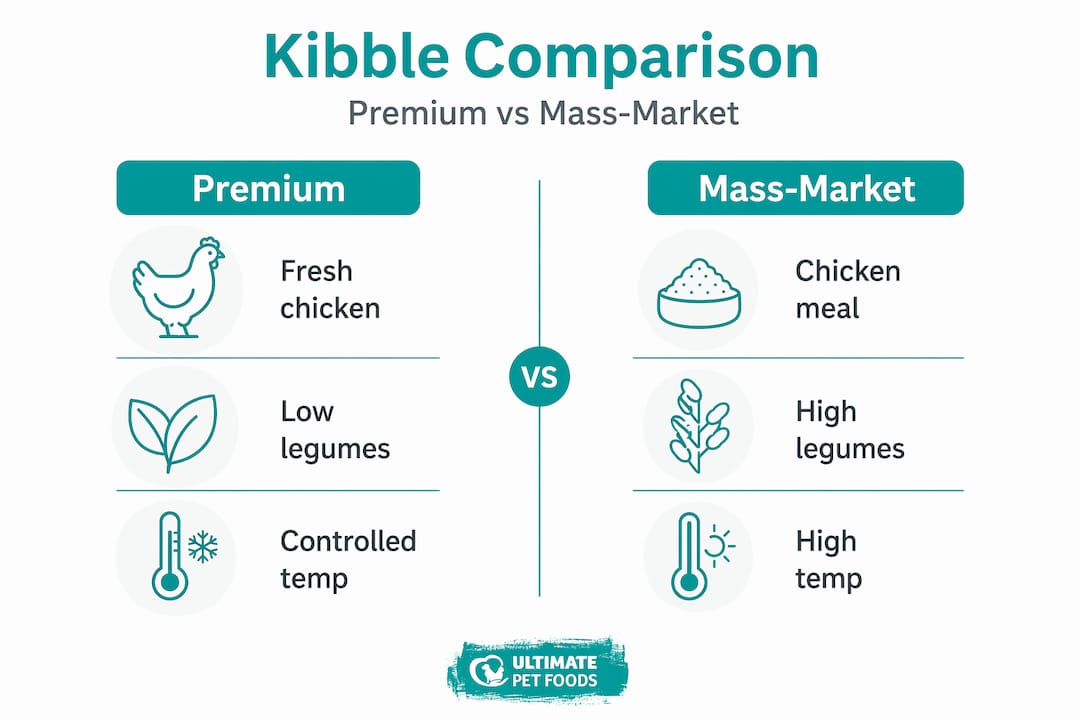
| Feature | Mass-market grain-free | Premium grain-free (Ultimatepetfoods) |
|---|---|---|
| Primary protein source | Dried meat meal or by-products | Freshly prepared chicken, gently cooked at 82°C |
| Ingredient quality | Feed-grade ingredients | Human-grade ingredients |
| Carbohydrate sources | High legume content | Balanced potato, sweet potato, lower legume levels |
| Prebiotics added | Rarely | MOS and FOS included |
| Nutritional adequacy | Variable | Complete and balanced for all life stages |
| Price (approx.) | £2.50 to £5.50 per kg | £6.00 to £12.00 per kg |
Grain-free premium dry kibble typically costs significantly more than mass-market alternatives, and part of that is manufacturing cost. Grain-free kibble requires special production adaptations, including longer barrel extrusion and different screw designs, to handle the lower starch content. Premium producers absorb those costs in exchange for better ingredients and tighter quality control.
The cooking temperature also tells a story. Human-grade ingredients cooked at precisely controlled temperatures, like Ultimatepetfoods’ 82°C gentle cooking process, directly impact nutrient retention and palatability. Mass-market kibble is often extruded at much higher temperatures, which degrades heat-sensitive vitamins and can reduce the biological value of the protein.
When comparing chicken dog food brands, look beyond the front-of-pack claims. Check the ingredient list for the position of the protein source (it should be listed first), note whether prebiotics are included, and check for a nutritional completeness statement.
Pro Tip: A “chicken meal” listed as the first ingredient is not the same as freshly prepared chicken. Chicken meal is a dried, concentrated product. It is not necessarily bad, but it lacks the moisture and nutritional profile of fresh meat.
How to choose the right food for your dog
Finding the right healthy chicken dog food comes down to matching the product to your dog’s actual needs, not the most appealing packaging.
Here is what to assess before you buy:
- Your dog’s health history. Has your vet flagged any allergies, intolerances, or heart concerns? Start there before making any dietary change.
- Life stage and breed. Puppies, seniors, and working dogs have different protein and calorie needs. Choose a recipe formulated for your dog’s specific stage, or one labelled as suitable for all life stages.
- Ingredient list order. The first ingredient should be a named meat, such as chicken or chicken meal. If peas or lentils appear in the top three, think carefully about legume loading.
- Nutritional adequacy statement. The AAFCO statement is the only legally recognised indicator of diet completeness and safety. Words like “natural” or “premium” carry no legal weight on a label.
- Functional health support. If your dog has specific needs around digestion, weight, skin, or joints, look for a recipe designed with those goals in mind rather than a one-size-fits-all formula.
Ultimatepetfoods offers both a core grain-free dry dog food range for everyday feeding and the Ultimate+ Functional Health range for targeted daily support. That range includes Digestive Care, Skin and Coat Care, Weight Control and Joint Care, Dental Care, and Healthy Living options, all made with hydrolysed proteins and designed for dogs with specific ongoing needs.
Pro Tip: Before making any switch based on a suspected allergy, keep a simple food diary for two to four weeks. Note ingredients, symptoms, and stool quality. This makes your vet conversation far more productive.
Transitioning to grain free chicken dog food
Switching your dog’s food too quickly is one of the most common mistakes owners make, and the digestive fallout (loose stools, gas, and vomiting) puts many people off what might otherwise be a genuinely positive change.
Here is how to do it properly:
- Days one and two: Feed 75% old food and 25% new grain-free chicken food. Mix thoroughly so your dog cannot pick around the new kibble.
- Days three and four: Move to a 50/50 split. Watch for any changes in stool consistency or appetite.
- Days five and six: Shift to 75% new food and 25% old food. Most dogs are adapting well by this point.
- Day seven onwards: Move to 100% new food. Continue monitoring stool quality and energy levels for another week.
- After two weeks: If everything looks settled, you can consider adding any toppers or supplements your vet has recommended.
If your dog is on the Ultimate+ Functional Health range for a specific condition like digestive sensitivity, the transition still applies. Hydrolysed proteins are gentler on the gut, but the digestive ecosystem still needs time to adjust to a new food, regardless of how well formulated it is.
Store kibble in a cool, dry place in an airtight container. Even the best grain free chicken dog food loses freshness and nutritional integrity if left exposed to air or moisture. The bag’s resealable closure is never as effective as a dedicated container.
My honest take after years in pet nutrition
I have spent a long time working in and around pet nutrition, and the single biggest thing I have learned is this: the grain-free question is almost always the wrong question.
I have seen dogs thrive on grain-free chicken recipes and dogs do equally well on high-quality grain-inclusive foods. What makes the difference is never the presence or absence of a grain. It is always the quality of the protein, the completeness of the recipe, and whether the food was produced with genuine care for ingredient integrity.
The DCM conversation worries me when I see owners dismiss it entirely because they read one reassuring headline. High legume loading in cheap grain-free recipes is a real concern. But I also know that dietary DCM is often reversible with a prompt diet change, which means the answer is not fear. It is paying attention and choosing carefully.
What I trust are recipes where freshly prepared meat is the foundation, where the cooking process is designed to protect nutrients rather than cut costs, and where functional additions like prebiotics reflect a genuine understanding of canine digestive health. That combination is far rarer than the grain-free label would suggest.
Do not let marketing drive your decision. Let your dog’s health, your vet’s guidance, and the actual ingredient list do that job instead.
— Glenn
Discover Ultimatepetfoods grain free chicken recipes
If you are ready to make a confident choice, Ultimatepetfoods is here to make that easy. Every recipe in our range is built around freshly prepared chicken, gently cooked at 82°C to lock in nutrients and flavour. We use human-grade ingredients throughout, with added prebiotics MOS and FOS to support gut health from the inside out. 🐾
Our core grain-free range is complete and balanced for everyday, lifelong feeding across all breeds and life stages. And if your dog needs more targeted support, our Ultimate+ Functional Health range covers Digestive Care, Skin and Coat Care, Weight Control and Joint Care, Dental Care, and Healthy Living. Every formula is designed not for short-term relief but for sustained, daily wellbeing. Explore our grain-free ingredients guide or try a sample box to find your dog’s perfect match. 🐶
FAQ
What is grain free chicken dog food?
Grain free chicken dog food is a dry or wet pet food that uses chicken as the primary protein and excludes cereal grains such as wheat, corn, and rice, replacing them with alternative carbohydrate sources like sweet potato or potato.
Is grain free dog food good for all dogs?
Grain free dog food is not necessary for every dog. It benefits dogs with confirmed grain allergies or sensitivities most clearly, but healthy dogs can thrive on quality grain-inclusive diets too. Always consult your vet before switching.
What is the risk of DCM with grain free diets?
The concern centres on high concentrations of legumes like peas and lentils in some grain-free recipes, which may affect taurine absorption. Choosing a recipe with balanced ingredient levels and seeking veterinary guidance reduces this risk significantly.
How do I know if a grain free dog food is complete and balanced?
Look for a nutritional adequacy statement from AAFCO or an equivalent regulatory body on the packaging. Marketing terms like “natural” or “premium” carry no legal definition and are not a substitute for verified nutritional completeness.
How long does it take to switch to grain free chicken dog food?
A gradual transition over seven to ten days is recommended. Start with 25% new food and 75% old food, then slowly shift the ratio every two days until your dog is fully on the new recipe.