
Dog food ingredient sourcing: a practical owner's guide
TL;DR:
- Dog food ingredient sourcing impacts the nutritional quality and safety of what your dog consumes daily.
- Understanding supply chain transparency, fresh versus rendered ingredients, and emerging sustainable proteins helps owners make confident, ethical choices.
Dog food ingredient sourcing is the process of selecting, verifying, and tracing the origin of every component that goes into your dog’s bowl, and it directly determines the nutritional quality and safety of what your dog eats every day. The global dog food market is projected to reach USD 97.4 billion by 2036, driven largely by owner demand for ingredient transparency and premium nutrition. That figure tells you something important: more dog owners than ever are asking the right questions about what is actually in their pet’s food. This guide to ingredient sourcing for dog food walks you through how to read ingredient lists, evaluate supply chains, and spot the innovations reshaping pet nutrition, so you can feed your dog with genuine confidence.
What does a guide to ingredient sourcing for dog food actually cover?
Ingredient sourcing, known formally in the pet food industry as raw material procurement and traceability, covers everything from the farm or fishery where a protein originates to the manufacturing process that transforms it into a complete meal. Understanding this process is not just for pet food manufacturers. As an owner, knowing the basics helps you distinguish genuinely high-quality products from those that rely on clever marketing.

The most important distinction to grasp early is between freshly prepared and dried or rendered ingredients. Freshly prepared meat or fish is added to a recipe in its natural, wet state before cooking, which means it retains more of its original amino acid profile and natural moisture. Rendered meals, such as “chicken meal” or “fish meal,” are pre-processed concentrates that can still provide good nutrition but have undergone more intensive heat treatment before they even reach the factory.
Prebiotics such as MOS (mannan-oligosaccharides) and FOS (fructo-oligosaccharides) are another sourcing consideration worth understanding. These compounds, derived from yeast cell walls and chicory root respectively, support the growth of beneficial gut bacteria. When a manufacturer sources and includes them deliberately, it signals a nutritional philosophy that goes beyond basic calorie delivery.
What are the best ingredients in dog food and how do you recognise quality sources?
The best ingredients for dog food share three characteristics: they are nutritionally dense, digestible, and traceable to a verified source. Protein is the most scrutinised category, and rightly so, because it underpins muscle maintenance, immune function, and coat condition.
Here is what to look for when assessing protein quality in a dog food:
- Named, single-source proteins such as “freshly prepared chicken,” “salmon,” or “duck” indicate a specific, traceable animal origin rather than a generic blend.
- Freshly prepared meat or fish cooked gently at 82°C helps preserve natural nutrients and amino acids that higher-temperature processing can degrade.
- Human-grade ingredients meet the same hygiene and quality standards applied to food produced for people, which sets a higher baseline for safety and freshness.
- Organ meats and nutritious trimmings are often listed as by-products. Pet food by-products consist of nutrient-dense organ meats and trimmings from the human food chain, contributing to both sustainability and high nutrition. This means “liver” or “kidney” listed as a by-product is a feature, not a flaw.
- Plant-based ingredients such as sweet potato, peas, and lentils provide digestible carbohydrates, fibre, and micronutrients, though they should complement rather than dominate the protein content.
One persistent myth worth addressing is the idea that synthetic nutrients are inferior fillers. Synthetic taurine, for example, is standard practice in pet food manufacturing and necessary for balanced diets. Taurine supports heart function and vision, and its synthetic form is chemically identical to the naturally occurring version. A food that lists added taurine is demonstrating nutritional completeness, not cutting corners.
Pro Tip: When reading an ingredient list, look for a named meat or fish in the first two positions. Ingredients are listed by weight before cooking, so a freshly prepared protein listed first confirms it is the dominant component of the recipe.
How do you evaluate sourcing practices and supply chain transparency?
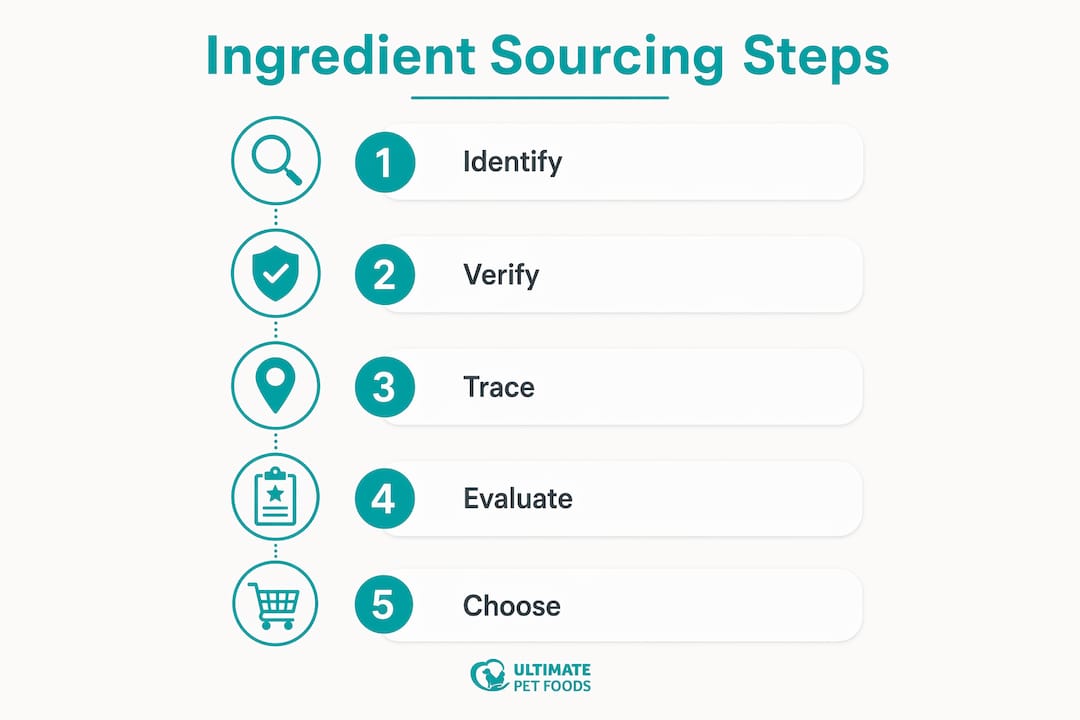
Supply chain transparency means a manufacturer can tell you not just what is in the food, but where it came from and how it was handled at each stage. This level of traceability is increasingly expected by informed owners, and the best brands make it easy to verify.
Here are four practical steps to assess a brand’s sourcing commitments:
- Check for a traceability tool or batch-code lookup. Some manufacturers allow you to trace your dog food back to its ingredient origins using a code on the packaging. This is the gold standard for transparency.
- Look for named supplier relationships or country-of-origin statements. Vague phrases like “sourced from approved suppliers” carry less weight than specific regional or national declarations.
- Verify sustainability certifications. Credible third-party certifications from bodies such as the Marine Stewardship Council (MSC) for fish or the Roundtable on Sustainable Palm Oil (RSPO) confirm that claims are independently audited.
- Research the manufacturer’s sustainability reporting. Sustainable sourcing across tier 1 priority crops reached over 96% globally in 2025, up from just 25% in 2020. That rapid progress shows the industry is moving, but not all brands are moving at the same pace.
The role of upcycled ingredients is also worth understanding. Upcycled ingredients from human food co-products such as cheese, bacon fat, and yeast are tested rigorously for nutrition, safety, and palatability. Using these co-products reduces food waste and often delivers excellent palatability, which is why you will find them in premium recipes rather than budget lines.
Supply chain innovation is accelerating at the farm level too. 2 Sisters Food Group, a major UK poultry supplier, is working to reduce soyameal carbon footprint by up to 70% by replacing 23% of imported soyameal with British-grown oilseed rape and beans. This kind of upstream sourcing decision directly affects the environmental profile of the chicken that ends up in your dog’s food.
| Transparency signal | What it tells you |
|---|---|
| Named country of origin | Ingredient is traceable to a specific region or farm |
| Third-party sustainability certification | Claims are independently verified, not self-reported |
| Batch-code traceability tool | Full supply chain visibility from source to bowl |
| Upcycled ingredient disclosure | Brand is actively reducing food waste |
What emerging ingredient innovations are shaping dog food sourcing?
The next generation of dog food ingredients is already in commercial production, and some of it is genuinely surprising. Understanding these developments helps you evaluate brands that position themselves as forward-thinking.
- Insect protein, derived from species such as black soldier fly larvae, is commercially available and approved for pet food in both North America and Europe. It requires a fraction of the land and water needed for conventional livestock farming and is naturally hypoallergenic for most dogs.
- Microalgae provides a plant-based source of omega-3 fatty acids, specifically DHA, without relying on wild-caught fish. This addresses both sustainability concerns and the growing pressure on global fish stocks.
- Cultured cell proteins, grown from animal cells without slaughter, could theoretically resolve up to 96% of pet allergies linked to common protein sources while also improving supply security. This technology is still in early commercial stages but is progressing rapidly.
- AI-assisted ingredient discovery is accelerating the identification of novel proteins and bioactives. Artificial intelligence enables faster discovery of sustainable, bioactive ingredients by simulating chemical spaces at speeds no human research team could match.
“The shift toward alternative proteins is not just an environmental story. It is a nutritional one. Insect meal and microalgae bring amino acid profiles and omega fatty acids that rival or exceed conventional sources in digestibility, and they do it with a fraction of the environmental cost.”
The main challenge for innovative ingredients is regulatory approval and consumer acceptance. In the UK, novel ingredients must pass safety assessments before they can be included in pet food. This means the products you see on shelves today have already cleared a meaningful quality bar, even if the ingredient sounds unfamiliar.
How can you choose dog food that matches your nutritional and ethical values?
Applying everything above to a practical purchasing decision comes down to reading labels carefully and knowing which signals matter most. Here is a direct comparison of what separates a well-sourced dog food from a less transparent one:
| What to look for | Strong sourcing signal | Weak sourcing signal |
|---|---|---|
| Protein listing | “Freshly prepared chicken (26%)” | “Meat and animal derivatives” |
| Ingredient traceability | Batch-code lookup available | No origin information provided |
| Sustainability claims | Third-party certified (MSC, RSPO) | “Responsibly sourced” with no verification |
| Nutritional completeness | Meets FEDIAF guidelines for all life stages | “Complementary food” with no complete claim |
| Added gut support | MOS and FOS prebiotics listed | No prebiotic or digestive support included |
For owners considering homemade dog food sourcing, the challenge is achieving complete and balanced nutrition without the benefit of formulation science. Home-prepared meals can be nutritionally incomplete unless they are designed with veterinary nutritionist input, because getting the calcium-to-phosphorus ratio, vitamin D levels, and essential fatty acid balance right requires more than good ingredients alone.
Commercial dry dog food from a quality manufacturer solves this problem by combining freshly prepared proteins, digestible carbohydrates, and precisely dosed micronutrients in every serving. Ultimatepetfoods recipes are made with freshly prepared meat or fish, gently cooked at 82°C to preserve natural nutrients, and include MOS and FOS prebiotics to support a healthy gut. Every recipe is formulated as a complete and balanced meal, suitable for daily feeding across all breeds and life stages.
Pro Tip: If you want to verify a brand’s sourcing claims before buying, look for a dedicated ingredient transparency page or traceability tool on their website. Brands with nothing to hide make this information easy to find.
Key takeaways
Ingredient sourcing quality is the single most reliable predictor of dog food nutritional value, and owners who understand sourcing signals can make better decisions for their dog’s long-term health.
| Point | Details |
|---|---|
| Freshly prepared proteins matter | Named, freshly prepared meat or fish cooked at 82°C preserves more nutrients than rendered alternatives. |
| By-products are not inferior | Organ meats and trimmings are nutrient-dense and support sustainability by reducing food waste. |
| Transparency is verifiable | Batch-code traceability tools and third-party certifications confirm sourcing claims independently. |
| Alternative proteins are advancing | Insect flour, microalgae, and cultured proteins offer hypoallergenic, sustainable nutrition with regulatory approval. |
| Complete formulations are non-negotiable | A complete and balanced label, meeting FEDIAF guidelines, confirms every nutritional need is met daily. |
Why ingredient sourcing is the conversation we should all be having
I have spent years looking at what separates genuinely good dog food from the products that simply look good on a shelf. The honest answer is almost always sourcing. Two products can list “chicken” as their first ingredient and be worlds apart in quality depending on whether that chicken is freshly prepared or a rendered concentrate, whether it comes from a farm with welfare standards or an anonymous supply chain, and whether the manufacturer can actually prove any of it.
What I find encouraging is that the industry is moving in the right direction faster than most people realise. The jump from 25% to over 96% sustainable sourcing of key crops in just five years is not a small thing. It reflects genuine investment, not just marketing language. But it also means the gap between the best and worst products is widening, which makes your ability to read a label and ask the right questions more valuable than ever.
My advice is to treat ingredient sourcing as a long-term investment in your dog’s health rather than a one-off purchase decision. A dog fed on well-sourced, complete nutrition every day will almost always fare better than one fed on inconsistent quality, regardless of how premium the packaging looks. Look for brands that show their working, publish their sourcing commitments, and make traceability easy. Those are the brands worth trusting.
— Glenn
How Ultimatepetfoods supports quality sourcing every day
At Ultimatepetfoods, we believe every wag and bounce starts with what goes into the bowl. Our recipes are built around freshly prepared meat or fish, gently cooked at 82°C to lock in natural nutrients and flavour, using human-grade ingredients you can feel good about. Every recipe includes MOS and FOS prebiotics to support healthy digestion from the inside out.
For dogs with specific health needs, our Ultimate+ Functional Health range uses hydrolysed proteins for targeted everyday support across Digestive Care, Skin & Coat Care, Weight Control & Joint Care, Dental Care, and Healthy Living. All our recipes are complete and balanced for daily feeding, suitable for all breeds and life stages. Explore our dry dog food range to find the right recipe for your dog.
FAQ
What does “freshly prepared” mean on a dog food label?
Freshly prepared means the meat or fish is added to the recipe in its natural, wet state before cooking, rather than as a pre-dried or rendered powder. This typically results in better amino acid retention and higher digestibility.
Are dog food by-products safe and nutritious?
Yes. Pet food by-products include nutrient-dense organ meats such as liver and kidney recovered from the human food supply chain, making them both nutritious and a positive contribution to reducing food waste.
How can I verify a dog food brand’s sourcing claims?
Look for a batch-code traceability tool on the brand’s website, third-party sustainability certifications such as MSC for fish, and named country-of-origin statements on the packaging. Vague phrases without verification are a sign to dig deeper.
Is synthetic taurine in dog food a concern?
No. Synthetic taurine is standard in pet food manufacturing and chemically identical to naturally occurring taurine. Its inclusion confirms a recipe is nutritionally complete, particularly for heart and eye health.
What are the most sustainable emerging ingredients in dog food?
Insect protein and microalgae are the most commercially advanced sustainable options, both approved for pet food in Europe. They require significantly less land and water than conventional livestock farming and offer strong hypoallergenic properties for sensitive dogs.