
A smart guide to budgeting for premium dog food
TL;DR:
- Cost-per-day and nutritional quality determine true value, not bag price alone.
- Different food formats vary in cost, digestibility, and practicality, influencing overall expenses.
- Tailoring diet choices to your dog’s needs and monitoring health outcomes optimize spending and health.
Most dog owners look at the bag price and stop there. It feels logical: a £60 bag costs more than a £25 bag, so the cheaper option saves money. But this thinking can actually cost you more over time, and it may leave your dog eating a diet that doesn’t truly support their health. The real measure of value is cost-per-day, not cost-per-bag, and once you understand this shift, budgeting for premium, natural, and grain-free dog food becomes far more straightforward. This guide walks you through the numbers, the formats, and the personal factors that shape what you actually spend each month.
Table of Contents
- Why bag price is misleading: The real maths of premium dog food costs
- Comparing premium food formats: Dry, wet, and fresh options
- The grain-free debate: Nutrition, price, and practical risk management
- Tailoring your budget: Factors that affect serving cost for your unique dog
- Why a flexible, evidence-led approach saves money and supports health
- Next steps: Find the right premium food for your dog’s needs
- Frequently asked questions
Key Takeaways
| Point | Details |
|---|---|
| Cost-per-day matters most | Comparing cost-per-day, not bag price, gives a true picture of value when budgeting for premium food. |
| Format affects your budget | Fresh, wet, and dry options all have different long-term costs depending on your dog’s size and needs. |
| Personalise for your dog | Adjust your budget based on breed, age, activity, and health rather than following one-size-fits-all plans. |
| Don’t follow labels blindly | Look beyond grain-free branding and consider medical advice and formulation instead of trends. |
| Track and adapt | Monitor your dog’s health and intake, then update your food choice and spend as needed for optimal wellbeing. |
Why bag price is misleading: The real maths of premium dog food costs
Now that you know price-per-bag isn’t the full picture, let’s break down the numbers that matter.
A budget kibble might cost £25 for a 12kg bag, while a premium grain-free option costs £55 for the same weight. On the surface, the budget option looks like the obvious winner. But serving size tells a completely different story.
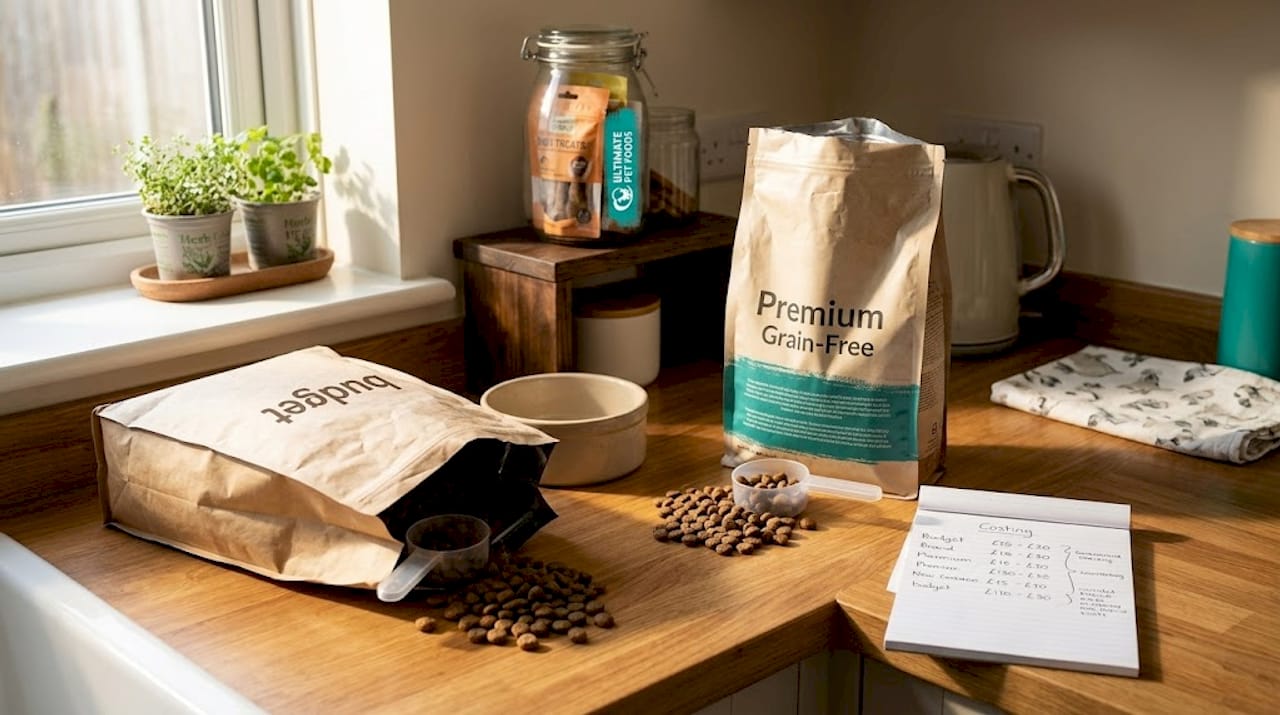
Budget foods often contain high levels of fillers such as wheat, maize, and soy. These ingredients bulk out the food but offer limited nutritional value, meaning your dog needs a larger portion to feel satisfied and meet their nutritional needs. Premium and natural foods, by contrast, are typically more calorie-dense and more digestible, so your dog absorbs more from a smaller portion. As caloric density and digestibility change the required serving size, a premium bag can last noticeably longer than a budget one.
Here’s a simplified comparison to illustrate:
| Food type | Bag cost | Bag weight | Daily portion (15kg dog) | Days per bag | Cost per day |
|---|---|---|---|---|---|
| Budget kibble | £25 | 12kg | 300g | 40 days | £0.63 |
| Mid-range kibble | £40 | 12kg | 240g | 50 days | £0.80 |
| Premium grain-free | £55 | 12kg | 190g | 63 days | £0.87 |
| Super-premium natural | £70 | 10kg | 160g | 62 days | £1.13 |
The gap between budget and premium narrows considerably when you calculate daily cost. And when you factor in potential vet bills linked to poor nutrition, the premium option often represents genuine long-term savings.
Key things to consider when calculating your true daily cost:
- Feeding guidelines on the bag are your starting point, but your dog’s actual intake may vary
- Stool quality is a reliable indicator of digestibility; firmer, smaller stools often mean better absorption
- Body condition tells you whether portions are right, regardless of what the bag recommends
- Caloric content (kcal per 100g) lets you compare foods on equal terms
“Cost-per-serving reveals true value far more accurately than the price on the front of the bag.”
Understanding the grain-free dog food basics is a useful first step before committing to any budget plan, as formulation quality directly affects how much your dog actually needs to eat each day.
Pro Tip: Divide the bag cost by the number of days it lasts at the recommended serving size for your dog’s weight. That’s your real daily spend, and it’s the only number worth comparing.
Comparing premium food formats: Dry, wet, and fresh options
Understanding true value means knowing your format options, so let’s compare how dry, wet, and fresh foods stack up.
Premium dog food isn’t one thing. It comes in dry kibble, wet food in tins or pouches, and fresh or gently cooked meals. Each format carries a different price point and a different set of practical considerations for your household.
Fresh food options have grown significantly in popularity, and for good reason. They tend to use whole, recognisable ingredients with minimal processing. However, the cost can be substantial. For a larger dog, fresh food orders can run to over £130 per fortnight, making it one of the most expensive formats available.
| Format | Typical monthly cost (medium dog) | Shelf life | Convenience | Digestibility |
|---|---|---|---|---|
| Dry kibble (premium) | £35 to £65 | 12 to 18 months | Very high | Good to excellent |
| Wet food (premium) | £60 to £100 | 2 to 3 years (unopened) | High | Very good |
| Fresh/gently cooked | £100 to £200+ | 3 to 5 days (fridge) | Moderate | Excellent |
| Raw (frozen) | £80 to £160 | 6 to 12 months (frozen) | Lower | Variable |
Dry kibble:
- ✅ Cost-effective and easy to store
- ✅ Widely available in premium, grain-free formulations
- ✅ Precise portion control
- ❌ More processed than fresh alternatives
- ❌ Lower moisture content, which matters for some dogs
Wet food:
- ✅ Higher moisture content supports hydration and kidney health
- ✅ Often more palatable for fussy eaters
- ✅ Good protein density in quality brands
- ❌ More expensive per calorie than dry food
- ❌ Opened tins need refrigeration and prompt use
Fresh and gently cooked:
- ✅ Minimal processing preserves nutrients
- ✅ Highly palatable and digestible
- ✅ Excellent for dogs with sensitive digestion
- ❌ Highest monthly cost by a significant margin
- ❌ Requires fridge space and careful rotation
Pro Tip: Consider combining formats. Many owners use a premium dry kibble as the base and add a small portion of wet food for palatability and moisture. This approach balances nutrition, cost, and your dog’s enjoyment without committing fully to the most expensive option.
The grain-free debate: Nutrition, price, and practical risk management
Once you’ve compared formats, ingredient decisions like “grain-free” are the next budgeting fork.
Grain-free dog food tends to sit at the higher end of the price spectrum, and that premium is worth examining carefully. Not all grain-free diets are equal, either in nutritional quality or in the evidence supporting their benefits. Knowing when grain-free genuinely makes sense for your dog helps you spend wisely rather than paying for a marketing label.
When grain-free may be the right choice for your dog:
- Your dog has a confirmed or suspected grain sensitivity or allergy
- Your vet has recommended a lower-carbohydrate diet for weight management
- Your dog shows signs of digestive discomfort on grain-inclusive foods
- You’re managing a skin condition linked to dietary triggers
- Your dog’s breed has a documented sensitivity to certain cereal grains
The grain-free diets for allergies resource is particularly useful if your dog shows any of these signs. However, it’s equally important to understand what to watch for.
The FDA’s investigation into dilated cardiomyopathy (DCM) in dogs raised questions about certain grain-free diets, particularly those high in legumes and pulses used as grain substitutes. The current evidence supports an association between specific formulations high in peas, lentils, and similar ingredients and DCM, though overall risk remains low and the science is still evolving.
“Formulation details matter far more than whether a food carries a grain-free label. Budget for quality ingredients and sound nutritional science, not marketing language alone.”
This doesn’t mean avoiding grain-free entirely. It means choosing grain-free foods that use diverse, high-quality protein sources and don’t rely heavily on legumes as primary ingredients. Comparing grain-free vs grain-inclusive options side by side, with your dog’s specific needs in mind, is the most sensible approach.
The practical budgeting takeaway here is straightforward: don’t pay a premium for grain-free unless your dog genuinely benefits from it. If they do, invest in a formulation with a strong nutritional profile and a reputable manufacturer, not simply the one with the most appealing packaging.
Tailoring your budget: Factors that affect serving cost for your unique dog
The final piece of your budgeting puzzle is customising to your dog’s individual requirements.
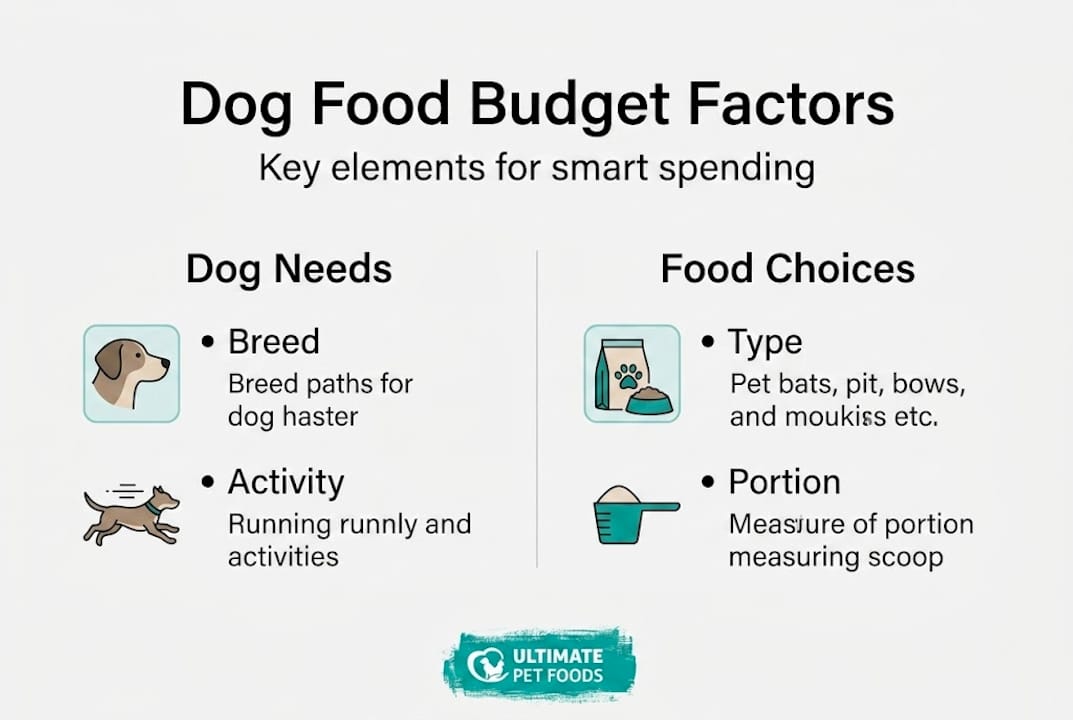
No two dogs have identical nutritional needs, and this has a direct impact on your monthly spend. A highly active Border Collie and a sedentary older Cavalier King Charles Spaniel may eat the same food, but the quantities, and therefore the costs, will differ considerably.
Key factors that influence your real-world premium food budget:
-
Body weight and size. Larger dogs eat more, which is obvious, but the relationship isn’t always linear. Some large breeds are surprisingly efficient eaters when fed a calorie-dense premium food.
-
Activity level. Working dogs, sporting dogs, and highly active breeds need more calories per day. This increases monthly spend but also means the nutritional stakes are higher, making quality even more important.
-
Life stage. Puppies and lactating females have significantly higher nutritional demands. Senior dogs often need fewer calories but benefit from targeted formulations supporting joint health, cognitive function, and digestion.
-
Health conditions. Dogs managing allergies, digestive issues, kidney disease, or weight problems may need specialist formulations that carry a higher price point. However, these diets often reduce the frequency and cost of vet visits over time.
-
Breed-specific tendencies. Some breeds have documented sensitivities or metabolic quirks. Understanding breed-specific dietary needs can help you choose a food that works efficiently for your dog’s biology.
-
Palatability and waste. A food your dog refuses to eat, or eats inconsistently, is never good value. Budget for a food your dog genuinely enjoys, as waste adds up quickly.
Your personalised premium budget checklist:
- Weigh your dog and note their current body condition score (BCS) on a 1 to 9 scale
- Identify your dog’s life stage: puppy, adult, senior, or reproductive
- Assess activity level honestly: low, moderate, or high
- Note any known health conditions or dietary sensitivities
- Calculate the daily serving size for two or three shortlisted foods
- Work out the cost per day for each and multiply by 30 for a monthly figure
- Factor in any supplements or toppers you currently use
- Review after four to six weeks based on body condition and stool quality
AAFCO compliance is a useful baseline for nutritional adequacy, but your dog’s body condition score, stool quality, and veterinary outcomes are the real measures of whether a food is working. Labels and certifications are a starting point, not the final word.
Pro Tip: Track your dog’s weight and body condition monthly. If their condition improves or declines, adjust portions before switching foods entirely. Small adjustments often resolve issues without the cost of a complete diet change.
Why a flexible, evidence-led approach saves money and supports health
After exploring the facts and figures, here’s our transparent take based on years in the field.
We’ve seen a consistent pattern: owners who spend the most on dog food aren’t always the ones whose dogs are healthiest. Equally, owners who cut corners on food often face higher vet bills and more health challenges down the line. The sweet spot lies in evidence-led flexibility, and it’s something we feel strongly about.
The dog food market is full of premium-sounding labels, and some of them are genuinely backed by quality ingredients and sound nutritional science. Others are marketing dressed up as nutrition. The difference isn’t always obvious from the packaging, which is why we encourage you to look at feeding results rather than front-of-bag claims.
Many owners develop what we call “label loyalty”: they find a brand they trust and stick with it regardless of how their dog is actually responding. This isn’t always wrong, but it can mean missing signals that a small adjustment could make a meaningful difference. A dog that’s gaining weight on a “weight management” formula, or showing dull coat despite a “skin and coat” recipe, is telling you something important.
Our honest advice: use the grain-free feeding guide as a practical reference, speak openly with your vet about what you’re observing, and treat your dog’s diet as something you refine over time rather than fix once and forget. The owners who get the best results are those who stay curious, stay observant, and aren’t afraid to adjust their approach when the evidence suggests it.
Spending smartly on premium food is not about finding the most expensive option or the trendiest ingredient. It’s about finding the right food for your specific dog, at a cost you can sustain, and monitoring the results with an honest eye.
Next steps: Find the right premium food for your dog’s needs
With the facts and a flexible mindset, you’re prepared for your next move. 🐾
We know that navigating premium dog food options can feel overwhelming, especially when you’re trying to balance health priorities with a realistic monthly budget. That’s exactly why we’ve built resources to make this easier for you.
Start by exploring why grain-free may be right for your dog to understand whether this approach suits your dog’s needs. If you’re ready to compare options side by side, our dog food comparison page makes it straightforward to evaluate formats, ingredients, and value. And when you’re ready to browse, our full range of premium grain-free options is built around natural ingredients, high digestibility, and real nutritional value. Every product we offer is chosen with your dog’s long-term health in mind, because that’s the kind of investment that truly pays off.
Frequently asked questions
What is the average monthly cost of premium dog food for a medium-sized dog?
Monthly costs typically range from £60 to £120, depending on format and brand, with fresh food options sitting at the higher end of the scale.
How can I reduce the cost of premium dog food without compromising on health?
Choose foods with higher caloric density and digestibility so smaller portions meet your dog’s needs, and compare cost-per-day across formats rather than focusing on bag price.
Is grain-free dog food always healthier for my pet?
Not automatically; the overall risk and evidence around grain-free diets is nuanced, and formulation quality and your vet’s guidance matter far more than the label alone.
How do I know which premium food is right for my dog’s breed and age?
Use brand feeding guidelines as a starting point, then monitor body condition and veterinary outcomes closely, adjusting portions and formulation based on real-world results rather than label claims.