

When Kirk came home as an eight-week-old Labrador, I did what most people do. I went to Pets at Home, found a member of staff, and asked what I should be feeding him. The answer was a wave of the hand at a shelf of standard puppy food — "anything from here will do." I had no idea that large breed puppies needed a specific formula. Nobody mentioned it. I picked something that looked reasonable and went home.
Within three weeks, his stools were loose, his coat looked flat, and he was flagging on walks faster than I expected a Labrador puppy to flag. He wasn't ill. He just wasn't thriving.
That interaction in a pet shop — and what followed — is a big part of why I eventually built Ultimate Pet Foods. Because the advice most puppy owners get at the point of purchase is genuinely not good enough. There is a meaningful difference between a food that's labelled for large breed puppies and one that's actually formulated for them, and most people never find out what that difference is until something goes wrong.
Why large breed puppies are a different feeding challenge
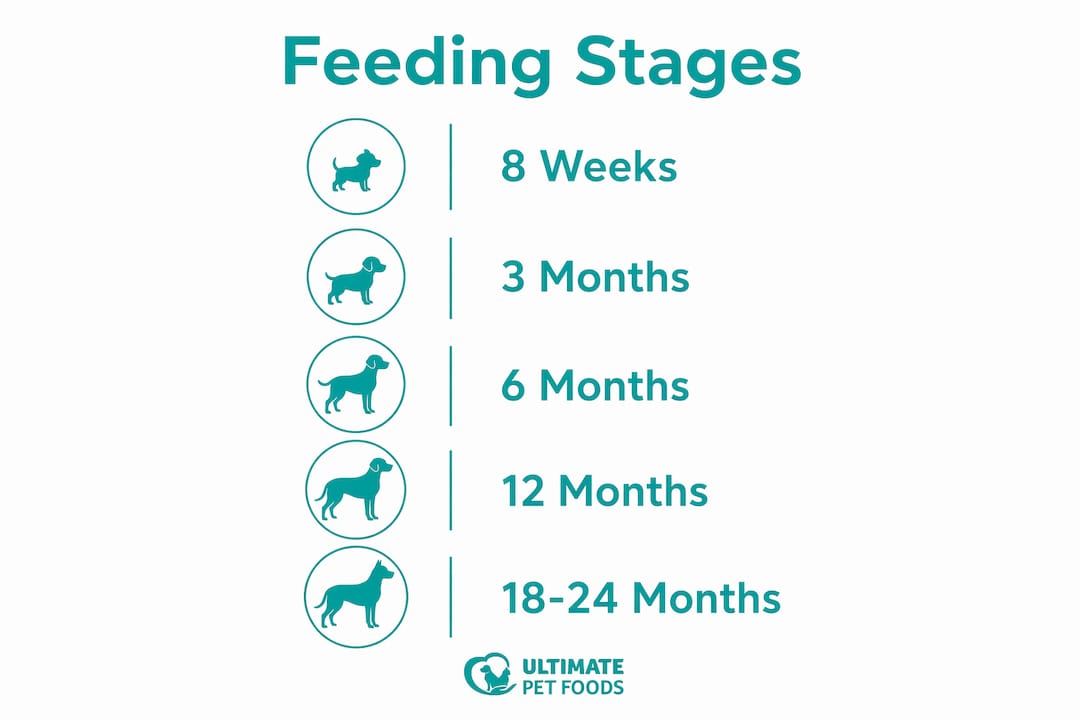
A Labrador, German Shepherd, Golden Retriever, or Rottweiler is not just a bigger version of a small dog that needs more food. The length of their growth window is what sets them apart. While a Chihuahua is fully grown at nine months, Kirk was still developing at 18 months. A Great Dane won't be fully grown until 24 months. That's two years of getting the nutrition exactly right, every single day.
During that growth window, the speed at which a large breed puppy develops is directly connected to what they eat. Too many calories, or too much calcium, and bone grows faster than cartilage can support it. The result is a group of conditions called developmental orthopedic disease — hip dysplasia, osteochondrosis, and related skeletal disorders. These aren't conditions that appear out of nowhere. They're overwhelmingly linked to overnutrition and rapid growth in puppies who were fed the wrong food, or too much of the right one.
This is why the formulation matters so much, and why feeding accurately matters just as much as the formulation itself. Large breed puppies need a different nutritional approach from the very first meal — not when problems start to show.
Tip: Large and giant breed puppies should stay on a large breed puppy formula for 18 to 24 months. Switching to adult food early removes the calcium and phosphorus controls their developing skeleton still needs.
What the right food actually controls
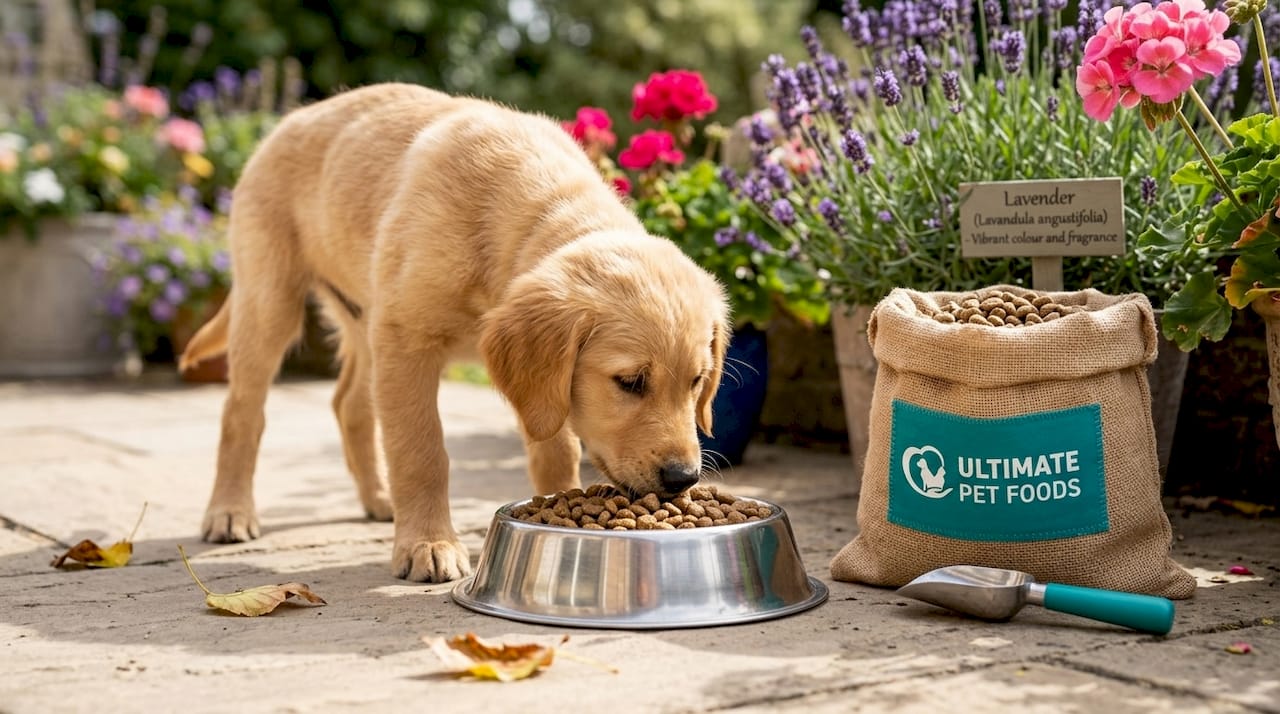
When I switched Kirk from supermarket food to a properly formulated grain-free large breed recipe built on freshly prepared salmon and chicken, I wasn't just changing the ingredients on the label. I was changing the specific nutrient ratios that govern how quickly and safely he could grow.
The four things a large breed puppy food genuinely needs to manage are:
- Calcium and phosphorus in the correct ratio — too much calcium is directly linked to bone mineralisation problems. The calcium-to-phosphorus ratio matters more than the absolute amounts, and adding calcium supplements on top of a complete food is one of the most common mistakes owners make.
- Fat content kept in check — higher fat means higher calorie density, and in large breed puppies, excess calories drive the kind of rapid growth that leads to orthopedic disease. Lower fat slows things down to a healthy pace.
- Vitamin D, carefully controlled — it regulates how the body absorbs calcium. Get it wrong in either direction and the calcium ratio you've carefully managed becomes less predictable.
- Restricted energy density — this makes it harder to accidentally overfeed. A kibble that's too calorie-dense means small measurement errors compound quickly.
Kirk's coat was visibly shinier within about four weeks of switching, which I attribute directly to the natural DHA from salmon oil in his recipe. But the bigger benefit was invisible — steadier, safer bone development throughout his entire 18-month growth period. He moved onto our adult large breed formula lean, active, and in excellent joint health.
What to look for when choosing a food
Most supermarket large breed puppy foods meet the minimum legal standard — but minimum and optimal are very different things. Here's what actually separates a properly formulated food from one that's just labelled correctly.
Freshly prepared meat or fish as the named first ingredient. Not "meat meal". Not "animal derivatives". A specific, named protein — chicken, salmon, turkey — that tells you what you're actually feeding. Freshly prepared meat delivers better digestibility and more consistent amino acid profiles than rendered meal.
Named salmon oil, not just "fish oil" or "fish derivatives". Salmon is a natural source of DHA, which supports brain and eye development during puppyhood, and omega-3 fatty acids that reduce joint inflammation. Generic fish derivatives don't tell you what you're getting or how consistently it's sourced.
Prebiotics — specifically MOS and FOS. These support the gut microbiome, which in large breed puppies means better nutrient absorption at the exact stage of development when every gram of calcium and phosphorus needs to reach the right place. They're rarely included in budget kibbles.
Glucosamine and chondroitin for cartilage support. Given how hard the skeletal system is working during an extended growth period, supporting cartilage integrity from the food itself is a meaningful advantage for breeds predisposed to joint conditions.
If a food meets all of these and has been formulated by veterinary nutritionists rather than just meeting legal minimums, it's doing the actual job. If it ticks one or two boxes while leaving the rest to chance, the label is telling you less than you think.
Tip: Don't try to compensate for gaps in a basic food with individual supplements. A properly balanced formulation does all of this simultaneously, and adding calcium or vitamin D on top of a complete food can create the exact imbalances you're trying to prevent.
How to feed a large breed puppy correctly
Finding the right food is only part of it. Kirk's development was healthy not just because of what he ate, but because of how we fed him. The two biggest mistakes I see large breed puppy owners make are free-feeding and relying on cups.
Measure every meal by weight, not volume. Cup measurements vary enormously depending on how tightly you pack the kibble. Calorie density also varies between brands, which means a cup of one food isn't the same as a cup of another. Calculate the right grams per meal based on your puppy's current weight and target adult weight, and stick to it. Small, consistent overfeeding is how orthopedic problems start.
Feed two or three smaller meals a day, not one large one. Large and deep-chested breeds are susceptible to bloat, which can be triggered by large single meals. Splitting the daily allowance across multiple feeds also supports steadier digestion and more even energy.
Check the ribs weekly. You should be able to feel them without pressing hard, but not see them. If you can't feel them easily, reduce the portion slightly. If you can see them, increase it. Body condition beats the scale as a week-to-week guide because it tells you what's actually happening rather than just how much your puppy weighs. The body condition score approach recommended by vets is a reliable framework for this.
Transition gradually between foods. Any switch — including from puppy to adult food at 18 to 24 months — should happen over several days, mixing increasing proportions of the new food with the old. Large breed puppies have sensitive digestive systems, and abrupt changes tend to set things back.
Tip: Use our puppy portion sizing guide to calculate accurate meal sizes based on your puppy's current weight and target adult weight. Getting this right from day one is the single most practical thing you can do for your large breed puppy's long-term skeletal health.
Why we built our grain-free large breed puppy recipe
After Kirk's early experience on supermarket food, I spent a significant amount of time understanding exactly what a large breed puppy recipe needed to do — not just nutritionally, but in terms of ingredients you could actually trace and trust. When we developed our grain-free large breed puppy formula with G.A. Pet Food Partners in Chorley, those requirements shaped every decision.
The recipes are built on freshly prepared meat and fish, gently cooked at 82°C using our Sourced™ process — a gentler method than standard high-temperature extrusion that better preserves the integrity of proteins and natural fats. Salmon is a named ingredient delivering natural DHA and omega-3s, not a catch-all derivative. MOS and FOS prebiotics are included as standard. Kibble size and texture are designed to support mechanical dental cleaning as your puppy chews.
For dogs with specific sensitivities — and this is something I understand personally through Kirk — our Ultimate+ Functional Health range uses hydrolysed proteins across five targeted formulas: Digestive Care, Skin & Coat Care, Weight Control & Joint Care, Dental Care, and Healthy Living. Hydrolysed proteins are broken down to a size that's less likely to trigger immune responses, which makes them a genuinely different proposition for dogs whose digestive systems don't respond well to standard proteins.
Kirk transitioned onto our adult large breed formula at 18 months and stayed on it for the rest of his life. The continuity — a trusted formulation from puppy through to adult, with consistent ingredients and a manufacturing process I could account for — is something I believe made a real long-term difference to his joint health and quality of life. He was a good dog. This brand exists because of him, and everything we make is still made with him in mind. RIP Kirk.
Our recipes are complete and balanced for daily feeding, with no need for additional supplements. See how our approach compares to standard supermarket options on our dog food comparison page, or read more about vet-recommended dog food and what separates it from supermarket alternatives.
FAQ
What is large breed puppy dry food?
Large breed puppy dry food is a specially formulated kibble that controls calcium, phosphorus, fat, and calorie levels to support steady skeletal growth in puppies whose adult weight will exceed 25 kg. It differs from standard puppy food in its nutrient ratios, which are designed to prevent developmental orthopedic disease.
How long should a large breed puppy stay on puppy food?
18 to 24 months, depending on breed size. Giant breeds should stay on a large breed puppy formula until the upper end of that range. Switching to adult food too early removes the calcium and phosphorus controls that protect their still-developing skeleton.
Can I add calcium supplements to my large breed puppy's food?
No — not if they're eating a complete and balanced large breed puppy food. The calcium is already precisely calibrated. Adding more disrupts the ratio that makes the formulation safe and is directly linked to developmental orthopedic disease. More is not better here.
Why is salmon beneficial in large breed puppy food?
Salmon provides natural DHA, which supports brain and eye development during the puppy phase, and omega-3 fatty acids that support coat health and reduce inflammation in developing joints. The difference between named salmon as an ingredient and a generic "fish derivative" is transparency and consistency — with a named ingredient, you know what you're getting and so does the manufacturing process.
How do I know if I am feeding my large breed puppy the right amount?
Check the calorie density (kcal per 100g) on your specific food, calculate portions from there rather than relying on cup guidelines, and monitor body condition weekly. You should be able to feel your puppy's ribs without pressing hard. Our dog food portion control guide gives you a practical framework based on current weight and target adult weight.


