
Choosing the right dog food for colitis: a UK guide
For most dogs with colitis, the best starting point is a hydrolysed protein or novel-protein, limited-ingredient diet that is highly digestible and contains appropriate soluble fibre. These approaches reduce antigenic triggers in the colon and help firm stools more reliably than a standard diet switch. UK primary-care data shows colitis accounts for a small proportion of acute diarrhoea cases in veterinary practice, so you are far from alone in searching for answers.
What to look for on the label:
- “Hydrolysed protein” or a single, genuinely novel protein source (e.g. venison, duck, or white fish your dog has never eaten)
- High digestibility (ideally above typical veterinary recommendation thresholds) or a “digestive care” positioning
- Added prebiotics, specifically MOS (mannan-oligosaccharides) and FOS (fructo-oligosaccharides)
Immediate vet reminder: if your dog is vomiting repeatedly, passing blood, losing weight, or seems lethargic, contact your vet today rather than trialling a new food first.
Key takeaways
The most effective colitis diet combines high digestibility, a hydrolysed or novel protein source, appropriate soluble fibre, and daily prebiotic support through MOS and FOS, run as a strict trial for 8–12 weeks under veterinary guidance.
| Point | Details |
|---|---|
| Choose the right diet type | Hydrolysed or novel-protein, highly digestible diets with soluble fibre are the most reliably effective starting points for colitis. |
| Run a strict trial | No treats, no extras, consistent feeding times; allow 8–12 weeks for food-responsive cases before drawing conclusions. |
| Avoid key triggers | High-fat food, sudden protein switches, dairy, flavoured chews, and scavenging are the most common causes of flares. |
| Add prebiotics daily | MOS and FOS integrated into a complete kibble provide more consistent gut support than intermittent supplementation. |
| Ultimatepetfoods Digestive Care | The Ultimate+ Functional Health Digestive Care kibble uses hydrolysed protein with added MOS and FOS, gently cooked at 82°C, for everyday feeding. |
Table of Contents
- Which diet types actually help a dog with colitis?
- How to run a strict diet trial for colitis
- What not to feed a dog with colitis
- Which supplements may support gut health during colitis?
- Home-cooked, over-the-counter, or prescription: which route is right?
- What to look for on the label when choosing a colitis diet
- What the research actually shows about hydrolysed proteins and digestibility
- Managing a colitis flare at home: what to do right now
- How to introduce new foods without triggering a flare
- Nutritional supplementation during colitis management: what to prioritise
- Long-term monitoring to prevent colitis relapse
- Our perspective on everyday feeding and digestive support
- Ultimatepetfoods digestive care range: where to start
- Sources
- FAQ
Which diet types actually help a dog with colitis?
Veterinary dietary guidance consistently recommends four main strategies for managing colitis through food. Each suits a slightly different clinical picture.
Hydrolysed protein diets
Hydrolysis breaks dietary protein into very small peptides or amino acids, too small for the immune system to recognise as foreign. This reduces the antigenic load reaching the colon wall, which is particularly useful when food-responsive enteropathy is suspected. Hydrolysed diets are the preferred choice for a strict elimination trial and for dogs that have already reacted to multiple protein sources.
- Pros: low antigen load, highly digestible, suitable for elimination trials
- Cons: more expensive; some dogs find palatability lower; prescription versions require vet authorisation
Pro Tip: Not all hydrolysed diets are equal. Look for a product where the protein source is named (e.g. “hydrolysed chicken” or “hydrolysed salmon”) rather than a vague “hydrolysed animal protein” — the source matters for traceability and for running a clean elimination trial.
Novel-protein / limited-ingredient diets
A novel protein is one your dog has genuinely never eaten before. Limiting the ingredient list reduces the chance of an unintentional antigenic trigger. These diets work well when you have a clear dietary history and can identify proteins your dog has not been exposed to.
- Pros: widely available without prescription; often more palatable; good for dogs with a known single-protein sensitivity
- Cons: cross-contamination in manufacturing can undermine strict trials; requires honest dietary history
Pro Tip: Check the manufacturing statement on the bag. “Made in a facility that also handles wheat, chicken, and beef” can compromise a novel-protein trial if your dog is genuinely food-reactive.
Highly digestible / bland diets
A highly digestible diet aims to ensure nutrients are absorbed in the small intestine before they reach the colon. Poorly digested protein that arrives in the large bowel is fermented by bacteria, worsening stool quality and inflammation. The practical target is a diet absorbed before the colon even sees it. These formulas suit acute flares, stress colitis, and dogs with malabsorptive tendencies.
- Pros: gentle on the gut; reduces bacterial fermentation in the colon; good for short-term recovery
- Cons: not always appropriate long-term without vet guidance; some bland home-cooked options are nutritionally incomplete
Modified soluble-fibre diets
Soluble fibre (psyllium, FOS, inulin) ferments in the colon to produce short-chain fatty acids, which feed colonocytes and help firm loose stools. Insoluble fibre, by contrast, adds bulk but can reduce overall digestibility. For large-bowel colitis specifically, a diet with a measured increase in soluble fibre often produces the most noticeable improvement in stool consistency.
How to run a strict diet trial for colitis
A diet trial only gives you reliable information if it is genuinely strict. Half-measures produce ambiguous results and extend the time your dog is uncomfortable.
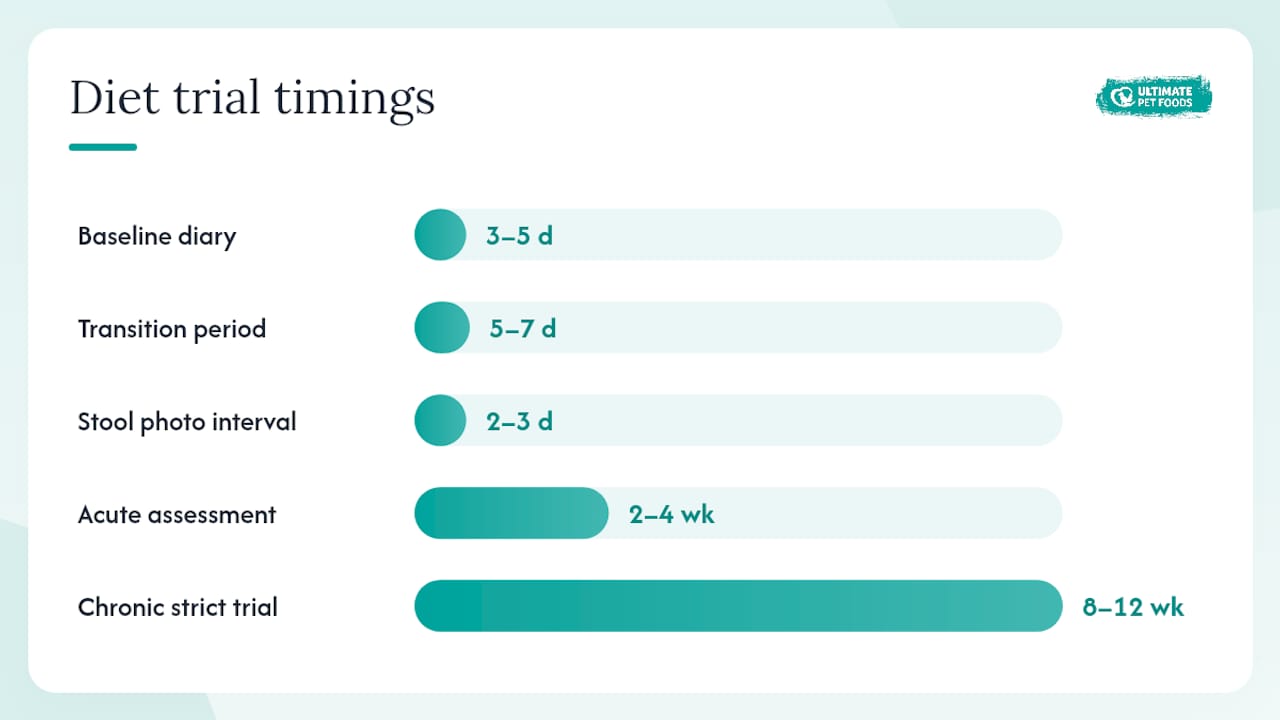
- Write a baseline food diary. Note current food, treats, dental chews, flavoured supplements, and any table scraps for three to five days before you switch.
- Switch fully to the trial food. Transition over five to seven days by gradually replacing the old food to reduce the risk of a transition-related upset.
- Remove every other food source. No treats, no flavoured toothpaste, no flavoured medications if avoidable (discuss plain alternatives with your vet), no table scraps, no dental chews unless they are made from the same protein as the trial food.
- Feed at consistent times each day. Irregular feeding can itself trigger colitis in susceptible dogs.
- Keep a daily symptom log. Record stool frequency, consistency (use the Bristol Stool Scale adapted for dogs), presence of mucus or blood, appetite, and energy level.
- Assess at the right time. For acute or stress-related colitis, two to four weeks may be enough to see clear improvement. For suspected food-responsive enteropathy or chronic colitis, veterinary guidance recommends an 8–12 week strict trial before drawing conclusions.
When to judge improvement: look for firmer stools, reduced frequency, absence of mucus or blood, and a return of normal appetite and energy. Partial improvement at four weeks is a positive signal worth continuing.
When to stop and call your vet:
- Worsening symptoms at any point
- New vomiting, significant weight loss, or lethargy
- No change at all after four weeks on a hydrolysed or novel-protein diet
Pro Tip: Take a photo of your dog’s stool every two to three days during the trial. It sounds unglamorous, but a visual record is far more useful to your vet than a verbal description, and it removes the memory bias that makes owners underestimate or overestimate progress.
What not to feed a dog with colitis
Getting the “avoid” list right is just as important as choosing the right food.
- High-fat foods and greasy leftovers. Fat slows gastric emptying and can worsen diarrhoea; rich human food is one of the most common triggers for a colitis flare.
- Dairy products. Most adult dogs have reduced lactase activity; dairy adds fat and can cause osmotic diarrhoea.
- Rich treats, rawhide, and flavoured dental chews. These introduce proteins and additives that break a diet trial and can independently irritate the colon.
- Bones (cooked or raw). Cooked bones splinter; raw bones introduce new proteins and bacteria that complicate both the clinical picture and any ongoing trial.
- Sudden protein switches. Changing protein source abruptly without a transition period is a reliable way to trigger a flare, even with an otherwise suitable food.
- Scavenging and bin-raiding. Dietary indiscretion is a leading cause of acute colitis in dogs. Secure your bins and supervise garden time during a trial.
- Stress triggers. Boarding, house moves, and big household changes can precipitate colitis independently of diet. Where possible, maintain routine during a trial period.
Pro Tip: Flavoured worming tablets and flavoured joint supplements are easy to overlook. During a strict diet trial, ask your vet for unflavoured alternatives or plain tablet forms — the flavouring agents in many supplements are enough to confound results.
Which supplements may support gut health during colitis?
Supplements can play a useful supporting role, but they work best alongside a well-chosen diet rather than instead of one.
- Prebiotics (MOS and FOS). Mannan-oligosaccharides and fructo-oligosaccharides act as selective substrates for beneficial bacteria in the gut. They are most effective when integrated daily into a complete food rather than added intermittently, because consistent supply maintains the bacterial environment rather than periodically disrupting it.
- Probiotics. Strain specificity matters. Veterinary-grade probiotic pastes (containing strains such as Enterococcus faecium SF68 or Lactobacillus acidophilus) are used short-term during flares to help restore microbial balance. Probiotics are not a guaranteed fix, and the MSD Veterinary Manual recommends them as adjuncts to dietary therapy rather than primary treatment.
- Psyllium husk. A soluble fibre supplement that can firm stools in large-bowel colitis. A typical starting point for home use is a small pinch (roughly 1 teaspoon per 10 kg body weight) mixed into food, but confirm the dose with your vet, particularly for puppies, elderly dogs, or those on other medications.
- Fish oil (omega-3 fatty acids). EPA and DHA have immunomodulatory properties and may reduce colonic inflammation as an adjunct. Expectations should be realistic: fish oil supports the diet, it does not replace it. Discuss dose with your vet before adding it to a dog with active colitis.
“Dietary therapy remains the cornerstone of colitis management. Supplements such as pre- and probiotics and soluble fibre are useful adjuncts, but they are most effective when the underlying diet is already appropriate for the individual dog.” — MSD Veterinary Manual, Colitis in Small Animals
Always check with your vet before adding supplements to the diet of a puppy, a senior dog, or any dog that is systemically unwell.
Home-cooked, over-the-counter, or prescription: which route is right?
Home-cooked diets
A plain chicken and rice meal is useful for two to three days during an acute flare, but home-cooked diets are rarely nutritionally complete for longer periods. Without input from a veterinary nutritionist, long-term home cooking risks deficiencies in calcium, phosphorus, and key micronutrients. Use them as a short-term bridge, not a permanent colitis diet.
Pro Tip: If you want to use a home-cooked diet beyond a week, ask your vet for a referral to a board-certified veterinary nutritionist (RCVS-recognised in the UK) who can formulate a balanced recipe specific to your dog.
Over-the-counter limited-ingredient and hydrolysed options
Good-quality OTC limited-ingredient and hydrolysed kibbles are appropriate for many dogs with mild to moderate colitis, particularly when a prescription-level elimination trial is not required. The key caveat is manufacturing cross-contamination: for a dog with confirmed severe food-responsive enteropathy, an OTC hydrolysed product may not be sufficiently controlled for a diagnostic trial.
Pro Tip: For a monitoring trial rather than a diagnostic elimination trial, a high-quality OTC hydrolysed dog food is often entirely appropriate and considerably more affordable than a prescription diet.
When vets prescribe therapeutic hydrolysed diets
Prescription hydrolysed diets are indicated when:
- A strict diagnostic elimination trial is needed to confirm food-responsive enteropathy
- The dog has refractory IBD or has failed to respond to OTC dietary changes
- Systemic signs (weight loss, hypoproteinaemia, vomiting) suggest a more serious enteropathy requiring controlled nutrition
Vet trigger list — escalate to diagnostics if you see:
- No improvement after an 8–12 week strict diet trial
- Persistent or worsening weight loss
- Repeated vomiting alongside colitis signs
- Fever, lethargy, or signs of systemic illness
- Blood in stools that does not resolve within 48 hours
What to look for on the label when choosing a colitis diet
Label checklist
- Named protein source: “hydrolysed salmon” or “duck” rather than “animal derivatives”
- “Hydrolysed” wording if running an elimination trial
- Fat level: moderate is preferable; avoid formulas where fat is the second or third ingredient
- Fibre sources: look for soluble sources (chicory, FOS, psyllium) rather than purely insoluble (cellulose)
- Added MOS and FOS: listed in the additives or supplement section
- Digestibility claim: “highly digestible” or a validated digestibility figure if available
- “Complete and balanced” declaration: confirms the food meets nutritional requirements for daily feeding
For sensitive stomach guidance specific to the UK market, checking both the guaranteed analysis and the ingredient order gives you the clearest picture of what you are actually feeding.
Questions to ask your vet
- Is this food suitable for a diagnostic elimination trial, or only a monitoring trial?
- How long should the trial run before we assess response?
- What improvement markers will you use to judge success?
- If the trial succeeds, can we step down to a maintenance diet, and what would that look like?
- Does my dog need any blood or faecal tests before or during the trial?
What the research actually shows about hydrolysed proteins and digestibility
The evidence base for hydrolysed protein diets in canine gut health has grown meaningfully over the past few years, though most trials remain relatively small and results vary by hydrolysate source.
| Study design | Key finding | Caveat |
|---|---|---|
| Replicated Latin-square trial, chicken hydrolysates | Higher fecal butyrate and lower protein-degradation metabolites vs chicken-meal control | Healthy dogs; effects varied by hydrolysate inclusion level |
| Randomised double-blind RCT, hydrolysed anchovy protein, 42 days | Reduced fecal indole and skatole (putrefactive compounds) vs control | Healthy West Highland white terriers; no change in systemic inflammation markers |
| Extruded-diet study, protein hydrolysates | Lower fecal peptides and protein-degradation metabolites; changes suggesting reduced oxidative stress | Healthy dogs; mechanistic, not a clinical colitis trial |
The chicken hydrolysate trial and the hydrolysed anchovy RCT both point in the same direction: hydrolysed proteins can reduce putrefactive fermentation in the colon and shift microbiota towards profiles associated with better colonocyte health. The practical implication is that maximising digestibility keeps more nutrients in the small intestine and less fermentable substrate in the colon.
Managing a colitis flare at home: what to do right now
Most mild colitis flares settle within 48–72 hours with simple management. Here is a practical checklist.
Immediate steps:
- Offer small, frequent meals of a bland, easily digestible food (plain boiled chicken and white rice, or your dog’s usual highly digestible kibble in smaller portions)
- Keep fresh water available at all times; dehydration worsens quickly with loose stools
- Use a vet-grade probiotic paste short-term to support microbial balance during the flare
- Avoid anti-diarrhoeal human medications (loperamide can be harmful in certain breeds, particularly collies with the MDR1 mutation)
- Keep your dog calm and maintain a consistent routine
Red flags requiring same-day veterinary attention:
- Blood in stools that is bright red or present in large amounts
- Persistent vomiting alongside diarrhoea
- Visible lethargy, weakness, or collapse
- Signs of dehydration (sunken eyes, skin that does not spring back when gently pinched)
- Fever or rapid weight loss
- No improvement after 48–72 hours of home management
How to introduce new foods without triggering a flare
Introducing any new food too quickly is one of the most reliable ways to provoke a colitis episode, even when the food itself is well-suited to your dog. The colon’s microbial community needs time to adapt to a change in substrate.
A five-to-seven day transition is the standard approach: replace roughly 25% of the old food with the new on days one and two, 50% on days three and four, 75% on days five and six, and complete the switch on day seven. For dogs with a history of colitis, extending this to ten days is sensible. If loose stools appear during the transition, slow down rather than push through.
One detail owners often miss: the texture and moisture content of a new food can itself cause a temporary change in stool quality, even without any ingredient sensitivity. Moving from a wet food to a dry kibble, for instance, changes water intake and transit time. Give your dog’s gut a full week to adjust before drawing any conclusions about whether the new food suits them.
Nutritional supplementation during colitis management: what to prioritise
Supplementation decisions should follow the diet, not precede it. Once you have chosen an appropriate base diet, the most practical additions are those already integrated into the food itself.
Prebiotics built into the kibble formula, specifically MOS and FOS, provide consistent daily support for beneficial bacteria without the variability of separate dosing. This matters because intermittent prebiotic use produces inconsistent effects on the gut microbiome; daily inclusion in a complete food maintains the environment more reliably.
For dogs in active recovery, a short course of a veterinary probiotic paste (two to four weeks) alongside the new diet can help re-establish microbial balance faster than diet alone. Once stools have normalised, continuing with a prebiotic-fortified complete food is usually sufficient for ongoing maintenance.
Fish oil is worth discussing with your vet if your dog has chronic or recurrent colitis, particularly if there is a suspected inflammatory component. The omega-3 fatty acids EPA and DHA support immune modulation in the gut lining, though the effect is gradual and works over weeks rather than days. Psyllium husk remains a practical, low-cost soluble fibre addition for dogs whose stools remain inconsistently formed even on a good diet.
Long-term monitoring to prevent colitis relapse
Chronic colitis rarely resolves permanently after a single dietary change. The dogs that do best long-term are those whose owners track patterns and act early on warning signs.
Keep a simple monthly log noting stool consistency, frequency, and any episodes of mucus or blood. A single loose day is rarely significant; two or three in a row, or any return of mucus, warrants a call to your vet. Weight monitoring at home (a monthly weigh-in on bathroom scales with your dog in your arms, then subtract your own weight) catches slow weight loss before it becomes clinically significant.
Diet consistency is the single most powerful long-term tool. Stick to the food that worked. Resist the temptation to rotate proteins or try new treats, particularly during the first six months after a successful trial. If you want to introduce variety later, do so one ingredient at a time, slowly, and with your symptom log running.
Annual vet check-ins for dogs with a history of colitis are worthwhile even when things seem settled. Faecal parasite screens, particularly for Tritrichomonas foetus and Giardia, are worth repeating periodically since both can mimic dietary colitis and are easily missed without targeted testing.
Our perspective on everyday feeding and digestive support
We formulate every Ultimatepetfoods recipe with the gut in mind from the start. Our freshly prepared meat and fish is gently cooked at 82°C, a temperature chosen to help lock in nutrients and natural palatability without the harsh processing that can reduce digestibility. We use human-grade ingredients where applicable, because the quality of the raw material directly affects how well your dog absorbs what they eat.
Every applicable recipe includes added MOS and FOS prebiotics, not as an afterthought, but as a core part of the formula. We believe prebiotics belong in the daily bowl, not in a separate supplement pot, because consistent daily intake is what actually shifts the microbial environment over time.
Our Ultimate+ Functional Health range takes this further. The Digestive Care formula uses hydrolysed proteins specifically to reduce antigenic load and support dogs with sensitive digestion, and it is designed for ongoing, everyday feeding, not just short-term recovery. The range also includes Skin & Coat Care, Weight Control & Joint Care, Dental Care, and Healthy Living options, each formulated for targeted daily support. These are complete and balanced dry kibbles, appropriate for all breeds and life stages where stated, and suitable for lifelong feeding.
Ultimatepetfoods digestive care range: where to start
If your dog has colitis and you are ready to try a well-formulated, everyday dry kibble with added MOS and FOS, the Ultimatepetfoods Ultimate+ Functional Health range is worth a close look. The Digestive Care formula uses hydrolysed protein, is made with freshly prepared meat gently cooked at 82°C, and is positioned as a complete, balanced daily food rather than a short-term fix.
Sample packs are available if you want to check palatability before committing to a full bag, which is always a sensible step when switching a dog with a sensitive gut. For dogs without a specific digestive concern, our high-meat chicken kibble offers a complete, gently cooked everyday option with the same commitment to freshly prepared ingredients. Always discuss any diet switch with your vet before changing the food of a dog that is currently unwell. Browse the full range and order a sample at Ultimatepetfoods.
Sources
- Dietary management in cats and dogs with chronic gastrointestinal disease (Vettimes)
- Controlled trials on chicken protein hydrolysates and canine gut metabolites (PMC)
- Colitis in small animals — MSD Veterinary Manual
This article is general information, not a substitute for advice from a qualified doctor. Consult a qualified healthcare professional about your own circumstances before acting on anything here.
FAQ
What food is best for a dog with colitis?
A hydrolysed protein or novel-protein, limited-ingredient diet that is highly digestible and contains soluble fibre (such as FOS or psyllium) is the most commonly recommended starting point. Look for added MOS and FOS prebiotics and a “complete and balanced” declaration on the label.
What should you not feed a dog with colitis?
Avoid high-fat foods, dairy, rich treats, flavoured dental chews, rawhide, cooked bones, and any sudden protein switches. Table scraps and scavenging are among the most common triggers for acute colitis flares.
How do you stop a colitis flare-up in dogs?
Offer small, frequent meals of a bland or highly digestible food, keep fresh water available, and use a vet-grade probiotic paste short-term. If symptoms do not improve within 48–72 hours, or if blood, vomiting, or lethargy appear, contact your vet promptly.
What brings on colitis in dogs?
Common triggers include dietary indiscretion (eating something unsuitable), sudden food changes, food sensitivities or allergies, intestinal parasites, stress, and bacterial infections. UK primary-care data shows colitis accounts for a small proportion of acute diarrhoea cases in veterinary practice, so you are far from alone in searching for answers.
Do dogs with colitis need a prescription diet?
Not always. Many dogs respond well to a high-quality over-the-counter hydrolysed or novel-protein kibble. Prescription therapeutic diets are indicated when a strict diagnostic elimination trial is required, when the dog has refractory IBD, or when systemic signs suggest a more serious condition needing controlled nutrition under veterinary supervision.