
How fresh ingredients improve dog food nutrition and health
TL;DR:
- Not all premium dog foods deliver the same benefits, and the term “fresh” does not guarantee superior nutrition.
- Understanding what qualifies as “fresh” ingredients and how they impact digestibility and urinary health helps owners make informed choices.
Not all premium dog foods deliver equal results, and the term “fresh” on a label does not automatically translate to better nutrition for your dog. Many owners invest in higher-end products trusting they are doing the very best for their companion, only to find persistent digestive issues, poor coat condition, or low energy that no amount of premium pricing seems to fix. Understanding what fresh ingredients actually mean, how they interact with your dog’s physiology, and what genuine nutritional quality looks like puts you in a far stronger position. This guide gives you that clarity, so every meal you serve supports a longer, healthier, happier life. 🐾
Table of Contents
- What do fresh ingredients mean in dog food?
- How do fresh ingredients impact digestibility and stool quality?
- The role of moisture: Hydration and urinary health benefits
- What to look for: Assessing fresh ingredients and premium dog food
- The uncomfortable truth: Why “fresh” isn’t everything and what most owners miss
- Explore premium fresh dog food options
- Frequently asked questions
Key Takeaways
| Point | Details |
|---|---|
| Freshness enhances digestion | Minimally processed fresh ingredients improve nutrient absorption and firmer stools for many dogs. |
| Moisture supports hydration | High moisture fresh foods boost daily water intake and help lower urinary health risks. |
| Not all ‘fresh’ foods are equal | The true health benefit depends on complete, balanced formulation as well as ingredient sourcing. |
| Assess full nutritional value | Owners should verify nutritional adequacy and suitability for their dog’s individual needs when choosing fresh dog food. |
What do fresh ingredients mean in dog food?
Now that we’ve acknowledged the confusion, let’s clarify what actually counts as “fresh” in your dog’s bowl.
In the dog food industry, “fresh” refers to ingredients that are minimally processed, sourced directly from whole food sources, and preserved through limited processing steps such as gentle cooking, freeze-drying, or refrigeration rather than high-temperature extrusion or chemical preservation. A fresh chicken breast used in dog food looks and behaves much like the one you’d roast at home. A meat meal, by contrast, is rendered under extreme heat into a dry powder, concentrating protein but also degrading heat-sensitive amino acids and vitamins along the way.
The distinction matters enormously at a nutritional level. Here is how different ingredient types compare:
- Fresh meat: Whole muscle meat with natural moisture content (around 70%), intact proteins, and a full amino acid profile. Minimal processing preserves enzymatic activity and bioavailable nutrients.
- Meat meal: Rendered and dried. Protein content is concentrated but the high-heat process can reduce amino acid digestibility and destroy naturally occurring moisture.
- Meat by-products: Can include organ meats, which are genuinely nutritious, or lower-quality parts. Quality varies enormously depending on the manufacturer’s sourcing.
- Highly processed kibble: Extruded at temperatures exceeding 150°C. Starch gelatinisation occurs and synthetic vitamins must be added back to compensate for losses during processing.
Understanding fresh vs meat meal is one of the most useful steps any owner can take when reading labels. However, there is an important caveat worth stating clearly. As research indicates, nutrient digestibility from fresh foods may be higher, but “the benefit is not automatic and depends on formulation quality and processing details.” Freshness is a starting point, not a guarantee.
Storage also plays a critical role. Fresh ingredients exposed to heat, light, or oxygen degrade quickly. A genuinely fresh product will use appropriate packaging, refrigeration, or cold-chain delivery to maintain nutritional integrity from factory to bowl. Knowing how to identify spotting fresh ingredients on packaging helps you cut through marketing language and focus on what actually matters.
“Fresh (minimally processed) dog foods may improve nutrient digestibility and reduce stool output and softness, but the benefit is not automatic and depends on formulation quality and processing details.” — University of Illinois Research
How do fresh ingredients impact digestibility and stool quality?
With a clear picture of what counts as fresh, let’s dig into what this means for your dog’s digestion and daily comfort.

Digestibility is the percentage of a food’s nutrients that your dog’s body actually absorbs and uses. It is arguably the most important measure of a food’s true value, far more meaningful than the crude protein or fat percentages printed on the back of the bag. Higher digestibility means your dog gets more nutrition from every gram eaten, produces less stool waste, and places less burden on the gastrointestinal tract.
Research consistently shows that processing method is one of the strongest predictors of digestibility. Freeze-dried foods generally achieve the highest amino acid digestibilities, while extruded kibble typically scores the lowest. Retorted (wet/canned) foods fall in between. The practical implications of this are significant.
| Food type | Typical amino acid digestibility | Moisture content | Stool output |
|---|---|---|---|
| Freeze-dried raw | 85–92% | 5–10% (rehydrated: ~70%) | Low |
| Gently cooked fresh | 80–88% | 65–75% | Low to moderate |
| Wet/retorted food | 75–83% | 75–82% | Moderate |
| Standard extruded kibble | 68–78% | 8–12% | Higher |
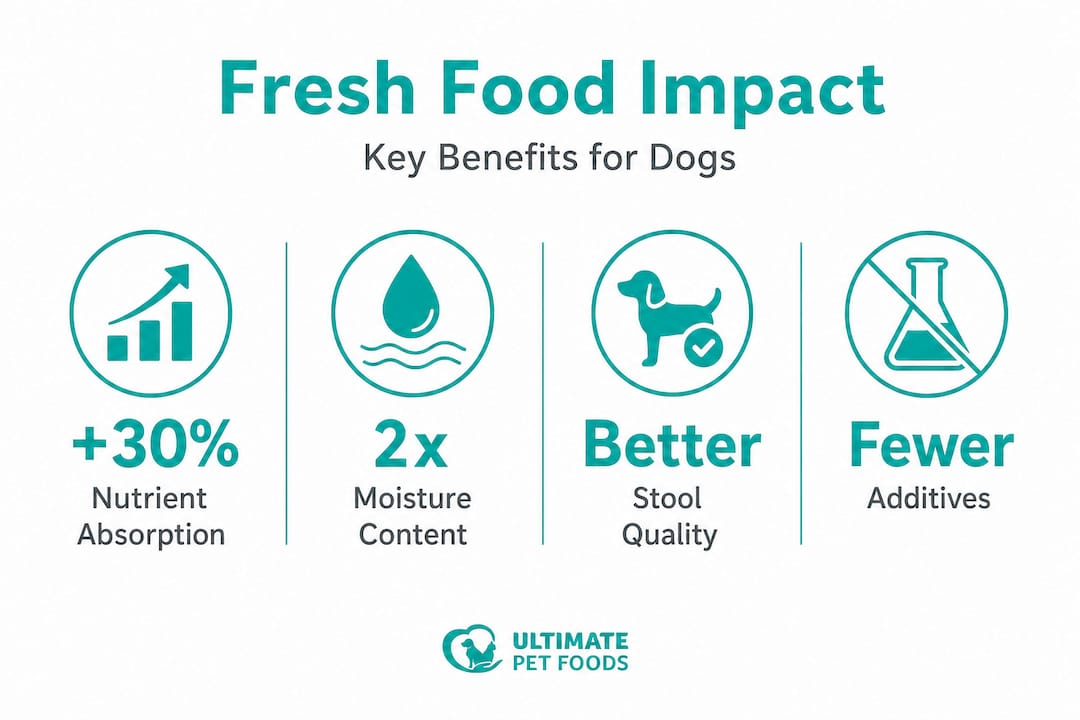
For dogs with sensitive digestion, the difference between a high-digestibility fresh diet and a standard extruded kibble is not abstract. It shows up in daily life: firmer, smaller stools, less gas, and a calmer digestive tract. Fresh food vs kibble comparisons consistently highlight that dogs on fresh diets tend to produce noticeably less stool volume, which is a direct indicator that more of the food is being absorbed rather than passing through unused.
Research into fresh diet advantages confirms that fresh ingredients can support better digestibility and quality-of-life markers including firmer stools and less undigested residue. However, this improvement is most reliably seen when the diet is also nutritionally complete and properly formulated.
Pro Tip: If your dog’s stools are consistently large, soft, or frequent, this can be a sign that their current food has low digestibility. Switching to a fresh or gently cooked option and monitoring stool output over two to four weeks is one of the most practical ways to observe real nutritional change.
Understanding the full range of fresh dog food benefits can help you connect the science with the practical differences you will notice at home.
The role of moisture: Hydration and urinary health benefits
Digestibility isn’t the only benefit; hydration plays a powerful and often overlooked role in keeping your dog healthy.
Dogs evolved as meat eaters and historically obtained much of their daily water from the prey they ate. Modern dry kibble upends this completely, providing only 8–12% moisture compared to the 65–75% moisture found in fresh and raw diets. Many dogs fed exclusively on kibble exist in a state of mild, chronic under-hydration, and their kidneys and urinary systems quietly bear the cost.
Fresh diets with high moisture content can measurably increase water intake by as much as 88g per day compared to dry feeding. That shift in fluid balance has measurable consequences for urinary health. Higher water intake dilutes urine and changes what is known as the relative supersaturation (RSS), a measure of how concentrated minerals like struvite and calcium oxalate become in the bladder. When RSS falls into the undersaturated or metastable range, crystal formation becomes far less likely.
The urinary health advantages of feeding with adequate dietary moisture are substantial:
- Reduced urine concentration means minerals are less likely to crystallise and form uroliths (bladder stones).
- More frequent urination helps flush the bladder regularly, reducing bacterial accumulation.
- Lower struvite risk, as research confirms that fresh diet feeding trials produced RSS values consistent with reduced struvite crystal formation.
- Kidney support through better filtration, as hydrated kidneys can process waste products more efficiently.
- Improved comfort for dogs prone to urinary tract sensitivity or recurrent infections.
📊 Key statistic: Dogs consuming fresh diets have been shown to increase their total daily water intake by approximately 88g compared to dry-fed dogs, a meaningful physiological shift that directly influences urinary crystal risk.
Compared to standard dry kibble, even traditional wet food offers a significant moisture advantage. But fresh, gently cooked, or raw diets tend to offer the most consistent and bioavailable hydration alongside superior nutritional quality. You can explore more about the advantages of fresh ingredients in supporting your dog’s overall health, including hydration and urinary comfort.
What to look for: Assessing fresh ingredients and premium dog food
Given all these physiological benefits, how can you be sure you’re choosing a genuinely beneficial fresh food for your dog?
Evaluating a fresh dog food requires more than glancing at the front of the packet. Marketing language like “natural,” “wholesome,” and “farm fresh” is largely unregulated, which means you need practical criteria to cut through the noise. Here is what we recommend looking for:
- ✅ Named protein sources listed first: Look for “fresh chicken,” “deboned salmon,” or “whole turkey” rather than generic “meat and animal derivatives.”
- ✅ Nutritional completeness declaration: The product should meet recognised standards for complete nutrition, ideally aligned with AAFCO or WSAVA guidelines for your dog’s life stage.
- ✅ Transparency on processing: Genuinely fresh brands will tell you how their food is prepared. Gently cooked, freeze-dried, and cold-pressed are positive indicators. Vague language can signal heavy processing.
- ✅ No unnecessary fillers or artificial preservatives: Artificial colours, flavours, and chemical preservatives like BHA or BHT have no place in a quality fresh diet.
- ✅ Appropriate moisture content for format: Fresh and wet products should contain 65–80% moisture. If a product claims freshness but shows low moisture without a freeze-drying explanation, question it.
There are also warning signs worth noting. A fresh product with no complete nutrition declaration, no named protein sources, or with a very long ingredient list dominated by plant-based fillers should prompt scepticism. Research underlines that you should focus on two core drivers: nutrient completeness of the finished diet, and how processing level and formulation affect digestibility and moisture outcomes.
Equally important is knowing when to seek professional input. If your dog has ongoing digestive issues, skin problems, urinary concerns, or a diagnosed condition, dietary changes should be made alongside veterinary guidance. As clinical evidence notes, symptoms that persist after switching to fresh food require proper veterinary evaluation rather than an assumption that “fresh equals correct.” Knowing how to assess quality dog food independently will make you a more informed advocate for your dog’s health.
Pro Tip: Ask the brand directly about their formulation standards and whether their recipes are developed with a veterinary nutritionist. Quality manufacturers are proud to share this information. Evasive answers speak volumes.
The uncomfortable truth: Why “fresh” isn’t everything and what most owners miss
With the science and practical tips covered, it’s time for a candid reflection about common mistakes even dedicated owners can make.
We see it often. An owner switches their dog to an expensive fresh food, uses nothing but whole proteins and natural ingredients, and expects transformation. When the results are underwhelming, the frustration is real and entirely understandable. But the truth is that “fresh” is a quality indicator, not a nutritional guarantee.
Research into processing and long-term health outcomes shows that higher digestibility does not automatically equal better long-term health outcomes. Microbiome effects and metabolite changes can vary significantly depending on diet composition and study design, not just ingredient freshness. A poorly balanced fresh diet can leave a dog deficient in calcium, zinc, or essential fatty acids just as easily as a poor-quality kibble can.
What we believe matters most is this: your dog is an individual. Their age, breed, activity level, gut microbiome composition, and health history all shape how they respond to any given diet. A senior Labrador with joint concerns has genuinely different nutritional needs to a young Border Collie in working condition. Fresh ingredients support better outcomes only when they form part of a thoughtfully balanced, appropriately formulated diet tailored to your dog’s specific needs.
We also encourage owners to resist the false binary of “fresh versus processed.” Some carefully formulated, high-quality processed options provide excellent nutrition for specific dogs, particularly those with medical conditions requiring therapeutic diets. What matters is not the processing level in isolation, but the totality of nutritional quality, ingredient integrity, and suitability for your individual dog. We strongly recommend using resources like our guide to choosing the best fresh pet food as a starting point, then combining that information with observation of your own dog’s response over time.
Long-term feeding studies in dogs are still an emerging field. The evidence we have is encouraging but not exhaustive. As responsible advocates for your dog’s health, we think the wisest approach combines evidence-based choices with close attention to your dog’s individual signals: coat quality, energy levels, stool consistency, and overall vitality. Those daily observations are irreplaceable data points that no study can replicate.
Explore premium fresh dog food options
If you’re ready to act on these insights, discover industry-leading options and further guides below.
We know how much you care about getting this right for your dog. At Ultimate Pet Foods, we’ve built our entire range around the principles this article explores: fresh, named protein sources, minimal processing, complete nutrition, and genuine transparency about what goes into every recipe. Whether your dog needs grain-free support for sensitive digestion, higher moisture content for urinary health, or a breed-specific formula, we have options formulated to real nutritional standards. 🐕
Explore the grain-free diet benefits that make this approach so effective for so many dogs, or read our in-depth fresh vs meal dog food comparison to see how our recipes stand apart. When you’re ready to make the switch, browse our full range of premium fresh and grain-free foods and take the first step towards genuinely nourishing every wag, bounce, and cuddle your dog has to give.
Frequently asked questions
Does fresh dog food help with sensitive stomachs?
Fresh dog foods may ease digestion and improve stool quality for dogs with sensitivities, but if symptoms persist, a vet should evaluate your dog rather than assuming fresh food alone is the correct solution.
Is all “fresh” labelled dog food nutritionally balanced?
Not all fresh dog food is nutritionally complete. Nutrient adequacy and adherence to professional standards such as AAFCO or WSAVA alignment matter just as much as the freshness of individual ingredients.
Can fresh dog food reduce urinary crystal risk?
Fresh diets with higher moisture content help dilute urine, and recent feeding trials confirm that urinary RSS values shift towards ranges associated with reduced crystal formation when dogs consume fresh food consistently.
Are fresh ingredients always better than kibble?
Freshness is one important quality indicator, but formulation quality and nutritional completeness are equally important. Research confirms that digestibility improvements from fresh food depend on the quality of formulation, not freshness alone.