

How to spot fresh ingredients in dog food: 5 key steps

TL;DR:
- Fresh ingredients are minimally processed whole foods, retaining natural moisture and higher nutritional value.
- Reading ingredient lists for named proteins and early placement helps identify high-quality dog foods.
- Packaging and shelf life clues can confirm whether ingredients are truly fresh and stored properly.
If you’ve ever stood in a pet shop aisle staring at a bag labelled ‘natural’ or ‘premium’ and wondered whether it’s actually any good, you’re not alone. Many dog owners are misled by clever marketing that wraps average ingredients in reassuring language. For dogs with sensitivities, allergies, or breed-specific dietary needs, this isn’t just frustrating — it can genuinely affect their health, coat, digestion, and energy. We’ve put together this practical guide to help you cut through the noise, read labels with confidence, and choose dog food that truly delivers on the ‘fresh’ promise. Because your dog deserves better than buzzwords.
Table of Contents
- What makes an ingredient ‘fresh’ in dog food?
- What you need to check before buying: ingredient list essentials
- Other visual and packaging clues to spot freshness
- How to verify freshness for grain-free and sensitive dogs
- Why most owners miss the freshness factor in dog food
- Choose trusted fresh dog food solutions
- Frequently asked questions
Key Takeaways
| Point | Details |
|---|---|
| Read ingredient order | The first ingredients on any dog food label reveal the bulk and determine its real quality. |
| Look for whole foods | Fresh dog food features named meats and visible vegetables, not vague or rendered components. |
| Check for short shelf life | True freshness often means refrigeration is needed and expiry dates are sooner than dry kibble. |
| Watch for special needs | Sensitive or grain-free dogs benefit most from transparency and limited, recognisable ingredients. |
| Ignore buzzwords | Real freshness is proven on the label, not just by advertising with trendy terms. |
What makes an ingredient ‘fresh’ in dog food?
The word ‘fresh’ gets used a lot in pet food marketing, but it has a specific meaning when it comes to ingredients. In dog food, fresh refers to whole, minimally processed foods that haven’t been rendered, chemically altered, or heavily heat-treated. Think whole chicken, fresh salmon, or raw lamb, rather than powdered or dried derivatives.
The biggest distinction to understand is the difference between fresh meat and meat meal. Fresh meat, such as ‘fresh chicken’ or ‘deboned turkey,’ contains natural moisture and retains more of its original nutritional profile. Fresh meat listed first on an ingredient label reflects its high moisture content before processing, which contrasts with ‘chicken meal,’ a rendered and concentrated product that has been cooked at high temperatures to remove moisture. Rendered meal isn’t necessarily harmful, but it’s a very different product from fresh meat.
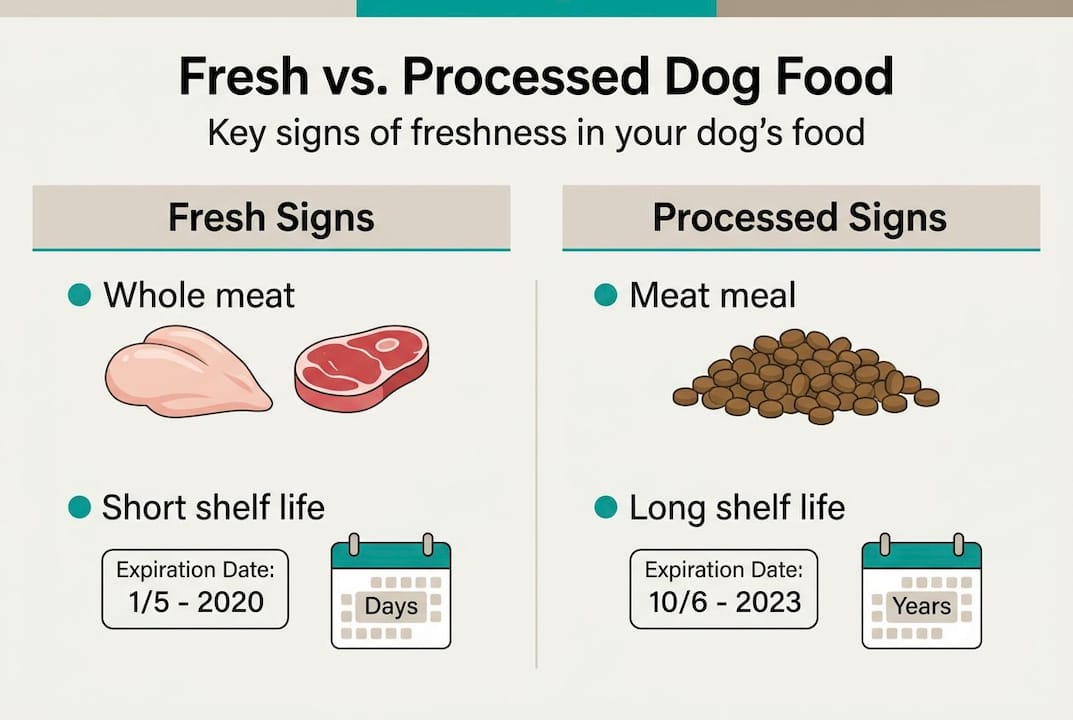
Here’s a quick comparison to make this clearer:
| Ingredient type | Processing level | Moisture retained | Nutrient quality |
|---|---|---|---|
| Fresh/whole meat | Minimal | High | Higher digestibility |
| Meat meal (rendered) | High | Very low | Concentrated but variable |
| Animal derivatives | Very high | None | Inconsistent, vague sourcing |
| Whole vegetables | Minimal | High | Rich in natural fibre |
For dogs with sensitive stomachs or skin conditions, the difference between these ingredient types really matters. Fresh proteins are more bioavailable, meaning your dog’s body can absorb and use the nutrients more efficiently. Understanding fresh vs meat meal is one of the most important steps in choosing a better food.
Fresh ingredients also tend to support better gut health, coat condition, and energy levels. The advantages of fresh ingredients go well beyond marketing claims — they reflect real nutritional differences that show up in how your dog looks and feels day to day.
- Fresh meat: whole, named protein source (e.g. ‘fresh chicken,’ ‘deboned salmon’)
- Meat meal: rendered, dried, concentrated protein (e.g. ‘chicken meal,’ ‘poultry meal’)
- Animal derivatives: vague, often low-quality by-products with no named source
- Whole vegetables and fruits: minimally processed, nutrient-rich additions
What you need to check before buying: ingredient list essentials
Now that you can distinguish fresh ingredients, here’s how to quickly analyse the ingredient list in-store or online. The ingredient list is your most powerful tool, and once you know what to look for, it becomes much easier to separate quality food from clever packaging.
-
Check the first ingredient. The first item on any dog food label is the most abundant ingredient by weight. Look for ‘fresh,’ ‘deboned,’ or whole meat as the very first ingredient. If it’s a grain, a by-product, or something vague like ‘meat and animal derivatives,’ that’s a red flag.
-
Scan for named proteins. ‘Fresh chicken’ is specific and traceable. ‘Poultry’ or ‘meat’ is not. Named proteins indicate a brand that’s confident in its sourcing.
-
Watch the order carefully. Ingredients are listed by weight before cooking. The first five ingredients make up the bulk of the food. If you see three fillers in the top five, the food is filler-heavy regardless of what the front of the bag says.
-
Spot the red flags. Avoid foods that list ‘animal derivatives,’ artificial preservatives like BHA or BHT, artificial colours, or unnamed fats. These typically signal lower-quality formulations.
-
Consider breed and sensitivity needs. Grain-free, high-meat, or breed-specific formulas need extra scrutiny. A food marketed for small breeds with sensitive digestion should have a short, clean ingredient list with a single, named protein source.
Pro Tip: Learning how to read dog food ingredients is a skill that pays off every time you shop. Print a small checklist and keep it in your bag for those in-store moments when you’re comparing two similar products.
Knowing how to spot quality dog food naturally comes down to practising this label-reading habit consistently. The more you do it, the faster it becomes second nature.
Other visual and packaging clues to spot freshness
Reviewing the ingredient list is only part of the puzzle. Packaging and appearance offer extra insight into whether a product truly contains fresh ingredients or is simply trading on the word.

One of the clearest signals is shelf life and storage requirements. Fresh ingredients require refrigeration or freezing and have a noticeably shorter shelf life than standard kibble. If a product claims to be ‘fresh’ but sits unrefrigerated on a warm shelf for 18 months, something doesn’t add up.
| Packaging type | Storage needed | Typical shelf life | Freshness indicator |
|---|---|---|---|
| Refrigerated trays/pouches | Fridge | 5 to 14 days | High |
| Frozen raw/fresh meals | Freezer | 3 to 6 months | Very high |
| Shelf-stable wet food | Ambient | 12 to 24 months | Moderate |
| Dry kibble | Ambient | 12 to 18 months | Lower |
Transparent packaging is another positive sign. Brands confident in their ingredients often use clear pouches or tubs so you can actually see the food. Whole pieces of meat, visible vegetables, and a natural colour palette are encouraging. Dull, uniform, heavily processed-looking food tells its own story.
Pro Tip: Check the dog food shelf life guidance for the specific format you’re buying. A shorter best-before date on a refrigerated product is actually a good sign, not a concern.
We also recommend looking into whether a brand offers ingredient traceability. Being able to trace your dog food back to its source is a strong indicator of a brand that takes freshness seriously and has nothing to hide. Transparency at this level is rare, and it matters.
How to verify freshness for grain-free and sensitive dogs
Spotting fresh ingredients is crucial for every dog, but it’s even more critical for those with sensitivities, allergies, or special dietary requirements. For these dogs, the wrong ingredient can trigger skin flare-ups, digestive upset, or chronic inflammation.
Here’s what to look for when choosing grain-free food for a sensitive dog:
- Named, single-source protein: One clearly identified meat source reduces the risk of triggering an allergic response.
- Minimal fillers: Potatoes and peas are common in grain-free recipes, but they shouldn’t dominate the ingredient list. If they appear in the top three ingredients, the food is more filler than protein.
- No artificial additives: Sensitive dogs react to more than just allergens. Artificial colours, flavours, and preservatives can all contribute to inflammation.
- Nutritional assurance: Look for foods that meet FEDIAF (European Pet Food Industry Federation) nutritional guidelines or similar standards, which confirm the food is complete and balanced.
“Fresh meats support better nutrient profiles in grain-free diets. For dogs with sensitivities, a food that is nutritionally verified and built around whole proteins offers the safest and most effective foundation.” We believe this is non-negotiable for dogs who need a little extra care.
For allergy-prone dogs, grain-free diets for sensitivities can be genuinely transformative when they’re built around fresh, traceable proteins and not just grain substitutes. The goal is a shorter, cleaner list of ingredients that your dog’s body can recognise and process easily.
Breed-specific formulas take this further by adjusting protein levels, fat content, and even kibble size or texture to suit a particular dog’s physiology. If your dog has a known sensitivity, a limited-ingredient, fresh-protein formula is almost always the better starting point.
Why most owners miss the freshness factor in dog food
We’ve seen this pattern time and again: a genuinely caring dog owner buys a food labelled ‘natural,’ ‘wholesome,’ or ‘premium,’ fully believing they’re making the right choice. And yet the ingredient list tells a different story. This isn’t a failure of the owner. It’s a failure of labelling standards.
Current pet food regulations allow brands to use terms like ‘fresh’ without strict legal definitions attached to them. A product can contain a small percentage of fresh meat and still legally feature the word prominently on the front of the bag. It’s a loophole that benefits marketing departments, not dogs.
Our honest advice? Ignore the front of the bag almost entirely. The real information lives in the ingredient list and the guaranteed analysis panel on the back. Focus on [choosing the best fresh ingredients](https://ultimatepetfoods.co.uk/blogs/dog-nutrition-health/choose-best fresh ingredients pet food for your dog) by reading what’s actually in the food, not what the brand wants you to feel about it.
We advocate for full label transparency because we believe pet owners deserve to know exactly what they’re feeding their dogs. When a brand is proud of its ingredients, it shows them clearly and specifically. That confidence is worth looking for.
Choose trusted fresh dog food solutions
Putting your new label-reading skills into practice is the most important next step, and we’re here to make it straightforward. 🐾
At Ultimate Pet Foods, our range is built around genuinely fresh, traceable ingredients with no hidden fillers or vague derivatives. Whether your dog needs a grain-free diet for sensitivities, you want to better understand grain-free ingredients before committing, or you’re looking for a breed-specific formula tailored to your dog’s unique needs, we have options designed with real care. Every product we offer is label-transparent and crafted to support the health of dogs at every life stage. Try a sample and see the difference fresh truly makes.
Frequently asked questions
Why is fresh meat listed first on good dog food labels?
Fresh meat is listed first because of its high moisture content before processing, which makes it heavier by weight than rendered alternatives. This placement signals a higher-quality protein source compared to concentrated meal products.
Are preservatives always bad in dog food?
Artificial preservatives like BHA and BHT often indicate lower-quality ingredients and are best avoided. Natural preservatives such as vitamin E (tocopherols) are safe, effective, and a sign of a more thoughtfully formulated food.
How can I tell if a dog food is truly grain-free and fresh?
Look for a short ingredient list starting with a named fresh meat, confirm there are no grains listed, and check whether the product requires refrigeration or has a noticeably shorter shelf life than standard kibble.
What ingredient terms should I avoid on labels?
Steer clear of vague terms like ‘meat meal,’ ‘animal derivatives,’ or ‘unspecified fats,’ as these typically indicate processed, low-traceability components with inconsistent nutritional value.
Is fresh food better for dogs with allergies or sensitivities?
Yes. Fresh, single-protein ingredients with minimal fillers are ideal for allergy-prone or sensitive dogs, as they reduce the number of potential triggers and support better digestibility overall.
Recommended
- How to Read Dog Food Ingredients: Make Informed Choices
- Fresh vs Meat Meal: Why Fresh Ingredients Make a Better Dog Food
- How to Spot Quality Dog Food for Optimal Canine Health
- How to check dog food quality: a practical guide
- Pet wellness checklist: Key steps for a healthy, happy pet – Teddy Pet


